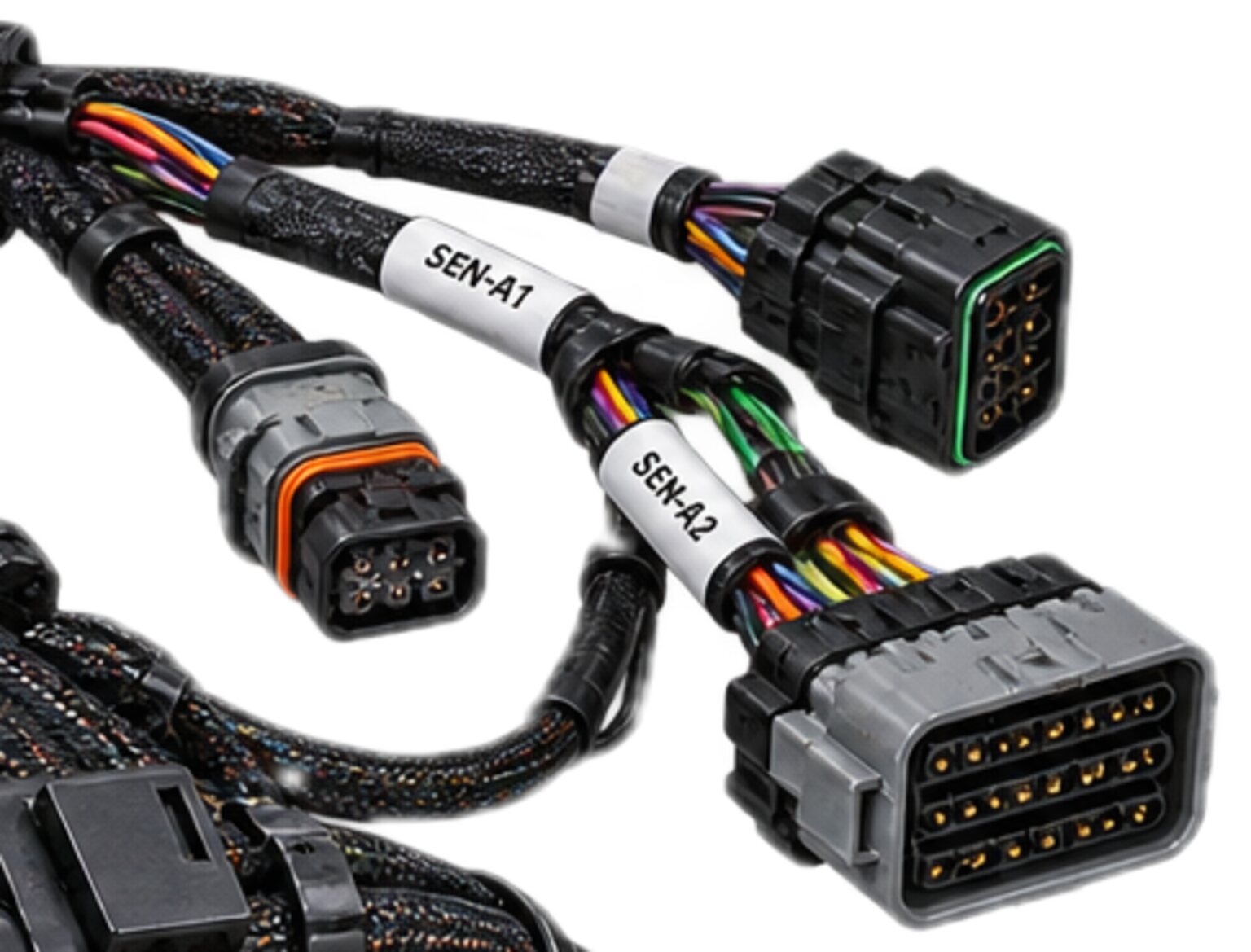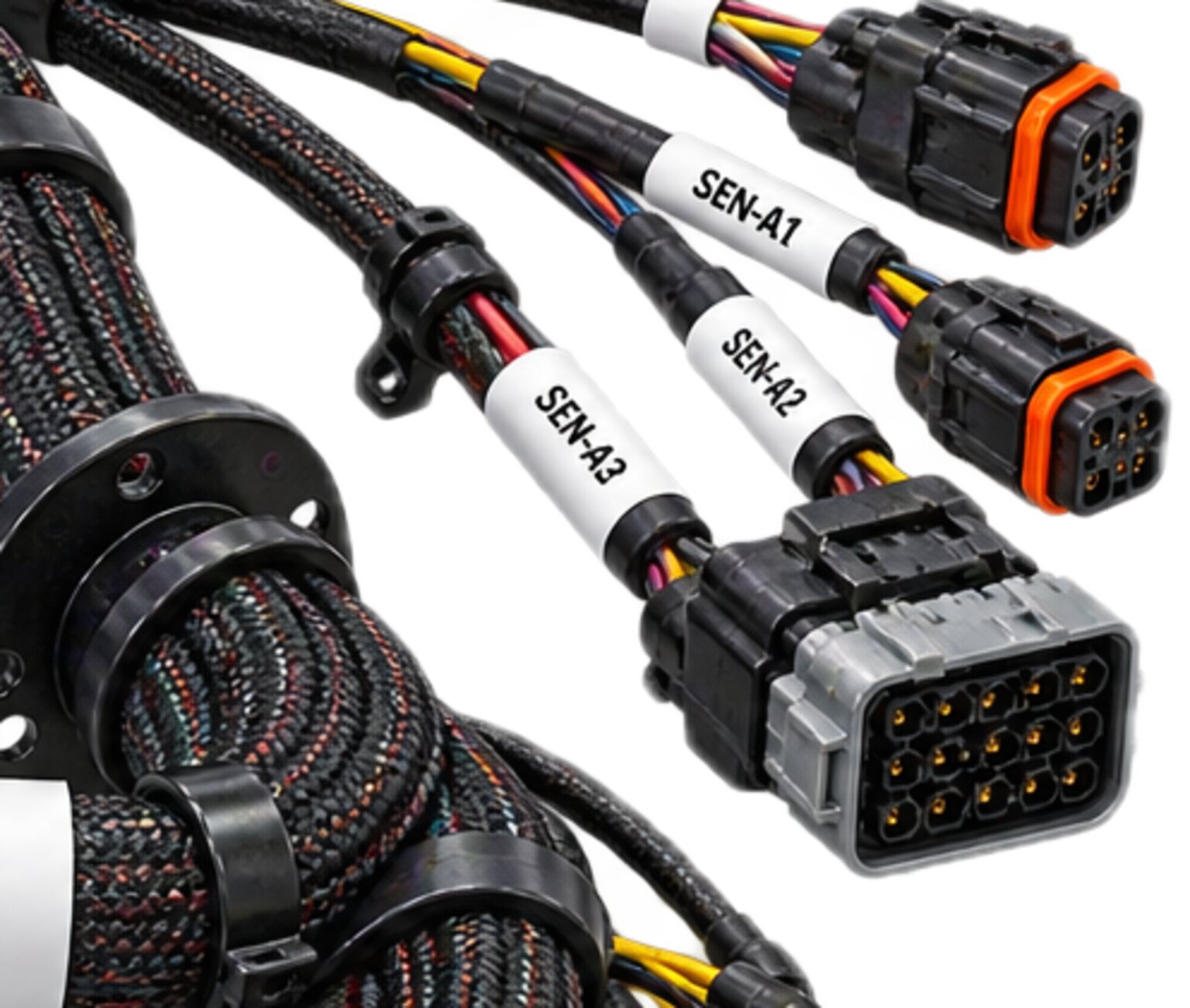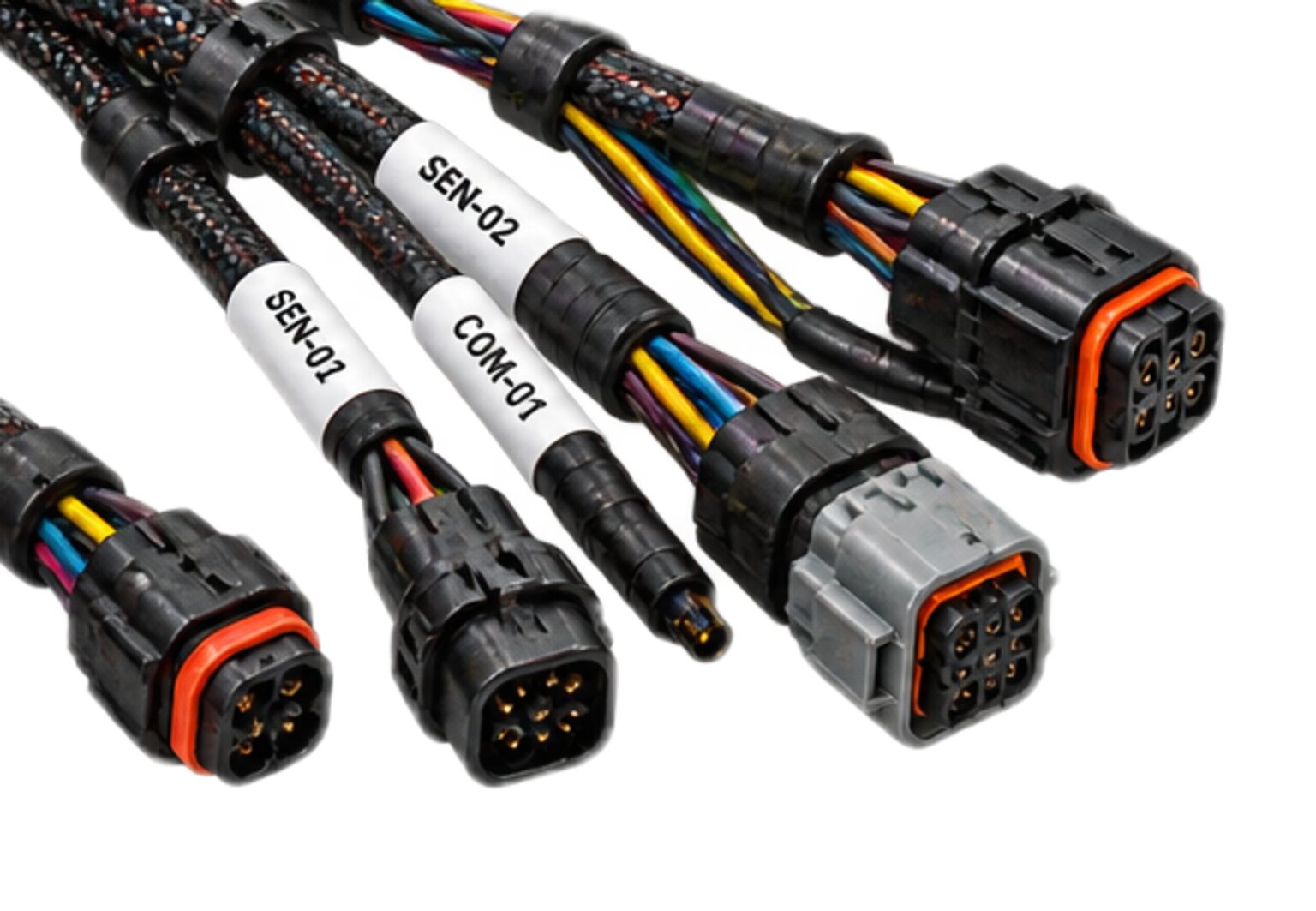
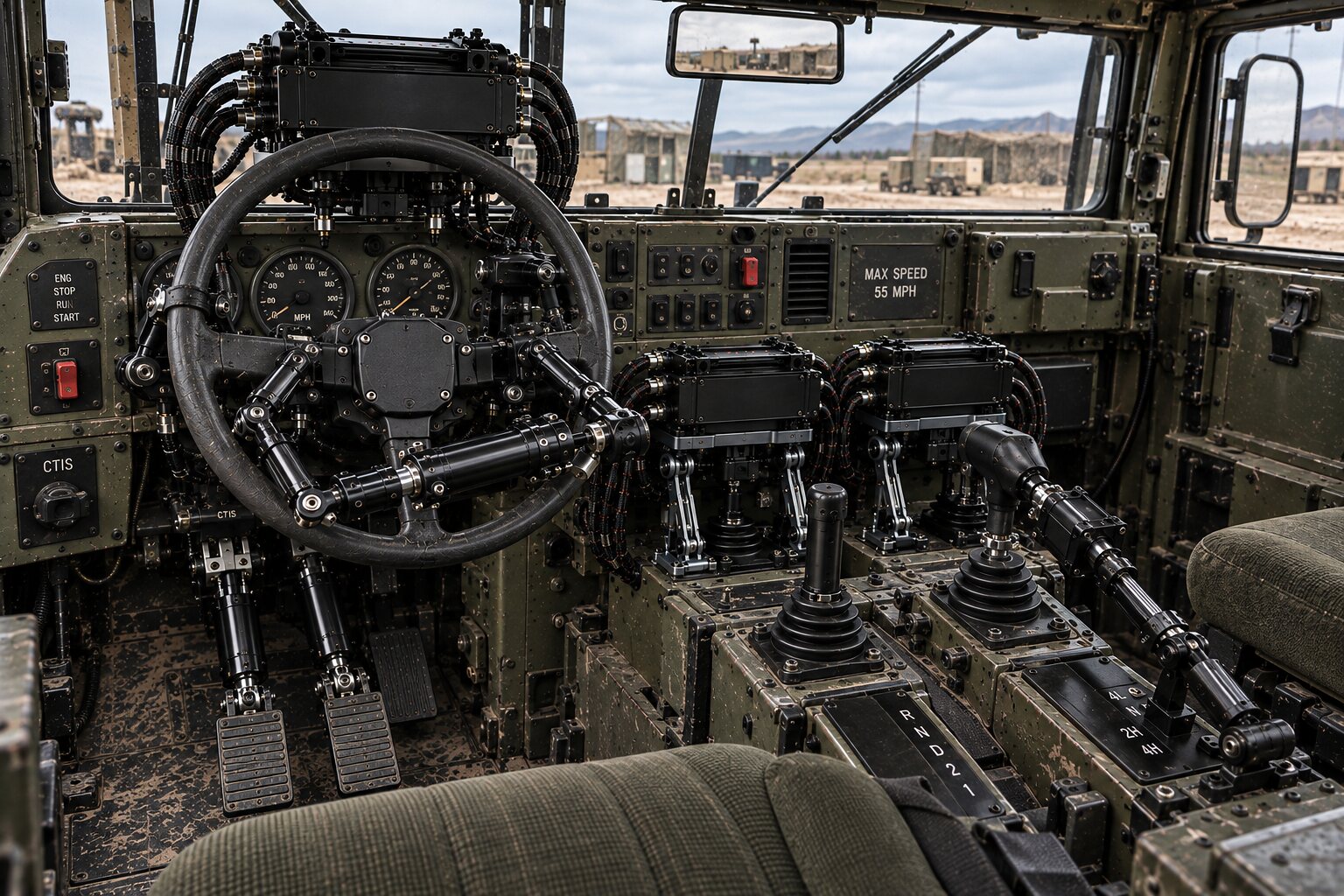
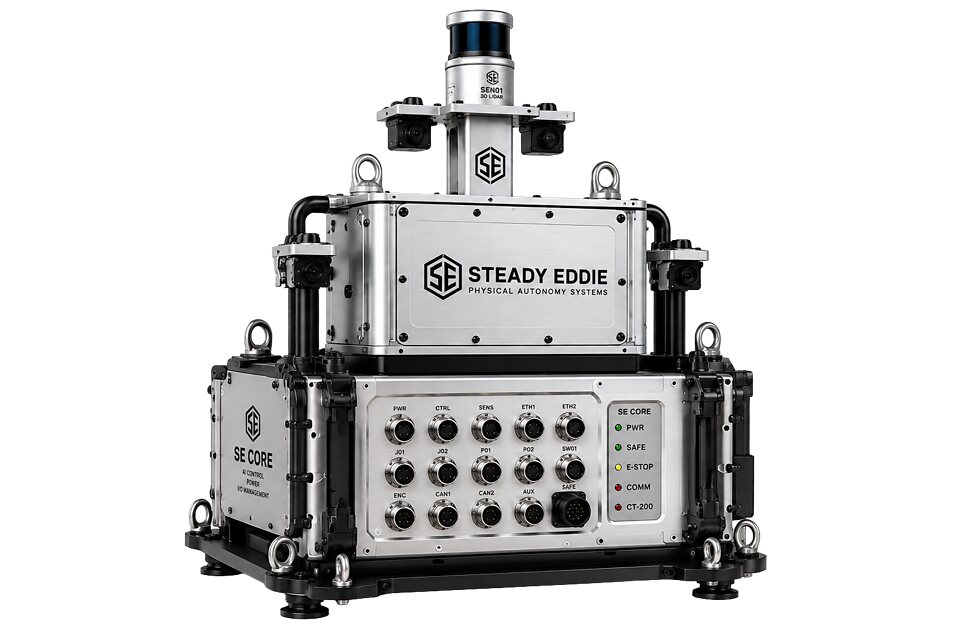
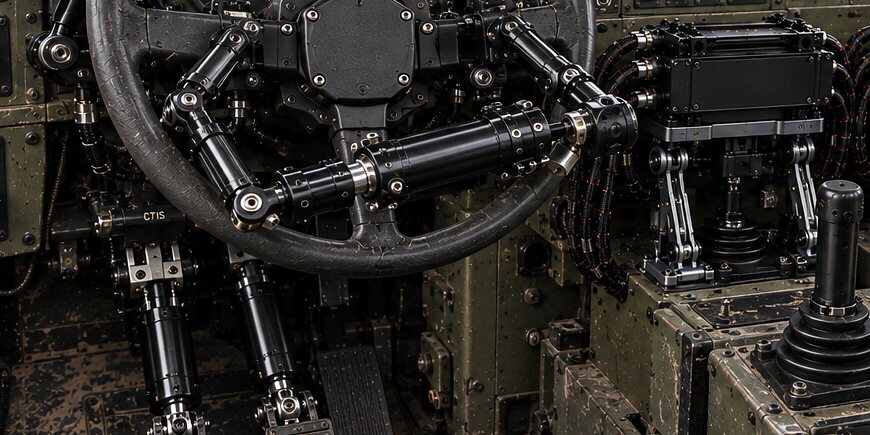
A capture rig sits in the cab of a working machine and records what a skilled operator does with it. Where the hands go, how far the levers travel, when the pedals move, which switches are pressed, and how the cab moves in reply. The rig is a set of sensors, a logger, and the loom that joins them. That loom is the training-systems line, and it is built to a rule stricter than any other harness we make: it is wired to nothing on the machine it is measuring.
Every sensing line in the rig runs to one logger, on one clock, from one battery. The battery, the logger and the reference that every reading is taken against all belong to the rig. A continuity check from any conductor in the rig to any conductor on the host, including the host's chassis, returns nothing. Not a high reading. Nothing. An isolation test then proves the two are separate. That open circuit is the product.
- An instrument that touches the thing it measures has changed the thing it is measuring.
- A rig that draws power from the machine loads it.
- A rig that shares a conductor with it puts the machine's noise on its own readings and its own faults on the machine.
- A rig that adds force to a lever measures a person working a different lever.
- The record from a rig like that is a record of the rig, and everything built on it inherits the error.
The seam that must stay empty
Every other line is built around a seam where two things meet. On a UAV the payload meets the carrier. On an autonomy retrofit the new controller meets the old machine. The training line's seam is defined the other way round. It is the surface between the rig loom and the host machine, and it is specified by what must never cross it.
The machine already knows most of what the rig wants to know. Its own harness carries lever position to its own controller, its own bus carries engine and hydraulic state, and its own supply is behind a panel. Tapping any of it would be the easy build. It is the wrong one, for three reasons that do not depend on each other.
The first is the measurement. A rig that reads lever position off the machine's own sensor is not recording what the person did. It is recording what the machine reported, after its own filtering, at its own rate, with its own faults. The only way to keep the person apart from the machine in copper is to measure the person with sensors the machine knows nothing about.
The second is the machine. Its harness was designed, built and signed for by someone who did not know the rig was coming, and a conductor added to it is a load its designer did not size and a fault path its safety case did not consider. The machine is then a different machine, and nobody has signed for the difference.
The third is the seam itself. A rig that shares nothing with the machine can be fitted and removed without changing it, which is what lets a rig programme move from one machine to the next and compare the records. If the rig changed each machine a little, no two records would be of the same thing.
So the rig attaches to the machine mechanically and to nothing electrically: clamps, straps and mounts that come off without a trace, and every one of them insulated, so a sensor body beside a metal control is not a bond to the machine.
The topology of a rig loom
A rig loom is many lines converging on one point. Each line begins at a sensor and ends at the logger, carrying its own supply out and its own signal and return back. The lines do not share. Two sensors that share a return conductor share each other's current, and the current of one appears on the other as a small offset that moves when the first one moves. On a rig measuring a person's hand, that offset looks exactly like the hand. So every sensing line has its own return, and every return lands on one reference point at the logger.
That reference point is the second thing the loom converges on. Every reading in the rig is taken against one common reference, and the loom is built so that reference is the same everywhere. Shields are terminated at the logger end, to the rig's reference, and left open at the sensor end. They are never bonded to the cab frame, because the cab frame is the machine, and a shield bonded to the machine is a conductor shared with it. That is the rule from the shielding and bonding page, a shield grounded where the drawing grounds it and nowhere else, applied where it matters most.
The third is time. The logger runs one clock and stamps every channel against it. A lever and a pedal that move in the same instant are recorded in the same instant, by the same device, against the same time base. Where a sensor has a clock of its own, a camera or a serial device, the logger drives a sync line to it so the two clocks can be tied together in the record. The sync line is a sensing line like any other, with its own conductors, identity and return.
The fourth is power. The rig carries its own battery, the battery feeds a distribution point behind its own protection, and from there the logger and every sensor that needs a supply is fed on its own protected branch. Distribution runs outward from one point, and one switch takes the whole rig down, so the rig is either alive and recording or off, and there is no state in between that a person has to remember to check.
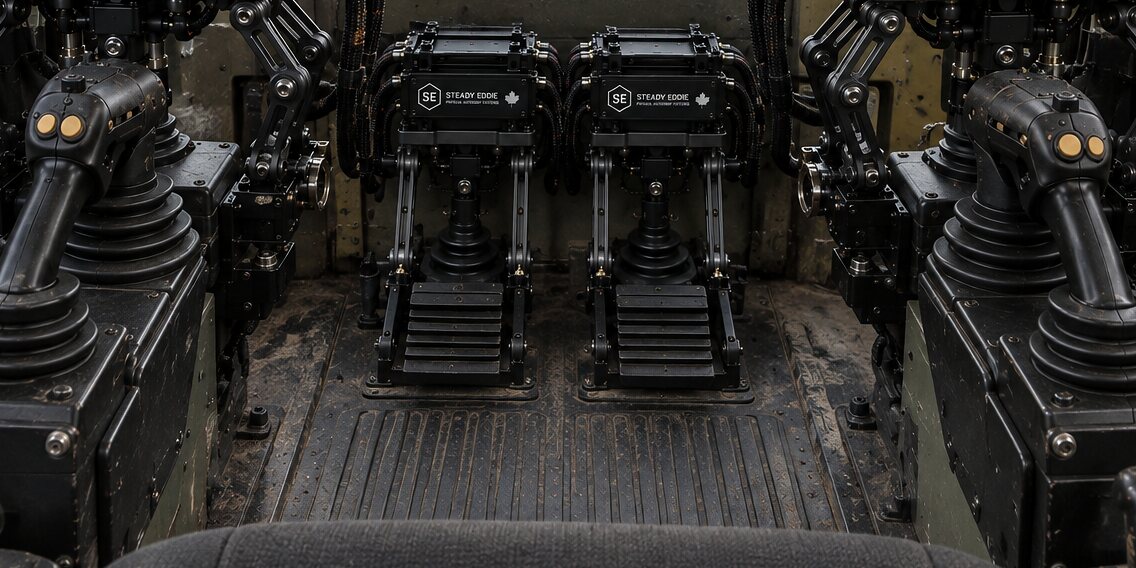
The lines gather into trunks by where they go, not by what they carry: one trunk to the left console, one to the right, one to the pedals, one to the seat, one to the sensors on the cab frame that measure how the machine moves in reply. Each line keeps its identity through its trunk, and the split points are where the zones are, not where the machine's own harness happens to run.
The witnesses
The operator's switches and buttons are the hardest thing on the rig to measure without touching. A lever's position can be read by a sensor on the rig's own bracket beside the lever. A switch is a contact inside the machine's harness, and the obvious way to know its state is to wire to it. That is refused.
- What the rig fits instead is a witness.
- A witness sits beside the control and sees the same motion the control sees.
- For a rocker switch it can be a non-contact sensor that sees the rocker's angle.
- For a button, a sensor that sees the button's travel.
- For a lever's detent, a sensor that sees the lever cross it.
- The witness has its own conductors back to the logger, its own identity and its own return, and it shares nothing with the switch it is witnessing.
- A witness that needs to be pressed adds force to the control.
- A witness with a spring adds a spring.
- A witness whose actuator rubs the lever adds friction.
- Each is a modification of the control, and a person working a modified control learns the modification.
- The set uses non-contact witnesses wherever the feel of the control matters, and where a contact witness is the only kind that fits, its actuating force is declared on the drawing beside the control's own, so the programme's engineer can decide whether it is acceptable.
Nothing is fabricated until the drawing is signed.
What the joints have to survive
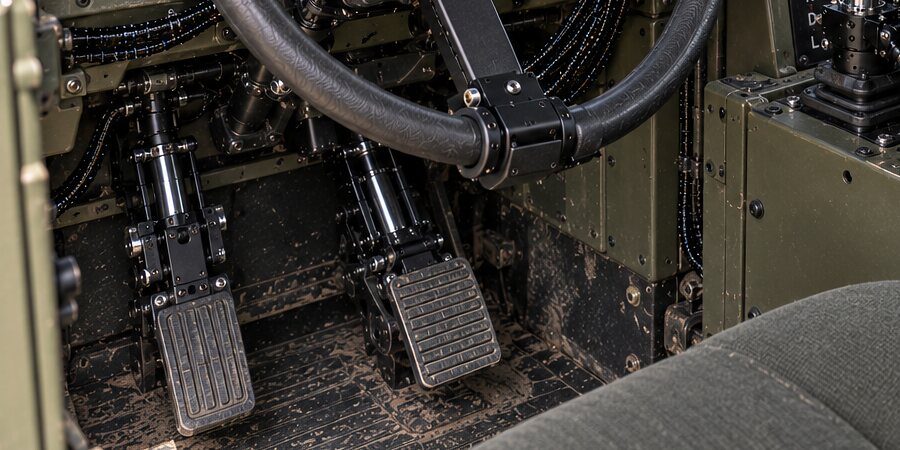
A rig loom lives in a cab with a person in it, and the person is what every joint has to survive. They climb in and out past the rig, in boots, several times a shift. A run across the floor takes a boot. A run up the console pillar takes a knee. A lead to a sensor on a lever is in the path of a glove every time the hand goes there. Every joint has to survive that, and where it cannot, it has to fail somewhere harmless.
So the connectors latch, and they are keyed so that a lead cannot be mated to the wrong port with a glove on in poor light. Strain relief is sized so that a pull on a lead parts at the connector or at a deliberate breakaway, never at the conductor. A lead that crosses the operator's reach is routed to the edge of that reach and clipped there, and where it cannot be, it is a breakaway lead whose separation the logger sees as a channel going open rather than a fault it cannot explain. These are the routing rules for a harness a person handles, made stricter because the person's movement is the measurement.
The cab vibrates with the machine, and every sensor mount vibrates with the cab. Conductors are stranded and the bundle is supported so that flexing happens along a length and not at a point. Fixed ends are the enemy. A conductor that flexes at a terminal fatigues at the terminal, and the failure arrives late, as an intermittent, on a channel that reads correctly on the bench.
The cab is cold in the morning and hot in the afternoon sun. Insulation that is fine in the shop stiffens in the cold and cracks where it is bent, a connector seal that keeps out dust at one temperature lets in condensation at another, and the rig's own battery gives less in the cold. Material is chosen for the cab, not the bench.
And everything must come off. A joint that survives a season of boots and gloves has to release cleanly when the campaign ends, without a mark on the machine, and mounts, clamps and straps are chosen for that as much as for holding on.
What each side promises the other
The rig promises the machine that nothing crosses. No conductor, no current, no bond, no load, no force. The machine's own harness is untouched. Its safety chain does not know the rig exists. When the rig comes off, the only evidence it was ever there is the record it took away.
The logger promises the sensing lines one clock and one reference. Every channel is stamped against the same time base, so no alignment has to be invented afterwards. Every channel is read against the same reference point, so a reading on one line means the same thing as the same reading on another. A programme that wants to know what the operator's left hand did in the instant their right foot moved reads it straight off the record.
The sensing lines promise the logger identity. Every conductor carries its circuit identity end to end, at the sensor, at every break in the trunk and at the logger, so a channel in the record can be followed back to the sensor it came from and the control that sensor was watching. On any harness we build that is the labelling and traceability discipline. On a rig loom it is the only link between a column of readings and the physical thing that made them, and a channel with no identity is data about nothing.
When one side changes, the promises decide what moves. A new sensor is a new line, with its own conductors, identity and return, and a change to the issued drawing before a wire is cut. A different machine is a different set of mounts and lead lengths, but the same empty seam and the same logger on one clock. The loom adapts to the machine at its mechanical ends only.
How a bad rig loom presents, and who pays
A tyre gauge that lets a breath of air out at every check reads a little lower every time, and you never know by how much. A rig loom that touches the machine does the same to the record, silently.
Tap the machine's supply and the rig's reference is now the machine's chassis, which moves with the alternator ripple and with every solenoid that fires. Every sensing line reads its sensor plus that noise, and the record shows a lever trembling that the hand never made, in time with the machine's own electrics. Worse, a fault in the rig is now a fault in the machine's supply, and a rig lead pulled by a boot can take the machine down mid-task.
Share a conductor with a machine sensor and the machine's own controller sees a load its designer did not size. On a sensor line built to be read by one high-impedance input, a second input shifts the reading, so the rig is measuring a machine that exists only while the rig is fitted, and the wire that did it is a wire in the machine's harness that nobody signed for.
Add force to a control and the operator adapts. A skilled person adjusts to a stiffer lever in minutes without knowing it, and from then on the rig is recording the adaptation. A system trained on those records is trained on the difference.
Share a return between two sensing lines and the pedal appears on the lever channel as a small shift that moves with the foot. Run two clocks and the pedal and the lever drift apart across the shift, so the record says the operator did things in an order they did not.
Each of those failures presents the same way, which is not at all. The rig powers up. Every channel reads. The record looks like a record. The corruption is inside the readings, and it goes into everything built on them. A value nobody measured never reaches a wire. Here the wire is the instrument, so a corrupted measurement is not one bad harness. It is a bad record of a person's skill, and it corrupts every system trained against it.
The currency is time that cannot be recovered. A capture campaign is an operator's days and a machine's days. If the corruption is found, the campaign is repeated and those days are spent again. If it is not found, the cost arrives later, in a system that behaves slightly wrong for a reason nobody can trace to a wire that came off a machine months ago. And there is the hazard, which nobody is paid to accept: a rig lead in a machine's safety chain, on a machine with a person in the cab.
How a set is bought
The rig programme owns the rig. It owns the design, the sensor list, the channel list, the logger, the cab drawings and the drawing master. We build to your issued set and we return the manufacturing detail.
The issued set tells us which sensors go where, what each one needs in supply, signal and return, how the logger is pinned, which controls carry witnesses and of what kind, and how the trunks run in the cab. We take off the material against it, source the components, and build the loom on a formboard laid out from the cab drawings, so that each trunk comes off the board the length the cab needs. Nothing is fabricated until the drawing is signed. A rig programme that is still deciding its sensor list is a programme we can talk with, but not one we cut wire for.
- What goes back to the programme is the shop pack: the as-built cut lengths, the pin-out as terminated, the identity of every conductor as labelled, and the test record for that kit.
- The test record says what is proven.
- That every sensing line is continuous from sensor to logger on its own conductors.
- That every return lands on the one reference and nowhere else.
- That every shield is open at the sensor end.
- That a continuity check from every rig conductor, its shields and its reference to every mount and clamp on the rig returns nothing.
- And that the same check, made on the machine with the rig fitted on the day it goes on, returns nothing too, recorded by whoever fits it.
- What each test is set to is stated on that kit's own specification by the engineer responsible for it.
- Test and acceptance describes the discipline, and the record describes what a shop pack contains.
That pack is owed to the programme's drawing master, so the next kit is built to the same detail and any change starts from what was actually made. The how to engage page describes the exchange from first drawing to returned pack.
The components we specify carry their own certification. The approval route for a finished, project-specific assembly is confirmed with the certifying body for that assembly before it is built, and we tell you where yours sits before we build it, not after. CSA and the Canadian Electrical Code govern any assembly we build for sale or installation in Canada, and a rig's own supply and distribution is an assembly like any other.
The four harnesses of the line
The line is bought as one kit or as the whole set. A single loom is built only where the drawings of the other looms of that rig exist, because they share one reference and one keying.
The sensor loom is the set of sensing lines from every sensor in the cab to the logger, each on its own conductors with its own identity and return, gathered into trunks by zone, shielded to the rig's reference only, and wired to nothing on the host machine.
The switch-witness set is the contacts and sensors that witness what the operator's hands and feet did on the machine's switches, buttons and detents, without adding force to any control, each witness with its own conductors back to the logger.
The logger and power harness is the rig's own supply and the logger it feeds: the battery, the one switch, the distribution outward to the sensor lines, and the reference point every return lands on, isolated from the machine it measures.
The full rig wiring set is the sensor loom, the witness set and the logger harness built as one kit to one issued drawing, formboarded to one cab and tested as one assembly, that lands on a machine and leaves it unchanged.
What this line refuses
We add no force a person can feel to any control. A witness that needs pressing, a spring that has to be overcome, a sensor arm that rubs a lever: each is a modification of the control, and we do not build a rig that modifies what it measures. Where only a contact witness will fit, its force is declared on the drawing and the programme's engineer decides. We do not decide it quietly.
We draw no power from the machine. The rig carries its own battery and the battery is its only source. There is no auxiliary tap, no accessory socket, no jump from the machine's supply for convenience on a long day. A rig that needs more running time gets a bigger battery on the drawing, not a wire into the machine.
We share no conductor with the machine. No signal tap, no bus tap, no chassis bond, no shield bonded to the frame. A continuity check from the rig to the host returns nothing, on the day the rig goes on and the day it comes off, and a rig that returns anything is not a rig that should be recording.
We build no sensing line without its own identity and its own return. There is no shared return to save copper, no unlabelled spare pressed into service on site, no channel that cannot be followed from the record back to the sensor and the control it was watching. A line that cannot be traced is a line that cannot be trusted, and we will not ship a rig loom whose record we cannot stand behind.