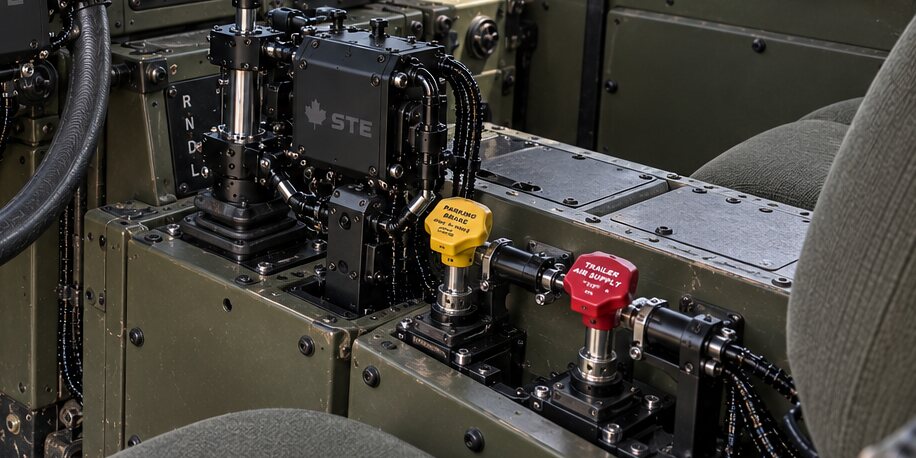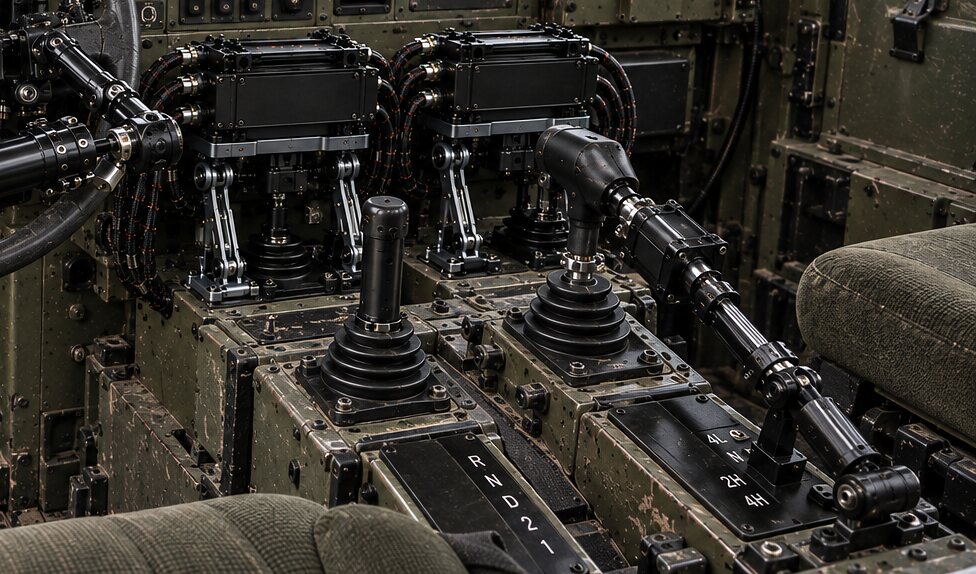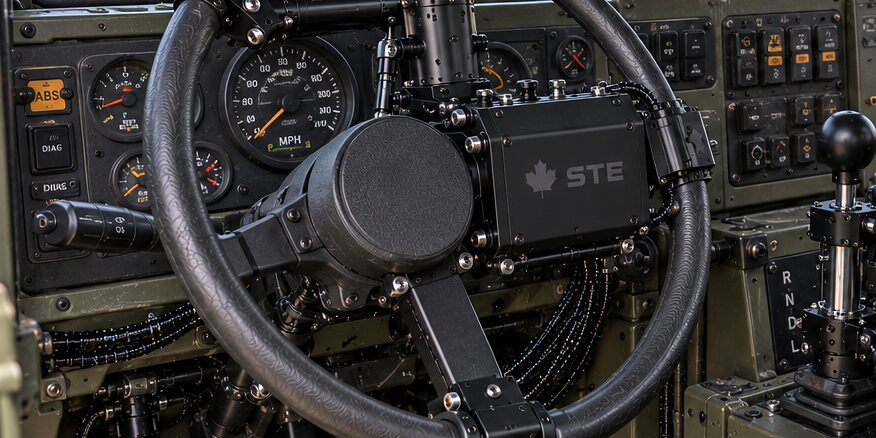
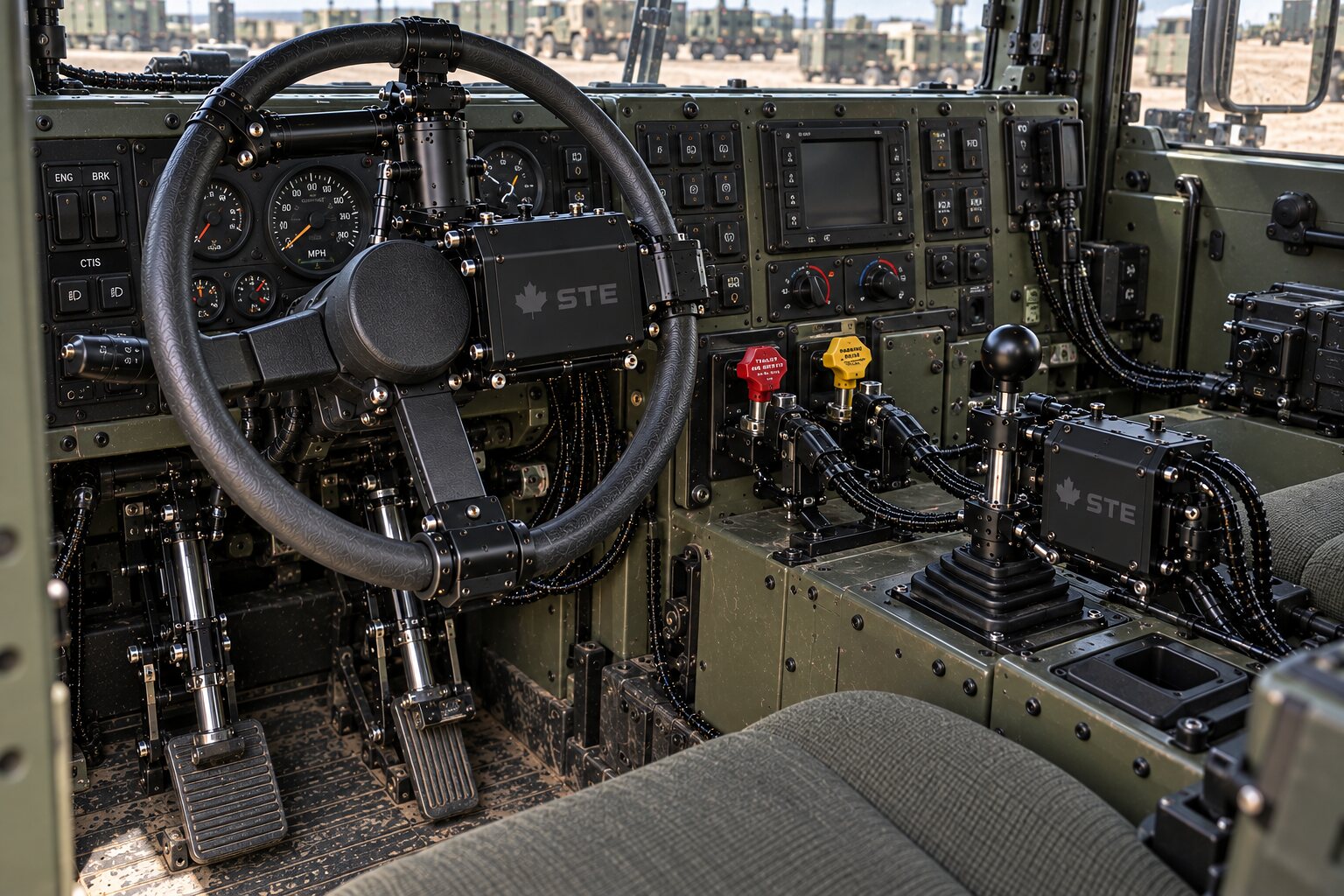
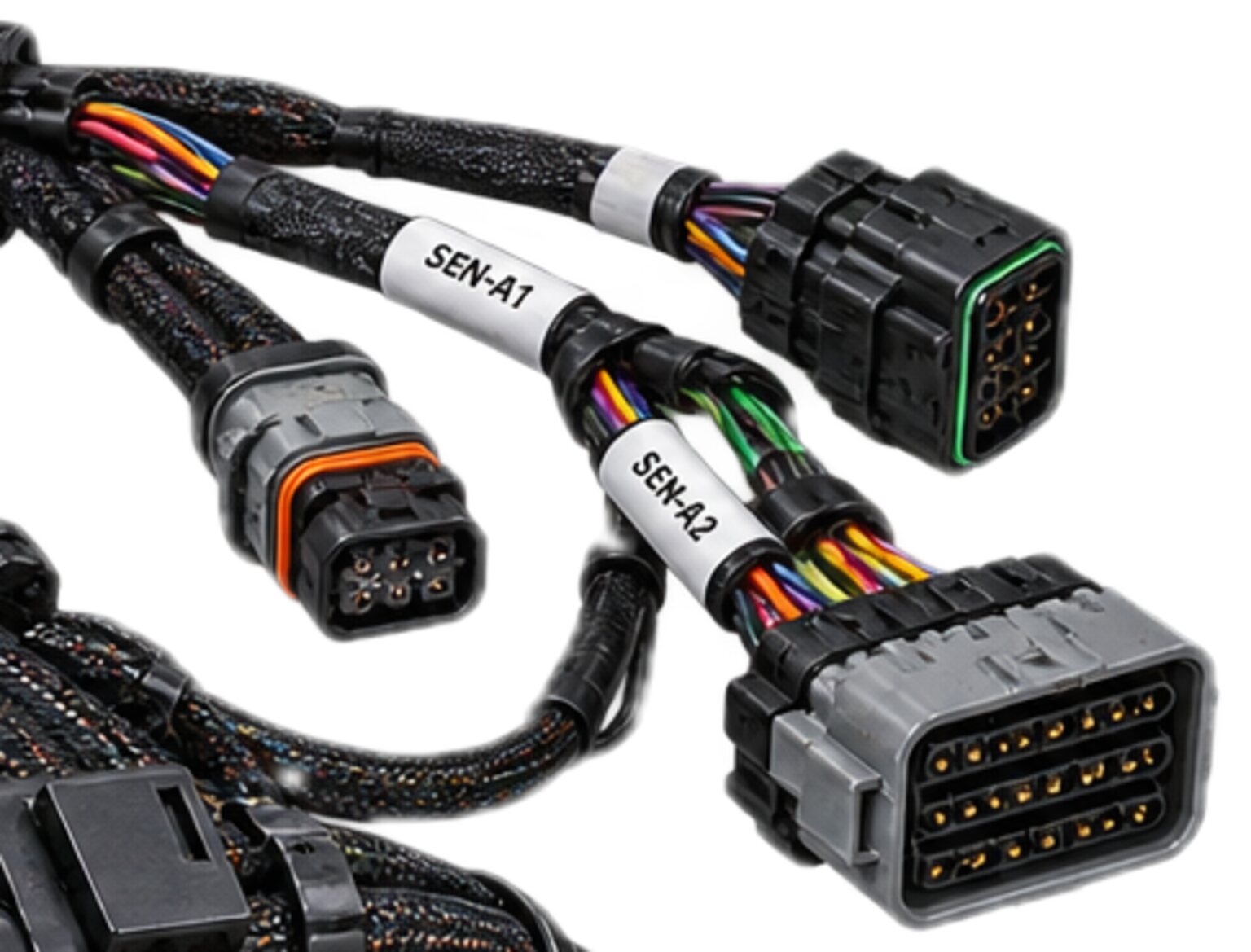
A capture rig sits in the cab of a working machine and measures the person working it. The sensor loom is the copper that makes the measurement: every sensing line on the rig, gathered to one logger, on one clock, from one battery, and wired to nothing on the host machine. The machine does not know the rig is there. That is the whole specification for the central harness of the training systems line, and everything below is how a loom meets it.
An instrument that touches the machine has changed the thing it was measuring. The sensor loom is built so that it cannot touch.
The mechanism
A sensing line is one sensor's signal and that signal's own return, twisted together along their whole length, under one shield, in one jacket. The return is not shared. It does not join the next line's return at a splice, at a breakout or in the logger's shell. It lands on its own contact beside its own signal, so the logger sees the difference between two conductors that travelled together, and nothing that one of them picked up alone.
Every conductor carries its circuit identity, end to end: the same identity on the sleeve at the sensor, at every break, at the logger and on the logger's channel map. No line is anonymous anywhere on the loom.
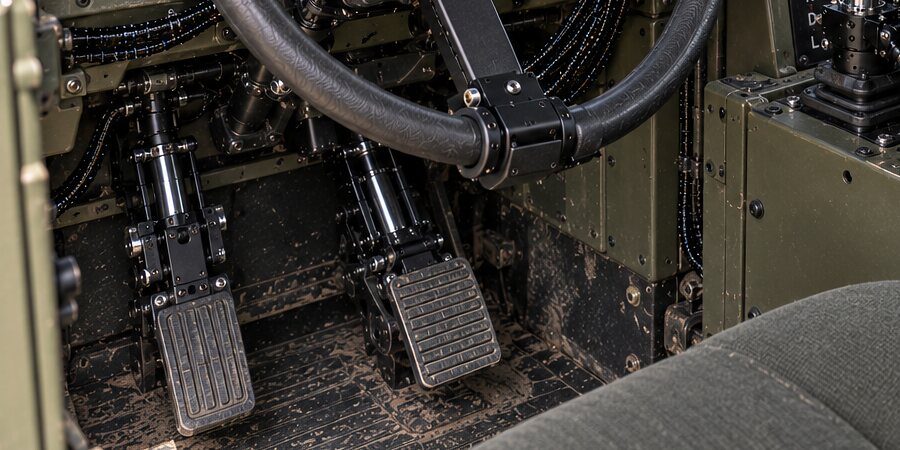
The sensors sit beside the controls and at the seat. A sensor beside a lever reads the lever's angle from the rig's own bracket. A sensor on a pedal reads the pedal's travel. The seat's sensors read where the person's weight sits and how it shifts. None of these is a part of the machine, and none is mounted to the machine's own sensor, switch or harness. Where a sensor needs a supply to work, the supply runs beside its signal in the same jacket, from the rig's battery, and never from the machine.
The loom is a star that looks like a tree. Every line runs from its sensor to its own input on the logger. The lines that leave one station travel together as a branch, and the branches gather into a trunk that ends at the logger. A branch is a place where the bundle divides. It is not a place where circuits meet. There is no terminal strip and no splice where returns are commoned to save a conductor. The junction block on the rig divides bundles; it joins no circuits.
Each sensor ends in a small sealed connector. Each branch ends at the logger in a keyed shell that fits one socket, so a branch cannot land in another branch's place. No shell on the loom is a shell the host machine uses. The loom's reference is a conductor, not a frame. Its zero is the rig battery's negative, carried to the logger on its own wire and bonded to nothing, not the rig's frame and not the machine's.
The logger's feed from the rig battery is a separate assembly, and the contacts that witness switches and detents are the switch-witness set. This brief is the analogue lines: the ones that read how far, how fast and how hard, rather than whether.
What it is engineered to
Most harnesses are engineered to a seam where two systems meet and exchange something. This one is engineered to a seam where nothing may cross. The rig is fitted to a machine for a session and comes off after it, and the standard for the fitting is that the machine is unchanged by it. That is the harder specification, because an exchange can be checked by watching it happen and an absence has to be proved.
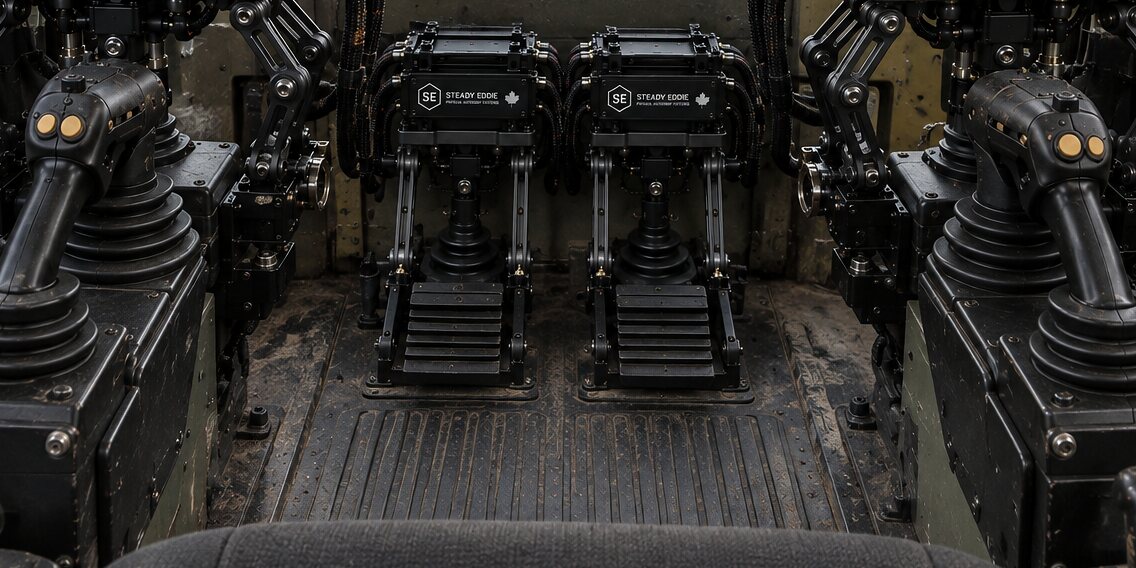
The rig promises the machine four things. The loom adds no force a person can feel to any control: nothing on it pulls a lever, loads a pedal or rests on a grip. It draws no power from the machine: the sensors and the logger run from the rig's battery through the rig's own harnesses. It shares no conductor with the machine: no return, no shield, no bond, no chassis. And it leaves no trace: when the rig comes off, the machine's harness is what it was, with no added tap, no pierced insulation and no spare tail left behind.
The logger promises the lines three things in return. One clock: every sample on every channel is stamped against the same time base, so what the hand did and what the foot did are placed in the same instant on one record. One reference: every channel is measured against the same zero, carried on the loom's own reference conductor, so a difference between two channels is a difference in what happened and not in where zero was. One input per line: every conductor has a contact waiting for it on the logger's map, and none is shared.
The joint has to survive a person. A cab is a small room that a person enters by grabbing whatever is at hand and putting a boot wherever it lands, and the loom runs exactly where the boot and the hand go. A cable a heel can hook will be hooked. So the strain relief at every sensor is on the rig's bracket and not on the sensor's body, and a pull on the loom arrives at a clamp before it arrives at a contact. Every moving control gets a service loop that lets the seat run its full travel and the pedal its full stroke without tension reaching the sensor end. Under all of it is a running machine, with its vibration, its closed cab in sun and in frost, its dust and damp, and each of those is a condition on the drawing for the assembly. When either side changes, the loom changes with it, drawn before it is cut.
Safety circuits never share a bundle, a splice or a shell with power.
The discipline applied to this harness
Every conductor carries its circuit identity, end to end. A line that loses its identity between the sensor and the logger is a lever that gets logged as a pedal, and nothing downstream can tell. The record will be complete, consistent, on one clock, and wrong. So the sleeves and the logger's channel map are printed from one list, and continuity is checked line by line against that list, not against a count.
Segregation on this loom is segregation from the machine. The loom is tied to the rig's members and never to the machine's harness, because a loom tied to the machine's harness is coupled to it whether or not a conductor touches: that harness switches solenoids, and the loom beside it hears them.
A shield has one end that grounds it and one that must not. On this loom the second end would be the machine, the one conductor the loom must never share, so every shield is drained at the logger end only, floated at the sensor and bonded to nothing on the way. The rig's frame is a structure, and it carries no current on purpose. Shielding and bonding has the rule in general.
The loom uses no connector family that appears on the host machine, so the isolation is mechanical before it is electrical, and its sensor connectors are chosen for a person mating them in a cab, in poor light, wearing gloves. Routing is for the person first. The pedal branch crosses the floor behind the pedal hinge, where a boot does not land. The seat branch is looped and captured so it cannot fall where a heel finds it. Every tie is on the rig. A loom tied to the machine is a loom that comes off the machine with a knife.
The test asks three things of every finished loom: that every line reaches its own input and no other; that every shield is continuous to the logger's drain and open to everything else; and that nothing on the loom reaches the machine. That last check is run with the rig fitted, from every conductor on the loom, shields and reference included, to the host machine's chassis, its cab structure and every point the rig's mounts touch, and it returns nothing. An isolation test asks whether two circuits that must never meet are in fact separate. The rig and the machine are two such circuits.
Done badly, this loom does not fail. It lies. A return shared between two lines puts one channel's movement into the other, and the record shows a pedal twitch every time a lever moves. A reference tied to the machine's chassis moves every time a machine load switches, and the record shows a person who flinched each time a valve fired. A loom that loads a lever changes how the person works it. Each of these produces a complete, plausible record. An open loom gives you nothing, and nothing is at least the truth.
A clamp meter reads a current without breaking the circuit, and a builder trusts it for exactly that reason. A sensor loom is the clamp meter's discipline applied to a person's hands and feet: read the thing without becoming part of it.
The shop refuses one shortcut on every loom of this kind. The machine already has a sensor on the lever, and someone always suggests tapping it. A tap is a shared conductor, a load on the machine's circuit, and a record of what the machine noticed instead of what the person did. We mount our own sensors, on the rig, and read the control from beside it.
How it is bought
The rig programme owns the design and the drawing master. We build to a customer's issued set and we return the manufacturing detail. The issued set for a sensor loom is the channel list, the sensor placements, the logger's input map and the rig's mechanical arrangement, and the takeoff is performed from that set, counted item by item against the drawing and sourced against the count.
From the takeoff we produce the shop drawing: the formboard layout, the cut list, the pin map, the identity list and the blank test record. The drawing is signed before anything is cut, because a sensing line cut to a guessed length is either short at the seat's full travel or long enough to fall under a heel.
The lengths are fixed on the machine. With the rig fitted, we walk every route with a person in the seat, the seat at both ends of its travel and each pedal at both ends of its stroke. Every run, every service loop and every breakout takes its measurement from the walk, and the cut list carries nothing else. A value nobody measured never reaches a wire.
Every assembly leaves with its own record: the identity of the assembly, the continuity of every line to its own input, and the proof that nothing crosses to the machine, which is the continuity check from the loom to the host machine's chassis, its cab structure and every point the rig's mounts touch, with the rig fitted, recorded as returning nothing, with the isolation test between the two recorded beside it.
What returns to the rig programme is the manufacturing detail: the as-built lengths from the walk, the cut list, the pin map and the test record, so that the drawing master is updated by the people who own it. We hold no design authority over the loom. We build the shop pack and owe it back, and we keep each assembly's record under its own identity, for as long as you tell us the assembly can be in service.
CSA and the Canadian Electrical Code govern any electrical assembly manufactured for sale or installation in Canada. The components we specify carry their own certification. The approval route for a finished, project-specific assembly is confirmed with the certifying body for that assembly before it is built, and we tell you where yours sits before we build it, not after.
To start, send the channel list and the logger's input map, or the issued set if it exists, through enquiries. We answer with what the takeoff needs, and with what the walk has to see before a length is cut.
We do not cut a sensor loom until its drawing is walked, and we do not build a loom with a socket for the machine on it. A loom that can be plugged into the machine will one day be plugged into the machine, and on that day the rig stops measuring the person.