
Hold a finished loom against the criteria below. Every termination, every tie and every label on it either looks like the work described here or it does not, and where it does not, the loom is a reject or a rework until it does. A machine that runs without a person at the controls vibrates, flexes, gets wet, gets handled with gloves on, and has nobody beside it to notice a fault beginning. Every criterion below comes from one of those.
Stripping
The strip is set for the barrel, not for the conductor. A crimp barrel has a length, and the strip shows enough conductor to fill it and reach the inspection window, and no more.
An acceptable strip has the insulation cut square and clean, with no tag of insulation left hanging and no melted or stretched edge. Every strand is there and every strand is unmarked. The strands keep their lay; they are not fanned out, not twisted tighter by hand and not birdcaged where the blade dragged them.
A nicked strand is a reject, not a blemish. The nick is where the strand will break, and under vibration it will. The stripping tool is set for the insulation and checked on a sample, and the sample is inspected under magnification before the run, because a blade that is nicking strands nicks every strand in the batch.
Crimping
The crimp tool is set for the contact and for the conductor, and it is set before the run, not adjusted during it. The setting is checked against a sample: a contact is crimped, examined under magnification, pulled, and sectioned so the barrel can be seen closed on the strands. The sample is recorded against the tool, the contact and the conductor. A tool nobody has set for this contact and this conductor makes a crimp nobody can vouch for, and the shop does not make it.
An acceptable crimp shows a bellmouth at the wire end of the conductor barrel, the small flare that keeps the barrel's edge from cutting strands where the conductor flexes. The inspection window shows conductor: strands visible, filling the window, not insulation and not empty barrel. The insulation grip closes on insulation, and only insulation. The conductor grip closes on conductor, and only conductor. Both barrels are centred in the tool's dies, and the crimp sits on the part of the barrel the contact was designed to be crimped on, not near it.
The crimp carries current. It never carries load. Strain on the joint goes into the backshell clamp, the boot, the tie behind the connector and the routing. When a loom is designed so that the only thing holding a conductor into a connector is the crimp itself, the loom is wrong before the first crimp is made, and the drawing is where the fix goes.

Safety circuits never share a bundle, a splice or a shell with power.
Contact insertion and retention
- A contact is seated when the retention clip has latched behind it, and the shop does not take the latch on trust.
- Every contact is inserted with the tool made for it, pushed on the conductor and never on the contact face, until it clicks.
- Then it is pulled.
- A contact that went in without a click is not seated, whatever it looks like from the front.
- A contact that clicked and then comes back on the pull is a reject: a bent clip, a damaged cavity or the wrong contact, and it does not matter which until it is out of the loom and being looked at.
The pull is on every contact, not on a sample, because a contact that is not retained is a machine fault on the day the connector is mated.
From the mating face, an acceptable connector shows every pin or socket at the same height, straight, unmarked and clean. Every cavity the drawing leaves empty has a sealing plug in it where the shell is sealed. A contact proud of its neighbours, a contact sunk below them, a bent pin, a plug missing from an empty cavity in a sealed shell: each is a reject, because each is a connector that will not do what connectors are asked to do, which is make and break safely every time a person handles it.
Soldering
Solder is permitted where the joint was designed for solder and where nothing moves. An acceptable solder joint is bright and fully wetted, with a smooth concave fillet, no blob, no dull or grainy surface, and no solder wicked back up the conductor under the insulation.
Solder is refused on a vibrating machine wherever a crimp is available, and a machine that works for a living vibrates. Solder wicks up the strands and turns a flexible conductor into a solid one, and the boundary between solid and flexible is a stress point sitting exactly where the conductor moves. The conductor breaks there. The failure takes months and it is intermittent.
Solder is refused inside a crimp, before a crimp, or as a repair to a crimp. A tinned conductor under a crimp or a screw terminal cold-flows: the tin creeps under pressure, the joint loosens, and it loosens more as it warms. Twisting conductors together and soldering them is not a splice this shop makes.
Splices
A splice is the exception. It is drawn or it is not made. A splice that appears in a loom and does not appear on the drawing is a reject, and the loom goes back to the board, because a splice nobody drew is a joint nobody designed, and the person who has to find it in the field does not know it is there.
Where the drawing calls for a splice, the drawing says what kind, and the shop makes that kind: a crimped splice in a sleeve that seals, supported on both sides so the splice carries no load, staggered along the bundle so that no two splices sit under the same tie or at the same station, inside the loom's protection and never outside it. The splice is marked on the loom where the drawing says it is, so that it can be found.

A splice is never made in a safety chain. The emergency-stop circuit and the interlock chain run as continuous conductors from contact to contact, with nothing in the middle that a person made at a bench. Safety circuits never share a bundle, a splice or a shell with power. The rule is set out under segregation, and workmanship is where it is kept or lost.
Shield termination
A shield is terminated the way the drawing names: around its full circumference into the backshell, gathered to a pin, or floated cleanly and insulated. Where the drawing names a full-circumference termination, the braid is dressed back over a ferrule, a ring or the backshell's shield clamp, evenly, all the way round, and clamped so that the whole circumference of the braid is in contact with the clamp. What the shield is bonded to, and at which end, is decided on the drawing and explained under shielding and bonding. Workmanship is doing what the drawing says with no gap in the ring.
A pigtail is a length of shield gathered into a single wire and brought to a terminal, and the shop makes one only where the drawing calls for the shield to land on a pin. A pigtail leaves the shield open around most of its circumference, and the pigtail itself is an unshielded conductor, so on a fast line it works as an antenna at the frequencies the shield was there to keep out. On a slow line it is a fine conductor, and that is the line the drawing puts it on.
Where the drawing floats a shield at one end, the braid is cut back cleanly, the cut end is insulated so no strand can reach a contact or the shell, and no drain is brought out. Braid frayed toward the cavities, a shield left long and loose under the boot, a shield bonded at an end the drawing left floating: each is a reject, because each changes the circuit the drawing designed.
Lay-up on the board
The loom is built on a board, laid out full size with a pin at every breakout and a fixture at every connector, so that every loom of that part is the same loom. The board is described under formboards and manufacture.
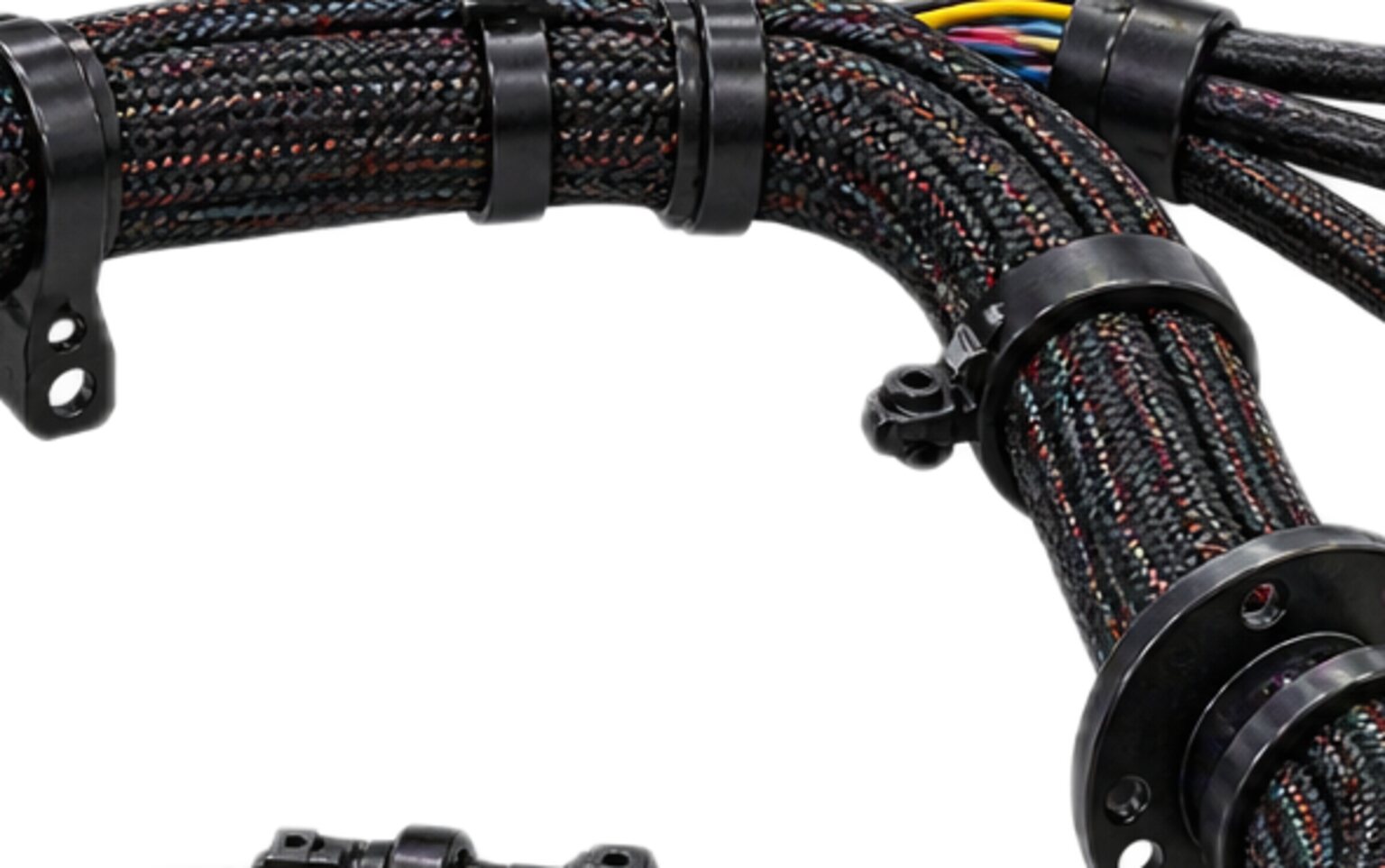
Bundle tightness is a feel the shop teaches and checks. The bundle holds its shape, its conductors lie parallel along it, and no tie is pulled so tight that it dents the insulation. Ties fall at the spacing the drawing sets, a rule taken from the bundle's diameter, so the ties fall at the same stations on every loom of that part. Every breakout has a tie on each side of it, close to it, so that the branch is held where it leaves and the trunk is held where it was left.
A breakout leaves the trunk at the angle the drawing shows, and it leaves once. A branch that leaves, rejoins and leaves again is a reject. A branch that reaches its connector under tension is a reject, because the tension is on the crimp. No conductor crosses another under a tie. Where a breakout makes a crossing unavoidable, the crossing is made clear of the ties and the ties are set on either side of it. A crossing under a tie presses two insulations against each other with the tie's full force, vibration turns that pressure into wear, and the wear turns into a short, months later, inside the bundle where nobody can see it. Where the drawing calls for a twisted pair, the pair keeps its twist to the connector, and the twist is not undone to make the lay-up look neater.
Sleeving, protection and the cut end of a tie
Sleeving is sized to the bundle and secured at both ends so that it cannot walk. A sleeve that walks leaves the point it was protecting and gathers somewhere else, usually against a connector. Convoluted conduit is fitted split or unsplit as the drawing says, and where split, the split faces away from whatever the loom would rub against. Heat shrink is recovered fully, not scorched, not split, and adhesive-lined wherever the drawing asks the joint to seal. Every place the loom crosses an edge has edge protection under it, whether or not the edge looked sharp on the day.
The cut end of a tie is cut flush with a tool made for cutting it flush. A tail left at an angle is a small blade. It cuts the hand of the person who reaches past it to service the machine, and it cuts the insulation of the conductor lying next to it, one vibration at a time. A tie tail is a reject on its own, without anything else being wrong with the loom. The head of the tie is turned to where it does not bear on a neighbouring loom, a moving part or a person's hand.
Labels
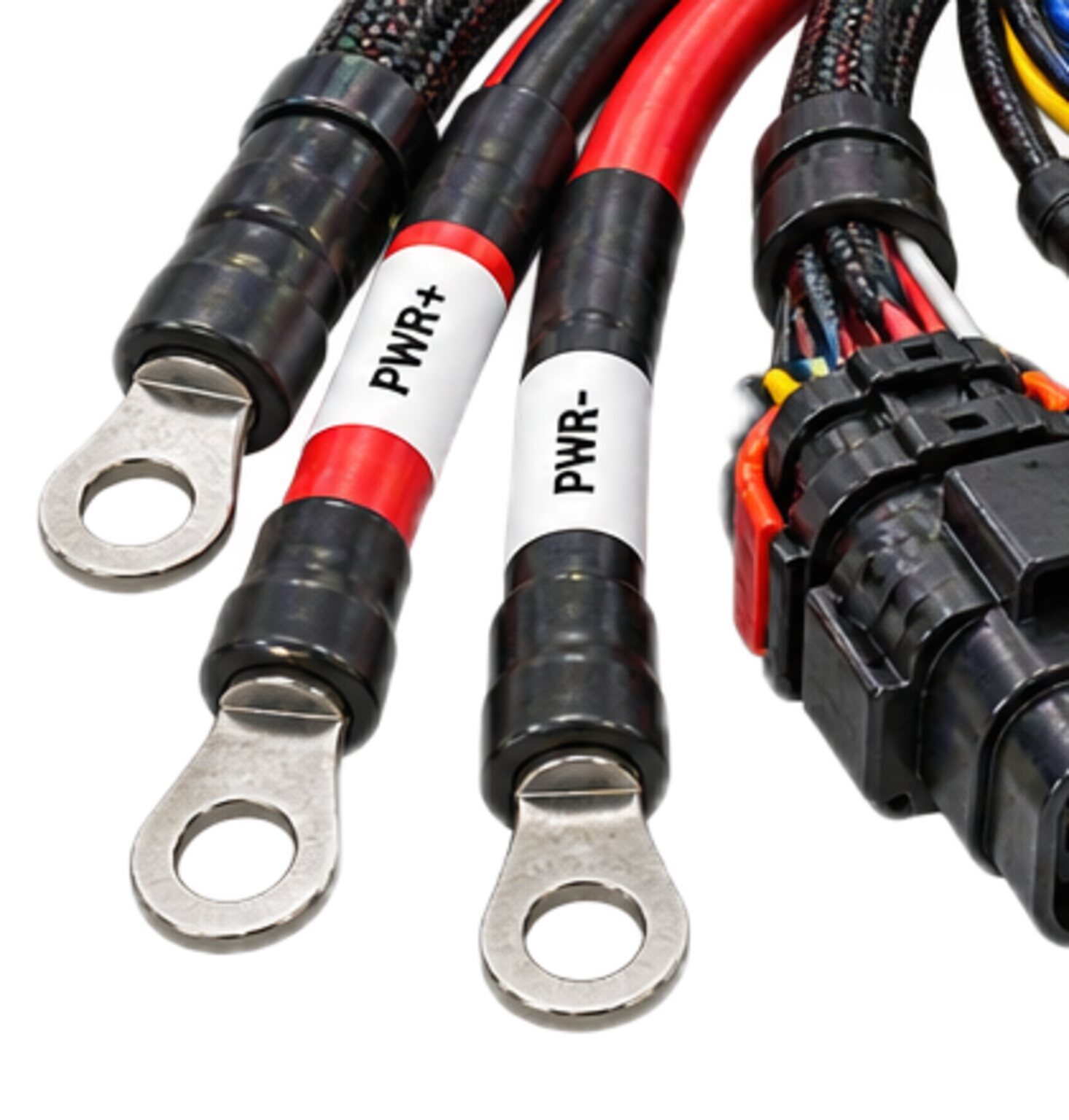
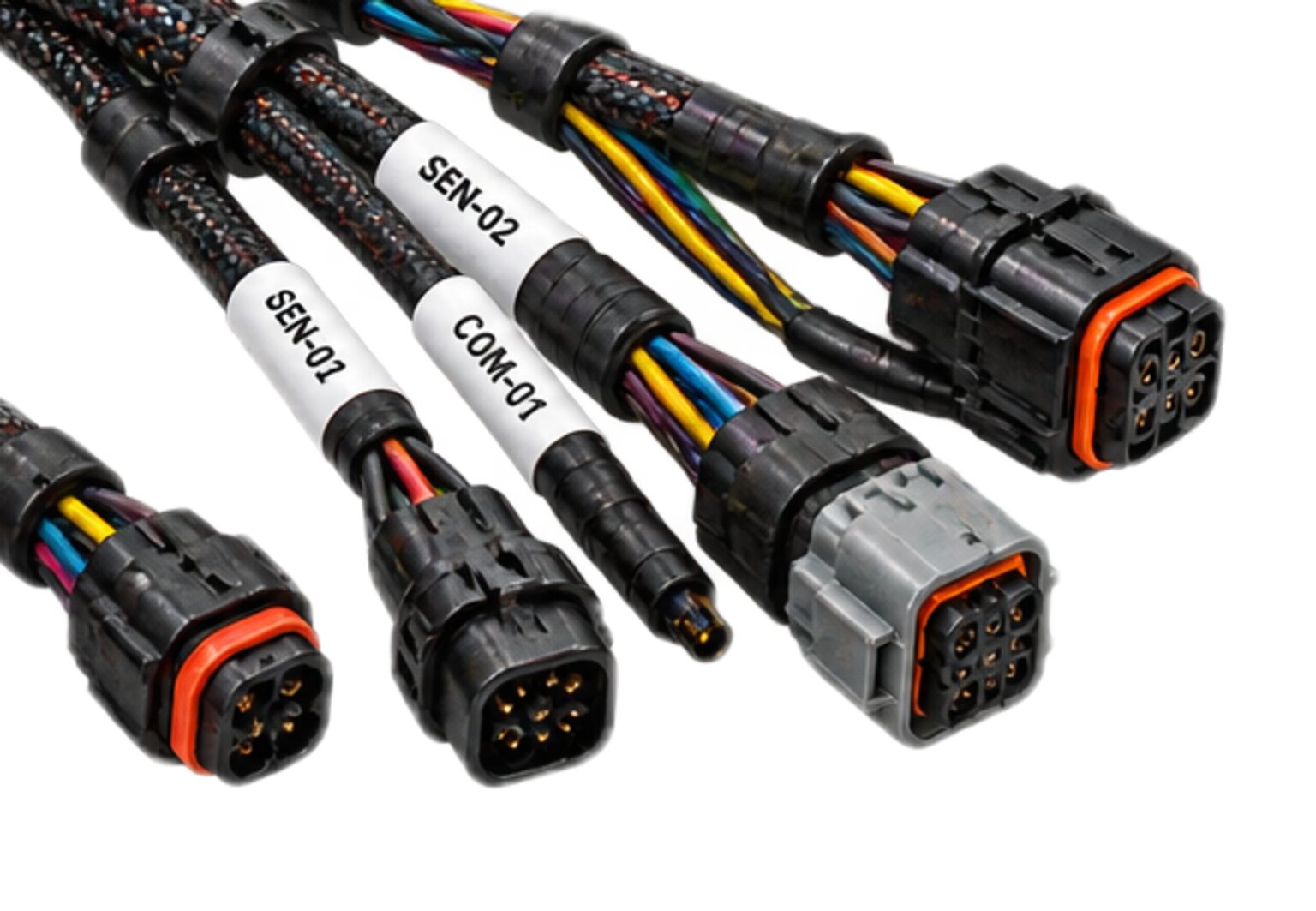
Every conductor carries its circuit identity, end to end. The label is placed where a re-termination does not lose it: back from the connector, past the length that would be cut off to fit a new contact, and never on the strip length or under the boot.
Labels sit on both sides of a breakout, on each branch and on the trunk, so that the loom can be read from any point without following it back. They read the same way up when the loom is in the machine, and they are the permanent kind, not a tape flag that peels at temperature and leaves a conductor nobody can name. What the label says, and how it ties to the drawing and to the loom's record, is set out under labelling and traceability. Workmanship is putting it where it survives.
Inspection and grading
A loom that looks right usually is, and a loom that looks wrong usually is. When a loom looks wrong, the fault you can see is rarely the only one. A tie at a wrong station means somebody was not working to the board. A crossed conductor under a tie means somebody laid up in a hurry. A tie tail means the cutters were the wrong tool, and the next question is what else was. Appearance is not proof, but it is evidence, and an inspector reads it before the tester is turned on. Continuity, isolation and the safety chain are proven by test, on every finished assembly, before it leaves, and that is described under test and acceptance.
A defect found at inspection has one of three outcomes, and the shop does not have a fourth.
| Outcome | What it means | Who decides |
|---|---|---|
| Reject | The loom, or the part of it, is scrapped and remade. The cause is written down. | The inspector. |
| Rework to the drawing | The defect is corrected, to the drawing and nothing else, and re-inspected. | The inspector, with the rework recorded. |
| Accept and record | The loom departs from the drawing in a way that does not change what it does, and it ships with the departure on its record. | The person responsible for the drawing, named on the record. |
A rework done to somebody's idea of what will do is a second defect on top of the first. A reject is not thrown away and forgotten; the cause is found and written down, whether it was the operator, the tool, the material or the drawing, because a reject with no cause recorded comes back on the next run.
Accept and record is the narrow door: a label a little further from the connector than the drawing shows, a tie station moved to clear a breakout. It is never for a crimp, a splice, a shield or a safety conductor. Nothing is accepted silently. The drawing sits under CSA and the Canadian Electrical Code; the shop's criteria sit under the drawing; and the record, described under quality and the record, is where every grade is written.
How a workmanship failure presents in service, and who pays
A workmanship failure does not fail at test. That is what makes it a workmanship failure rather than a build error. The nicked strand carries current on the bench. The tie into the insulation is a short that has not happened yet. The crimp that carries load holds through acceptance and through commissioning. The pushed-back contact makes while the shell is pressed together and opens when the machine moves.
In service the failure presents as an intermittent, and it presents on a machine that is moving, warm, wet, or all three, with nobody standing beside it. The fault clears when the technician touches the harness, and it comes back when the technician leaves. On a safety chain, an intermittent opens the chain and stops the machine, which is the safe outcome, and it stops it in a field or on a floor at the point in the cycle when a stop costs the most. The finding costs more than the harness did.
Who pays is plain. The operator pays in a machine that is down and in the hours of somebody hunting an intermittent. The integrator pays in a truck roll and in the trust of the operator. The shop pays in a returned loom and in every loom it sells after.
What we refuse
No crimp from an unset tool. A tool is set for this contact and this conductor and checked on a sample before the run, or it does not make a crimp that leaves this shop, whatever the crimp looks like.
No splice in a safety chain. The emergency-stop and interlock conductors run continuous from contact to contact. A drawing that calls for a splice in one goes back to whoever drew it.
No pigtail where the drawing calls for a full-circumference termination, and no full-circumference termination where the drawing calls for the shield to land on a pin. The drawing chose the termination for the frequency the shield has to work at, and it is not the shop's to change.
No rework without a record. A defect that is corrected and not written down is a defect nobody can find later, and the loom is unchanged on paper while it is different in the hand.
A loom that meets these leaves the shop. We will not ship one that does not.