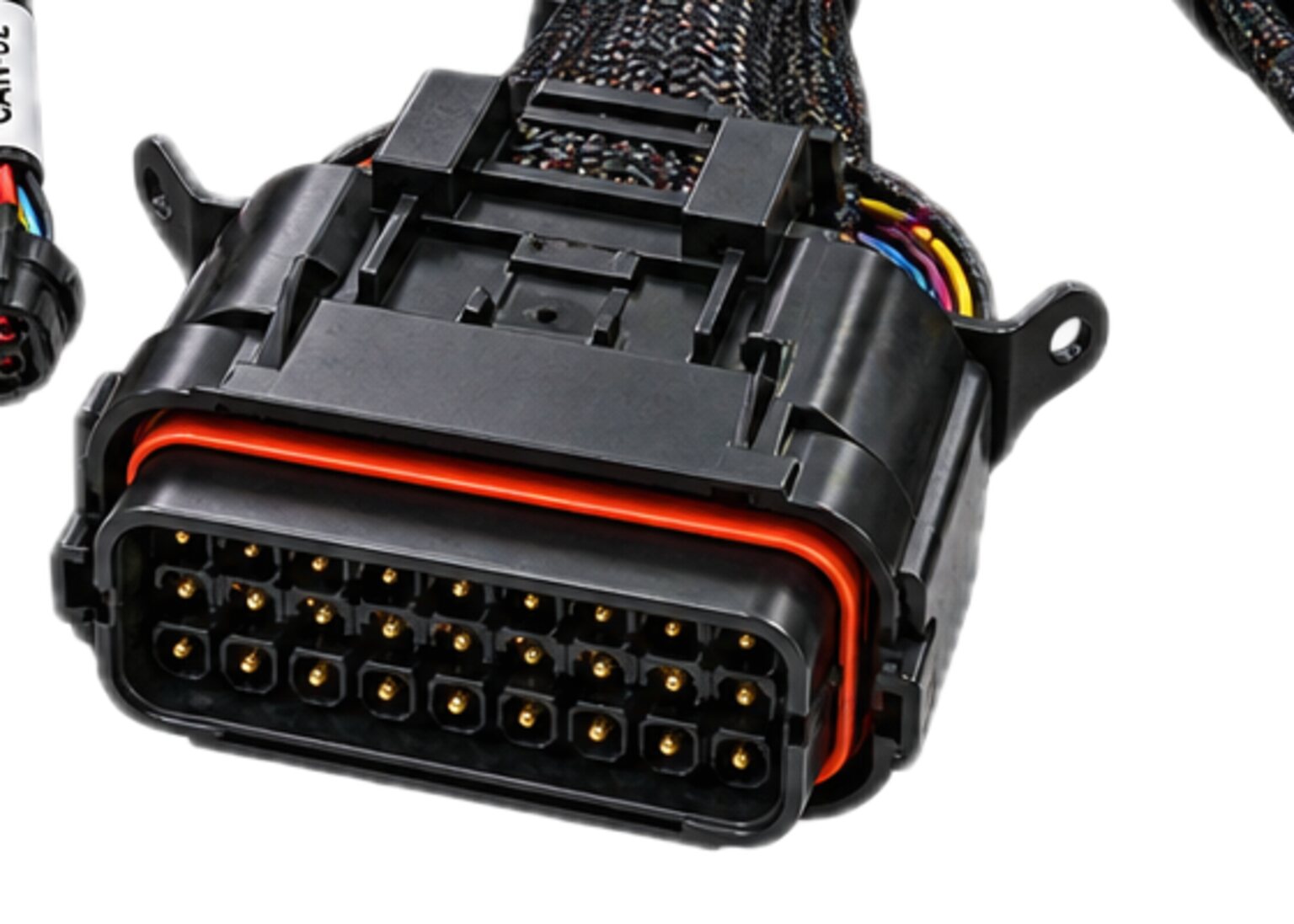
A wiring harness is built in a fixed order, and the order is not a preference. Each stage hands the next one a document, and the next stage does not start until it holds it. An unquestioned set is not taken off. An undrawn takeoff is not cut. An unsigned drawing is not fabricated. An untested assembly gets no label, no bag and no place on the truck. Skipping a stage does not make the work faster. It moves the stage downstream, to where it costs more and where you pay for it.
Intake
The work starts when you issue a set at a stated revision: the schematic, the interconnect, the connector and contact selections, the routing view or model, and the specification the finished assembly is measured against. Where the harness is one side of an interface, the set also says what the other side promises, because a harness is built to a mating half it never sees until it lands.
Intake reads the set before anyone prices it, against a fixed list of questions, and each closes before takeoff.
- Which revision is issued, and whether every sheet is at it. A sheet at an earlier revision is a conflict found on the board or on the machine, never in the office.
- Whether the schematic and the interconnect agree. A circuit on one and not the other is a conductor with no home.
- Whether every connector has a named shell, insert, contact and backshell, and whether that contact suits its wire. A contact that does not match the wire is a crimp that cannot be made to specification.
- Whether the wire specification is stated per circuit. Gauge, insulation, temperature rating and colour are the designer's decisions, and we do not fill the gaps.
- Where segregation is required. The safety-interlock chain, the emergency-stop loop and the power feed are called out as separate bundles, or we ask. Safety circuits never share a bundle, a splice or a shell with power, and the drawing has to show it, because a formboard cannot enforce a rule the drawing does not carry.
- Where the finished assembly sits for certification. CSA certification and the Canadian Electrical Code govern any electrical assembly manufactured for sale or installation in Canada. The components we specify carry their own certification. The approval route for a finished, project-specific assembly is confirmed with the certifying body for that assembly before it is built, and we tell you where yours sits before we build it, not after.
A question that does not close goes back to you in writing, as a query naming the sheet and revision, and the answer joins the record. Intake produces a closed set, and the quotation follows the shop drawing drawn from it and no other document. It refuses to proceed without an issued revision, because a quotation against a moving set is for a harness you will not receive.
A harness kit is a pre-hung door. It is only pre-hung if the rough opening on site is the one it was built for. Intake is where the opening is measured. Skip it and the door arrives wrong, and nobody on site has a plane.
The takeoff
The takeoff turns the set into a bill of material and a bill of work. Every conductor is listed with its circuit identity, its from and its to, its wire specification, its terminal at each end and its length. Every connector is listed with its shell, insert, contacts, seals, backshell and cavity plugs.
A length comes from a dimension the design authority issued on the drawing, or from a measurement somebody took on the machine or on a fixture that represents it, and from nowhere else. It does not come from scaling a sheet that does not say it is to scale, or from a guess. A value nobody measured never reaches a wire. Where the set gives no length for a branch, the takeoff stops on that branch and the query goes back. A harness long by more than the drawing allows is a service loop nobody designed, coiled somewhere it will chafe.
The takeoff also writes down what the drawing does not show: the service loop at a fixed end so the bend radius holds where the conductor leaves the connector, the drip loop where a run crosses from wet to dry, where a shield drain lands, the strain relief at each backshell. They are manufacturing decisions, not design changes, and each is written down to be approved rather than discovered.
The takeoff refuses to substitute a part. A connector that is unavailable is a query to you, with the proposed equivalent and the reason named, not a swap made on the bench because the shell looks the same. Two shells that look the same and key differently are two harnesses that do not mate. Skip the takeoff, or do it from memory, and the shortage appears at the formboard, where a bench sits idle while a part is chased.
A value nobody measured never reaches a wire.
The shop drawing
The shop drawing is the harness as it will be built, drawn by the shop from your set, and it is the principal sheet of the shop pack: the cut list, the formboard drawing, the termination table, the kit list and the test plan are drawn with it. Your schematic says what connects to what. The shop drawing says how: the bundle laid flat, every branch and its breakout, every length between breakouts, every connector with its cavity map and the identity in each cavity, the bend at every fixed end, which bundles stay separate, and the tests the finished assembly has to pass. It carries the queries, their answers, and the revision of your set it was drawn from.
Then it goes to you, and it waits. Nothing is fabricated until the drawing is signed. Your signature goes on the pack as well as on your own set, so the thing being signed is the thing being built. You sign it because the design is yours and the harness has to fit the machine you are building, not the one we imagine.
The rule is where the cost of an error is lowest. A shop drawing is corrected with a pen. A cut list is corrected with new wire. A formboard is corrected by stripping the board. A terminated harness is corrected by cutting the connector off and scrapping the conductor behind it. A landed harness is corrected on the machine, by a technician who was scheduled to do something else, on a line that is waiting.
The shop drawing refuses a verbal approval, an email that says it looks fine, and a marked-up copy. A mark-up is a request for a new revision, and the re-issued revision is the one that is signed. It also refuses a signed drawing whose source set has moved. When you issue a new revision of the set, the shop drawing goes back to draft against it, whatever stage the work is at, and we come back with what the change costs before we act on it. That can cost a formboard. It costs less than a harness built to a revision you have withdrawn.
Skip the shop drawing and the harness is built to a reading of the schematic that lives in one head. The second unit is built to a slightly different reading, and nothing was written down to tell the two apart.
The cut list, the kit and the formboard
A signed shop drawing produces a cut list: every conductor by circuit identity, with its specification, its cut length including the stripping allowance and the service loop the drawing shows, and its label. Wire is pulled from a reel whose lot is recorded against the cut list, so a faulty reel traces to every harness it went into. Each conductor is cut, marked with its identity at both ends, and kitted with its terminals. The kit is one harness in one tray with its cut list on top, and the tray does not move to the board until every line on the list has been ticked against it.
The formboard is the shop drawing at full size, pinned to a board, with a peg at every breakout and a saddle at every connector. The bundle is laid on it conductor by conductor. The board does not decide the route. It holds the route the drawing chose, so that every harness built on it is the same harness. Breakouts are tied where the drawing shows a breakout and nowhere else. Separated bundles are laid on separate pegs and stay on them, because a safety loop that crosses into the power bundle on the board arrives at the machine inside the power bundle, and a person reading the loom later has no way to tell. The rules that decide what is kept apart are the drawing's; the board only enforces them.
The formboard refuses a cut list at a superseded revision, a kit with a line missing, and a conductor with no identity, because nobody can prove an unmarked conductor landed where the drawing says. The first harness off a new board is not the first unit of the run but the proof of the board, built out fully and offered up to the machine before a second unit is laid. Skip the board and lengths and branch angles drift from unit to unit, and the harness that fits the first machine binds on the second. More on the board is at formboards and manufacture.
Termination
Termination is where the harness stops being wire and becomes an assembly. Each conductor is stripped to the length the contact needs without nicking a strand, because a nicked strand breaks under vibration and the conductor then carries less than it was chosen to carry. The contact is crimped with the tool and the die specified for that contact and that wire, and with nothing else. The tool's calibration is current or the tool is not on the bench.
Sample crimps are made from the same reel and the same contacts before the harness is terminated, and they are gauged, pulled and sectioned against the contact maker's specification for that contact and wire: the height, whether the crimp holds the conductor, and whether the strands fill the barrel without voids or crushing. The samples are recorded against the harness they qualify. Each contact is then seated in its cavity until its retention clip clicks and pulled back to prove it is held, so that one that is not locked is found now rather than on the machine.
A ring terminal on a stud is torqued to the value stated for that stud on the drawing, or the drawing is queried and the stud waits. A soldered joint is made only where the drawing calls for one and never in a run that flexes, because solder wicks up the strand and moves the flex point. A shield is terminated at the end, or the ends, the drawing says, because the drawing chose the termination for the frequency the shield has to work at. A splice is made only where the drawing shows one, and never in a safety circuit. A safety circuit that needs a splice needs a redesign, and that goes back to you as a query.
Termination refuses a torque nobody stated, a contact with no matching die, a cavity plug omitted because the cavity was empty anyway, and a conductor whose identity mark is not legible. Skip the discipline here and a cold crimp passes continuity on the bench and opens on the machine in the cold, or under vibration, months later, as an intermittent that arrives long after anyone would think to look at a crimp. The connector and contact choices that decide most of what can go wrong here are on the connectors page.
The test sequence and the record
- A finished assembly is tested before it is labelled, and in an order, because each test assumes the one before it.
- First the visual: every cavity populated or plugged, every backshell seated, every tie where the drawing shows one, every identity mark legible.
- Then continuity, conductor by conductor, from each cavity to the cavity the drawing says it lands in, which proves every circuit goes where it should and nowhere else.
- Then isolation, which asks whether two circuits that must never meet are in fact separate.
- Then the bond test, which asks whether a path the drawing intends to be metal is metal.
- Then the keying proof, on the closed assembly, which offers every plug to every receptacle it could reach and takes a refusal from all but its own.
- Then the checks the drawing calls for on that assembly and no other.
The values a test is run at are not ours to set. They are stated on the specification for that assembly by the engineer responsible for it, or they are not stated, and an unstated value is a query, not a default. The shop carries no house number.
Every assembly gets its own record: its serial, the shop drawing revision it was built to, the revision of your set behind that drawing, the wire and contact lots in it, the crimp tool and sample crimps that qualified it, each test with its result and the person who ran it, and any rework with its own re-test. An assembly that fails is not repaired and passed. It is repaired and goes back to the start of the sequence, because a repair that touched one conductor may have disturbed the one beside it.
The test stage refuses to pass an assembly on the strength of the last one that passed, refuses a record with a blank in it, and refuses to let the person who terminated the assembly witness its test. Skip the test, or sample instead of testing every unit, and the assembly with the mis-pin is the one that reaches the machine, where commissioning finds it with a schematic in one hand and a meter in the other. What each test proves is on test and acceptance; what the record is for after the harness leaves is on the record.
Labelling and packing
Every conductor carries its circuit identity, end to end. That is the label rule, and it is why a technician on site can find a fault without us. The identity is on the conductor at both ends, on the connector and on the assembly, and it matches your schematic, not a scheme of ours. A harness that carries the shop's identities instead of the designer's has to be translated on site, and the translation is where the error goes in.
The assembly's own tag goes on after test, not before, so that no tag vouches for an assembly that has not passed; the conductor identities went on at the cutting station, because a sleeve will not pass over a terminated contact. Each label is checked against the record, and the record against the drawing. Connectors are capped and mating faces protected. The harness is coiled no tighter than the tightest bend the drawing allows the stiffest cable in it, because a harness coiled tight in a box arrives with a set it did not have on the board. It is bagged with its record.
A kit is packed in the order of install: the harness that goes in first is on top, and whips and pre-cut lengths are bundled by the location they serve, so the person who opens the kit opens it once. Packing refuses a label that does not match the record, a record that does not match the drawing, and an assembly with no record. Skip this stage and the harness arrives as a coil of unmarked wire, and the site rebuilds the drawing from the meter. How identity is carried and read after delivery is on labelling and traceability.
What goes back to your drawing master
The last stage is not the truck. It is the return of the manufacturing detail to the master that owns it. We build to a customer's issued set and we return the manufacturing detail. The design is yours and so is the shop pack drawn from it. Where the harness belongs to a machine programme, that programme owns the design and the drawing master, and the full shop pack, from shop drawing to test sequence, is owed back to it.
A master that does not carry the shop's detail describes a harness slightly different from the one on the machine. The next unit, built by us or by anyone, is built from the master, and the difference appears again. The lengths measured on the fixture, the service loop the takeoff added, the cavity plug the drawing forgot, the query and its answer: all of it belongs in the master, and none of it is ours to keep. The shop pack refuses to become a private copy. When your master moves, the next harness is built from the moved master and a fresh shop drawing, not from the pack behind the last one.
Skip the return and the harness works, and the drawing lies. It keeps lying until a second shop builds to it, or a technician trusts it, or the interface on the other side changes and nobody can say what the harness on the machine actually is. That is the failure that arrives latest and costs most, because by then the person who knew is gone.
What we refuse
- We do not fabricate before the drawing is signed.
- We do not quote a set that nobody has issued.
- We do not take a length from a sheet that does not state it, and we do not invent one.
- We do not substitute a part on the bench.
- We do not crimp with a die that is not the specified one, and we do not put a splice in a safety circuit.
- We do not run a test at a value nobody stated, and we do not pass an assembly on the record of the one before it.
- We do not ship a label that does not match the record, and we do not keep the manufacturing detail as our own.
- Each refusal marks a failure the trade already knows, and each is cheaper than the failure it stops.
- If the set you hold cannot yet survive intake, how to engage says what a set needs before it comes to us.