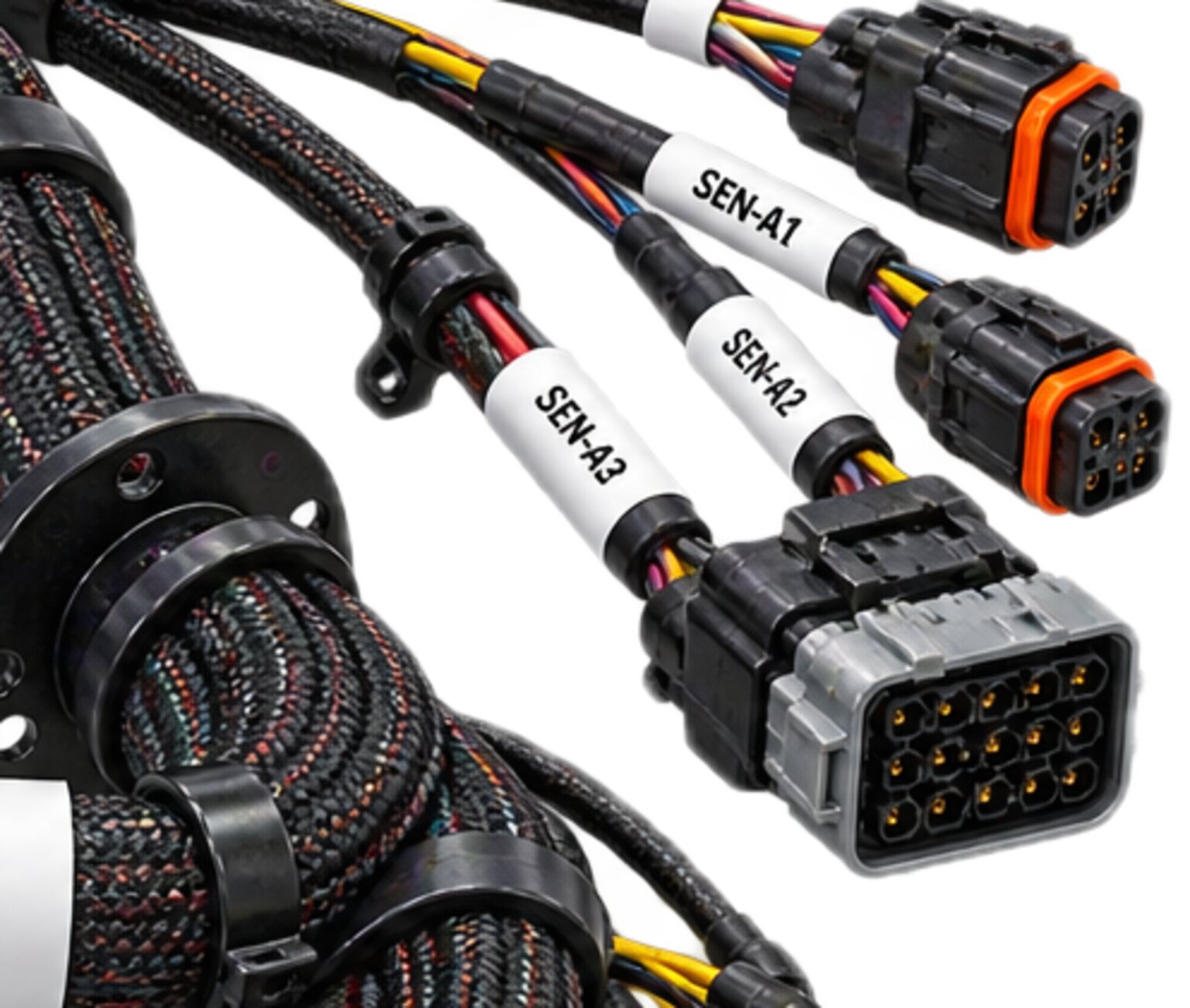
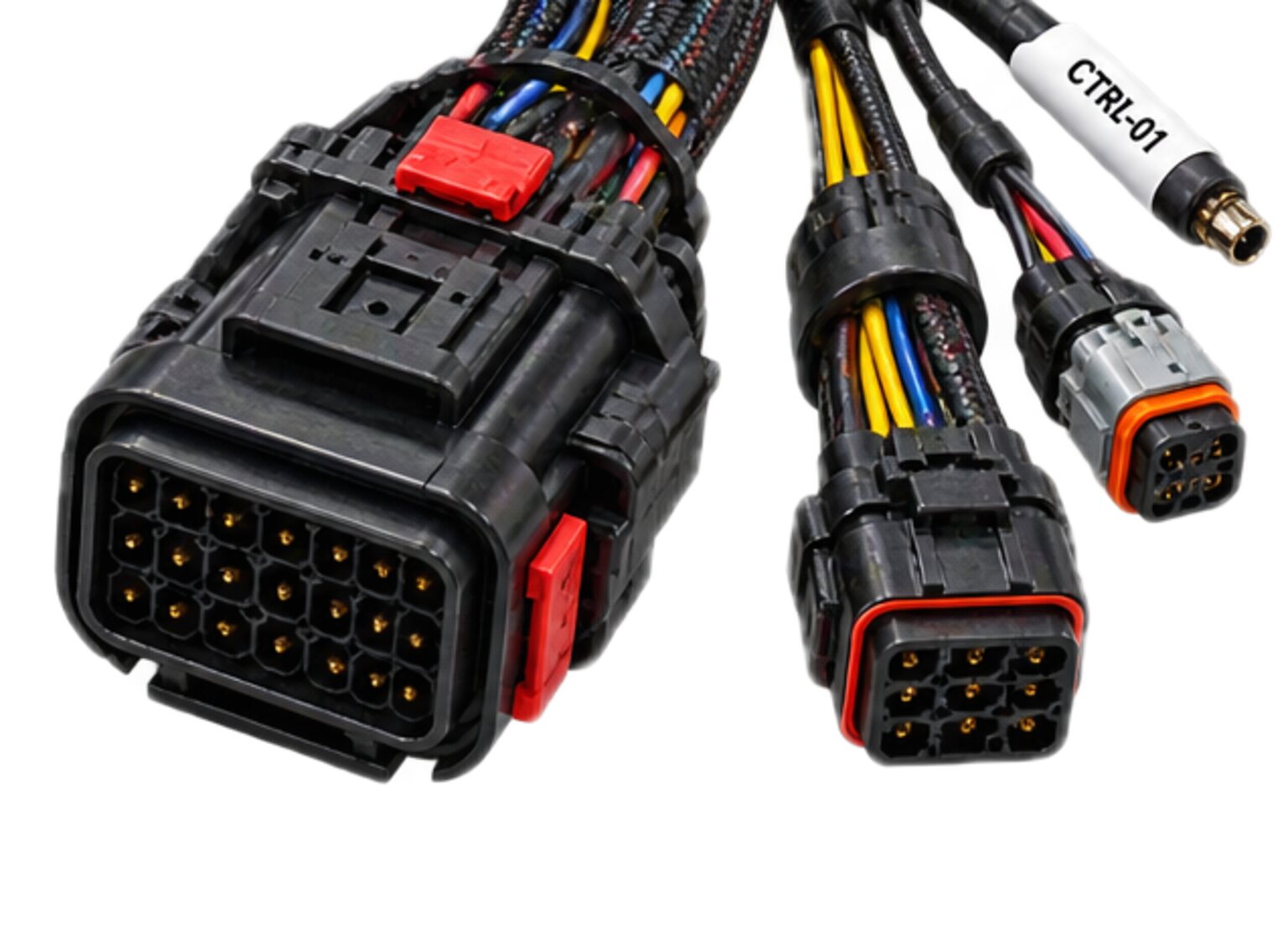
There is one master drawing for every harness this shop builds, and nothing is fabricated until it is signed. The drawing is the harness before the harness exists. It carries every circuit, every conductor, every termination, every length and every label, and it carries the name of the person answerable for all of them. The formboard is laid out from it. The kit is cut from it. The test is written from it. If a fact about the assembly is not on the drawing, the shop does not know it, and a builder who fills the gap from experience has designed something nobody signed.
The signature matters more than the drawing. An unsigned drawing is a proposal. A connector may still be under discussion, a route may still be moving, a conductor size may still be waiting for a calculation. A value nobody measured never reaches a wire, and the signature is how the shop knows that every value on the sheet was measured, or calculated, or taken from an interface the other side has committed to. The person who signs is saying: build exactly this, and I will answer for it. Until someone is willing to say that, the board stays empty.
On the autonomy and training lines the design authority sits with the machine programme, not with us. We build to a customer's issued set and we return the manufacturing detail. The rule does not change. Your drawing is signed by your authority, the shop drawing we draw from it is signed by you, and the two are reconciled before the first conductor is cut. Where they disagree, the work stops until they agree. A harness built to two drawings is built to neither.
How a change is controlled
Drawings change. A connector becomes unavailable, a bracket moves, a customer adds a circuit, a test finds an error in the sheet. None of that is a failure. The failure is a change that reaches the floor by any route other than a new revision.
A change is a new revision of the master drawing, signed again by the authority that signed the last one. The revision records what changed and why, so that a person reading the sheet later can see the difference without laying two drawings side by side. Only then does the new sheet go to the floor. And when it goes, the old sheet comes back. Every printed copy of the superseded revision is collected, marked and taken out of the working area, and the record for any assembly in progress is checked against the new revision before work on it continues.
That last step is the one a shop skips when it is busy, and skipping it is how a superseded sheet reaches a bench. A superseded sheet on a bench looks exactly like a current one. It has a title block, a revision and a signature. The builder working from it is doing everything right, and the harness built from it passes every check the builder runs, because the builder is checking against the sheet in front of them. The error surfaces at site, when the loom does not reach the bracket that moved, or when the circuit added on the current revision is simply not there. By then the assembly has been taped, sleeved, labelled and shipped. Withdrawing the old revision is not paperwork. It is the whole control.
Material that reaches a board
Every conductor, contact, connector, seal, sleeve and label in a harness comes from somewhere, and the shop knows where. Material arrives against a purchase record that names the part and its maker. It is checked on receipt: the part number on the packaging against the order, the packaging against its contents, the contents against the drawing's specification for that item. Wire is checked for the marking on its insulation. Contacts are checked against the connector family they are meant to seat in, because contacts from different families can look alike and are not interchangeable. Anything that does not match is set aside, not shelved.
Once accepted, material is stored so that its lot stays with it. A reel keeps its reel tag. A bag of contacts keeps its lot label. When the kit for an assembly is pulled, the lots that went into it are written against that assembly's record. This is a small discipline with a large effect. It is what lets a finished loom be traced to a specific reel of wire and a specific lot of contacts, which is the only way a problem found in one harness can be bounded to the others that share its material.
A conductor or a contact of unknown provenance never reaches a board. Not from the odds-and-ends drawer, not from a reel with no tag, not from a sample bag a supplier sent, not from the end of the last job. This costs the shop something. When the right contact is in a tagged bag that has not arrived and an identical-looking contact is on the shelf, the identical-looking contact stays on the shelf. A crimp made on a contact of the wrong plating or the wrong alloy is a crimp whose resistance changes with heat and time, and nobody finds it on the bench.
Nothing is fabricated until the drawing is signed.
The inspection and test plan, in the order the work is done
Every assembly has an inspection and test plan before the first conductor is cut. The plan is written from the drawing, and it follows the work through the shop rather than waiting at the end. A test at the end can tell you an assembly is wrong. It cannot tell you which step made it wrong, and by then the labour is spent.
The first article is proven on the board. The first assembly of any new drawing, or any new revision, is built on the formboard and checked against the drawing in full before a second is started: every branch length against the board pins, every breakout position, every conductor identity at every end, every connector clocking and keying, every label. Where the first article and the drawing disagree, the disagreement goes back to the engineer, not to the builder, because the drawing may be the thing that is wrong. Only a first article that matches its drawing releases the board for the run. What the board itself is for is on formboards and manufacture.
In-process checks happen at termination, because a termination fault is the one the bench is least able to see. Each crimp is inspected as it is made: conductor visible in the inspection window, no strands outside the barrel, the insulation grip on insulation and not on copper, the crimp form as the tooling is meant to leave it. A sample crimp from each tool set-up is pulled to prove the joint holds, and the measured result is recorded against the specification for that terminal on that assembly. Each contact is seated in its cavity and then pulled back against the lock to prove it has latched, because a contact that has not latched passes a continuity test on the bench and backs out of its cavity the first time its own mate pushes on it. What a good joint looks like, and what a bad one looks like, is on workmanship.
Every finished assembly then goes through the same sequence, in the same order. A continuity test proves that every conductor lands where the drawing says it lands, and nowhere else. An isolation test asks whether two circuits that must never meet are in fact separate, and it is run on every finished assembly before it leaves, with the safety circuits checked against every power conductor in the loom. Shield and bond continuity is proven to the point the drawing names as the bond. Then the assembly is inspected as a whole: routing against the drawing, sleeving and tape, the bend at every fixed end, strain relief at every connector, and every label against the drawing's schedule. What each test proves, and what accepting an assembly means, is set out on test and acceptance.
The record leaves with the assembly. It shows the drawing revision the assembly was built to, the material lots that went into it, who built it, who inspected it, who tested it, and what the tests found. A harness without that record is a harness whose quality is a matter of opinion. What the record holds, and what it is for, is on the record.
When a harness fails a check
A harness that fails a check is not reworked quietly. It is held.
That sentence is the difference between a shop with a quality discipline and a shop with good intentions. Without the rule, a builder who finds a bad crimp cuts it off, makes a new one and moves on. That builder has just done three things. They have shortened a conductor below the length on the drawing. They have used a second contact from the kit, so the kit is now short and the count no longer reconciles. And they have made the record untrue, because the record will say the assembly was built and tested with no finding, and it was not.
So a failed check stops the assembly. It is tagged, moved off the working bench, and a nonconformance record is opened that says what was checked, what was found and who found it. Then the assembly is dispositioned. The inspector chooses between two things: rework the assembly back to the drawing and retest it in full, or scrap it and remake it. Only the person responsible for the drawing can accept it as it is, and the departure from the drawing is then written down and signed for that assembly alone. The record carries the decision, the name and the retest.
Rework has limits, and disposition is where the limits are enforced. A crimped contact is never re-crimped. It is cut off and a new one is made, and that consumes conductor length. A conductor cut back twice may no longer reach. A connector whose cavity lock has been damaged by a removal tool does not go back into the assembly. A shop that reworks quietly sees none of these limits, because it is not counting.
Traceability, from the loom back
Every conductor carries its circuit identity, end to end. In a finished loom that identity is the identity on the drawing. From there the trail runs backward, and it runs all the way.
The assembly label carries the drawing identity and the revision the assembly was built to. The record carries the material lots pulled for it, so the reel the conductor came from and the lot the contacts came from are on record. It carries the initials of the person who cut, the person who terminated, the person who inspected and the person who tested, against each step. The crimp tool and its set-up are recorded against the terminations it made. The test record carries the results, and where a result was measured rather than passed or failed, the number is on the record for that assembly, where it belongs.
- This is what makes a problem bounded.
- If a lot of contacts turns out to be bad, the shop can name every assembly that lot went into.
- If a builder's crimps are found out of form, the shop can name every crimp that builder made in the affected window.
- If a drawing revision is found to carry an error, the shop can name every assembly built to it.
- Without the trail, the only answer to any of those questions is every harness ever built, and that is not an answer a buyer can use.
A finished loom with no record is a used car with no service history. It may be fine. You have no way of knowing, and neither does the person who sold it to you. How the identity gets onto the conductor is described on labelling and traceability.
Certification
Any electrical assembly manufactured for sale or installation in Canada must satisfy CSA certification and the Canadian Electrical Code, and the route to that approval is not the same for a component as it is for a finished assembly built to one customer's drawing. The components we specify carry their own certification. The approval route for a finished, project-specific assembly is confirmed with the certifying body for that assembly before it is built, and we tell you where yours sits before we build it, not after. How that route is worked out for a given assembly, and what it asks of the drawing, is on CSA and the Code.
How a quality failure presents in service, and who pays
A harness rarely fails on the bench. It fails on the machine, later, in a way that does not look like a harness failure.
A high-resistance crimp does not open. It heats under load, the heat softens the insulation and grows the resistance, and the circuit browns out in a way that looks like a controller fault or a tired battery. A contact that never latched makes on the bench and opens under vibration, so the fault is intermittent and clears the moment a technician touches the connector. A conductor of the wrong size runs warm and the failure arrives months later as a thermal event nobody can reproduce. A safety circuit that shares a bundle with a motor feed picks up a transient and trips a stop nobody commanded, and after enough nuisance trips somebody bypasses the interlock. A mislabelled conductor lands on the wrong terminal at site and the machine does something it was not told to do the first time it is powered.
Every one of those started on a bench, as a check that was skipped or a record that was not kept, and every one presents in the field as something else. The engineer chasing the fault is chasing a controller, a sensor, a battery, a piece of software. The harness is the last thing suspected, because it has no moving parts and it passed its test.
Who pays is the reason a buyer should weigh the shop's discipline and not only its price. The integrator pays in schedule, because a machine that will not commission holds up everything downstream of it. The operator pays in a truck roll to a site that has no labour, which is the whole reason the machine is autonomous. Somebody pays in rework, and rework in the field is done without a formboard, without the drawing, by a person whose skill is the machine and not the loom. On a safety circuit the currency changes. An interlock that fails to open, or that is bypassed because it kept opening for no reason, is a hazard to whoever is standing near the machine when it moves. That is why segregation is a discipline of its own.
What we refuse
We refuse to build to an unsigned drawing. Not from a marked-up print, not from a verbal instruction from a customer in a hurry, not from a drawing the builder is sure is about to be signed. A harness built to an unsigned drawing has been built to nobody's authority, and no schedule makes that acceptable.
We refuse quiet rework. A failed check is held, dispositioned and recorded, every time, including the times when the fix is obvious and would take a minute. A minute of rework is the cheapest thing in the shop. An untrue record is the most expensive.
We refuse to write a record after the fact. The record is made as the work is done, by the person doing it, at the step where it happens. A record reconstructed from memory after the shift is a story about the work, and a story is not a record.
We refuse to claim a certification we do not hold, for a component or for an assembly. A claim that cannot be shown on a document is a value nobody measured, and it never reaches a wire, a label or a page.