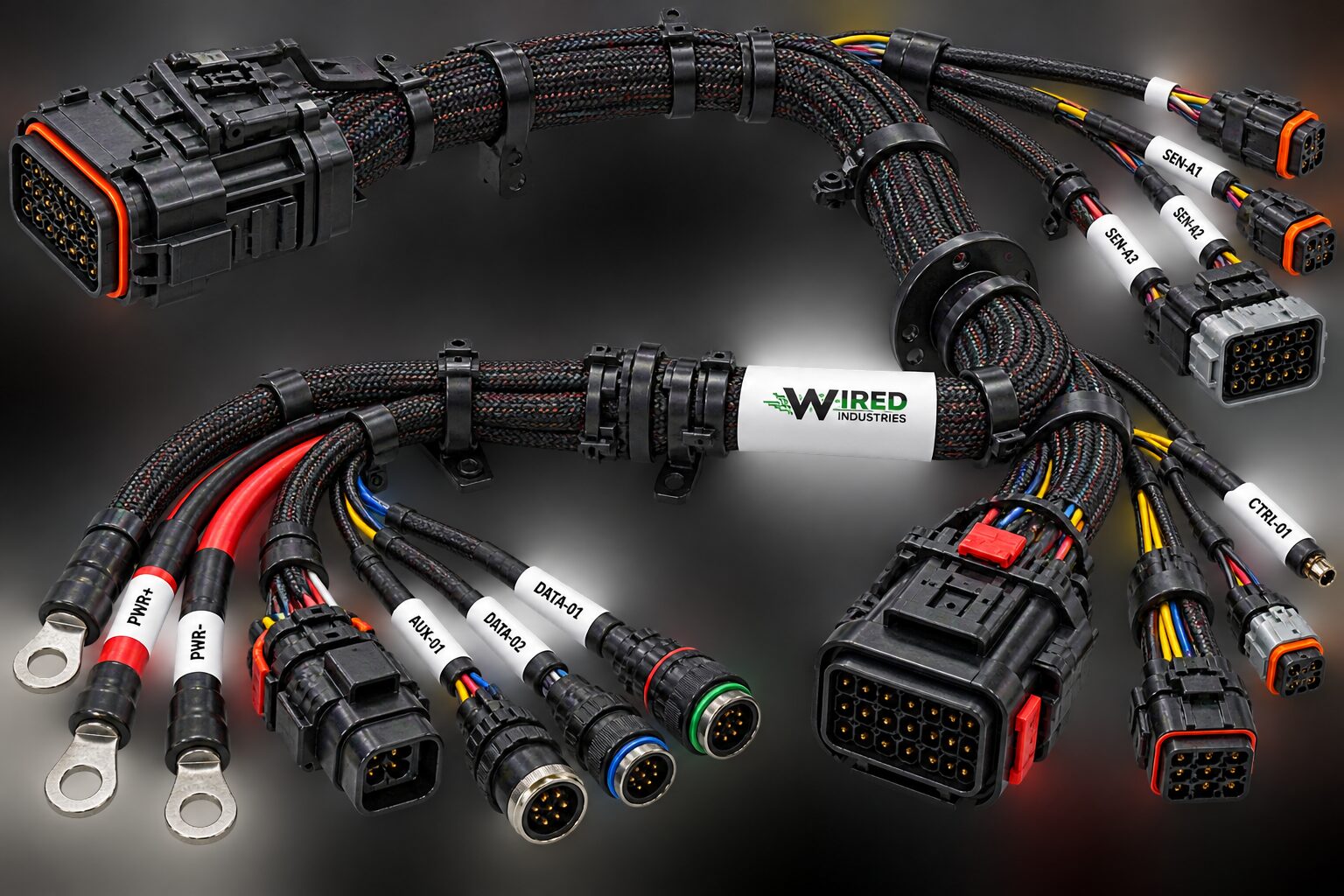
Wired Industries manufactures the wiring harnesses and wiring systems that autonomous and uncrewed machines are assembled around. You issue an electrical drawing set or an interface specification. We perform the takeoff, source the material, lay out the formboard and build the harnesses, whips and pre-cut kits, then test, label and pack them so they arrive at your site or your assembly line ready to land. We build to your issued set and we return the manufacturing detail. The shop is in Alberta. Wired Industries is an operating division of Sustainable Infrastructure Group Ltd.
Autonomy is decided in software and delivered in copper
Every autonomous system has a seam. It is the place where a safety circuit, a power feed and a data bus share one physical bundle and must never touch each other, and where a connector has to make and break safely every time a person handles it. Software decides what the machine does. Copper decides whether the stop command reaches the contactor, whether the encoder reads position or reads the motor beside it, and whether the payload is still on the bus after the third landing of the day.
That seam is a harness problem, and it is the part of an autonomous system that cannot be corrected in software after it ships. A firmware release can move a threshold. It cannot move a splice. If a safety return was crimped into the same shell as a motor feed, the machine carries that fact for the rest of its life and shows it at the worst time: as an intermittent, months later, on a machine nobody can hold still long enough to find the fault.
It is also the part most often designed last, by whoever has time. The controls engineer has the logic. The mechanical engineer has the frame. The wiring falls between them, and it gets drawn in the last week from a sketch, from what is in the bin and from a length somebody paced off. That is where we start. The harness is engineered on its own terms: what is in the bundle, what is kept out of it, where it branches and what decides the branch, what each joint has to survive, and what the test at the end has to prove.
One rule governs the shop before any other. Safety circuits never share a bundle, a splice or a shell with power. Not when it would save a connector. Not when the drawing is late. A stop chain that runs on its own conductors from the button to the contactor, and is proven before power is applied, is a stop chain you can trust in the dark. Anything else is a stop chain you are taking on faith.
Copper is like rebar. Once the pour is made, what you placed is what you have, and the only way to change it is to break it out. We would rather place it right.
Four lines, four seams
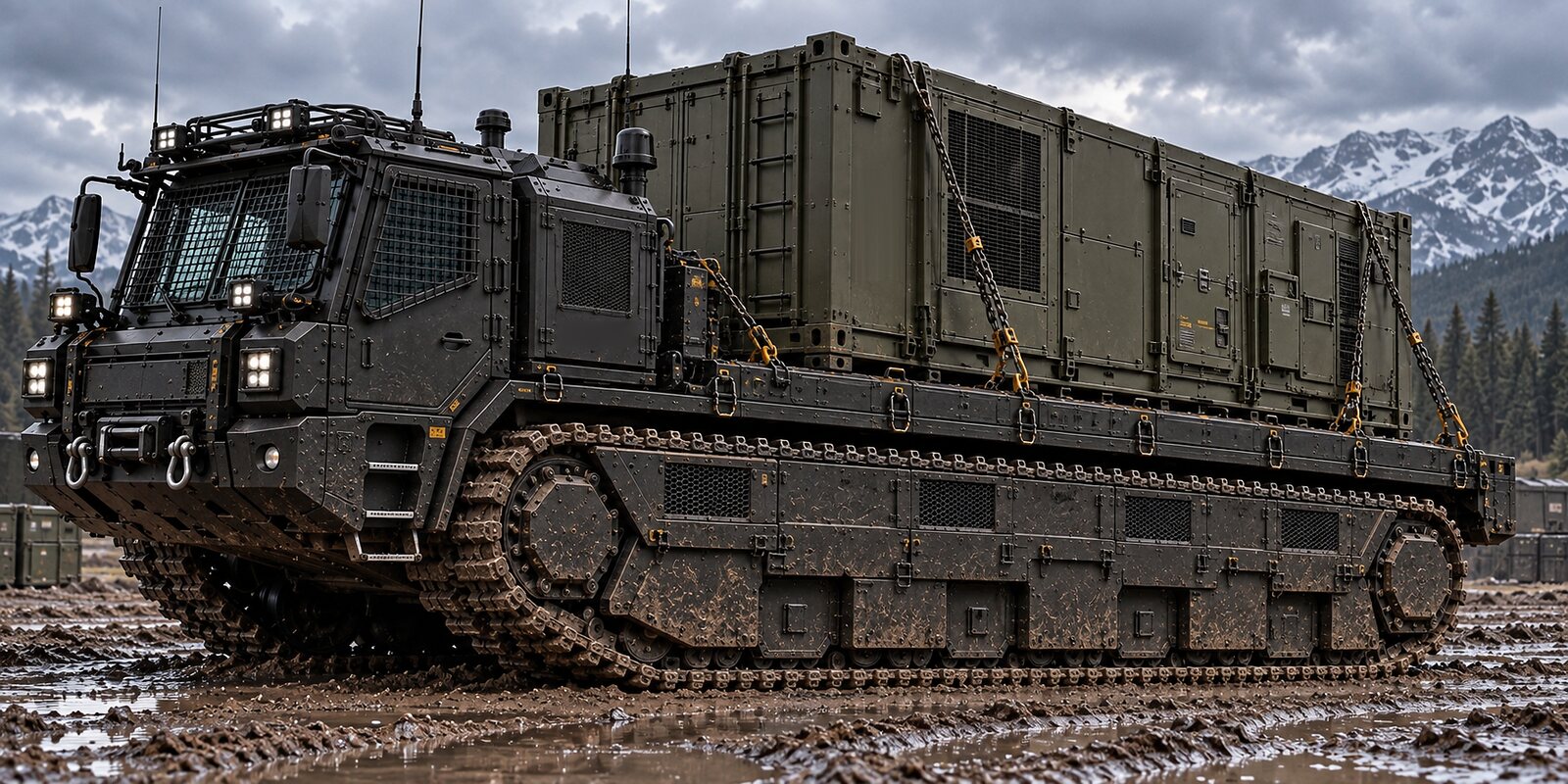
UAV: the payload-to-carrier seam
The payload-to-carrier harness is the power feed, the data bus, the safety-interlock set, and the ground and bond, engineered as one matched set rather than four parts that happen to share a shell. Each has its own job. The power feed carries current and drops voltage along its length. The data bus carries a signal that the power feed beside it would like to corrupt. The interlock says whether the payload is safe to energize and safe to release. Ground and bond are two different things that a hurried drawing calls by one name: bond carries fault current and holds the payload at the same potential as the carrier, while a signal ground is a reference, and a reference with current on it is no longer a reference.
The seam is hard because a person handles it. A payload is mated in the field, in the cold, with gloves on, by someone who is thinking about the mission and not about pin alignment. The connector has to key so that it cannot go on wrong, latch so that vibration cannot walk it off, and sequence so that the bond makes first and the presence loop makes last, and breaks in the opposite order. The shield is grounded at the ends the drawing names, because a slow analogue line wants one end and a fast bus wants both, and a shield grounded at both ends across a poor bond is a loop that carries current you did not design. Get one of these wrong and the failure presents as a payload that drops off the bus in flight and comes back on its own, which is the kind of fault that gets blamed on software for a month. More on the UAV line.
Autonomy: the retrofit loom behind a removable operator
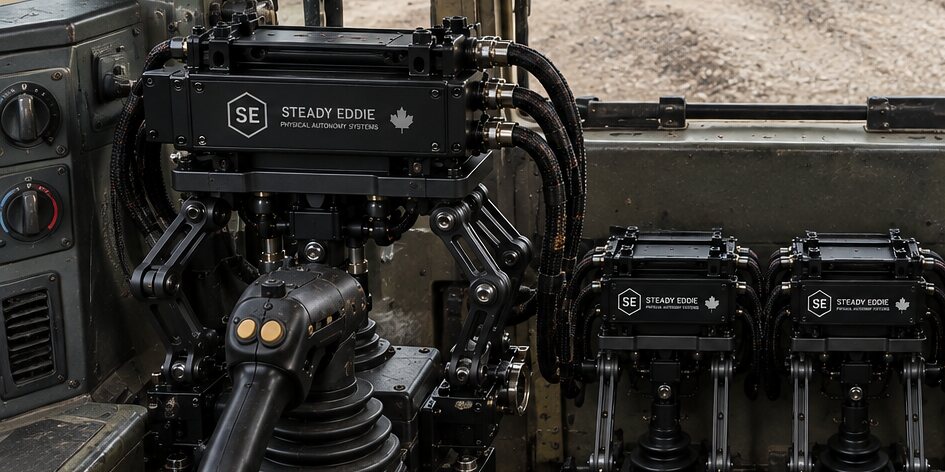
The autonomy harness is the loom that goes onto a machine built for a person, so that the person can step off and the machine can keep working. It carries power distribution, actuator motor and feedback, network and fieldbus, and the emergency-stop and safety-interlock chain. Motor lines are noisy and feedback lines are quiet, and they want to be in the same bundle because they go to the same actuator. The harness designer separates them, shields the ones that need it, bonds the shields where the drawing says and nowhere else, and routes the stop chain on its own conductors so that no fault on the power side can hold the stop open.
The seam is hard because the operator has to be able to come back. A retrofit loom is a second set of circuits laid beside the first, and the machine must return to manual control without a wrench. So the loom lands on defined points, comes off as a unit, and leaves the original circuits as it found them. On a machine programme the design and the drawing master belong to the programme. We build the full shop pack against that issued set and we return the manufacturing detail, so that what was built and what was drawn are the same document. More on the autonomy line.
Training systems: the instrumentation loom inside a capture rig
The training harness is the instrumentation loom inside a capture rig that measures a person working a machine. Sensing lines run to one logger, on one clock, from one battery, and they are wired to nothing on the host machine. This line carries the sharpest version of the argument. An instrument that touches the machine has changed the thing it was measuring. So the loom adds no force to any control, draws no power from the machine and shares no conductor with it. A continuity check from the rig to the host harness must return nothing, and an isolation test must prove the two are separate; that pair is run on every rig before it leaves.
- The seam is hard because the easy path always runs through the machine.
- The machine has a battery, so the rig could use it.
- The machine has a bus, so the rig could listen on it.
- The machine has a bracket, so the sensor could bolt to a control arm.
- Each shortcut couples the instrument to the thing it is measuring, and each one is refused.
- The rig carries its own power, keeps its own time so that every channel is stamped against one reference, and mounts so that a sensor bears on nothing that moves under the operator's hand.
- More on the training-systems line.
Industrial plant: pre-wired plant for ground that has no labour
The industrial plant line is pre-wired plant for ground that has no labour: skid and modular assemblies, remote-site power and control packages, pre-terminated enclosures and interconnect, shipped complete and landed plug-and-play. The seam here is between the shop and a site where nobody is. Whatever leaves has to be right when it arrives, because the person who can fix it is a day away.
That is why every conductor carries its circuit identity, end to end. The label at the enclosure matches the label at the field device, matches the drawing, matches the test record, and the person landing it in the dark reads a circuit, not a colour. CSA governs and the Canadian Electrical Code applies to any assembly built for installation in Canada. The components we specify carry their own certification. The approval route for a finished, project-specific assembly is confirmed with the certifying body for that assembly before it is built, and we tell you where yours sits before we build it, not after. More on the industrial plant and remote site line.
Nothing is fabricated until the drawing is signed.
How the work runs
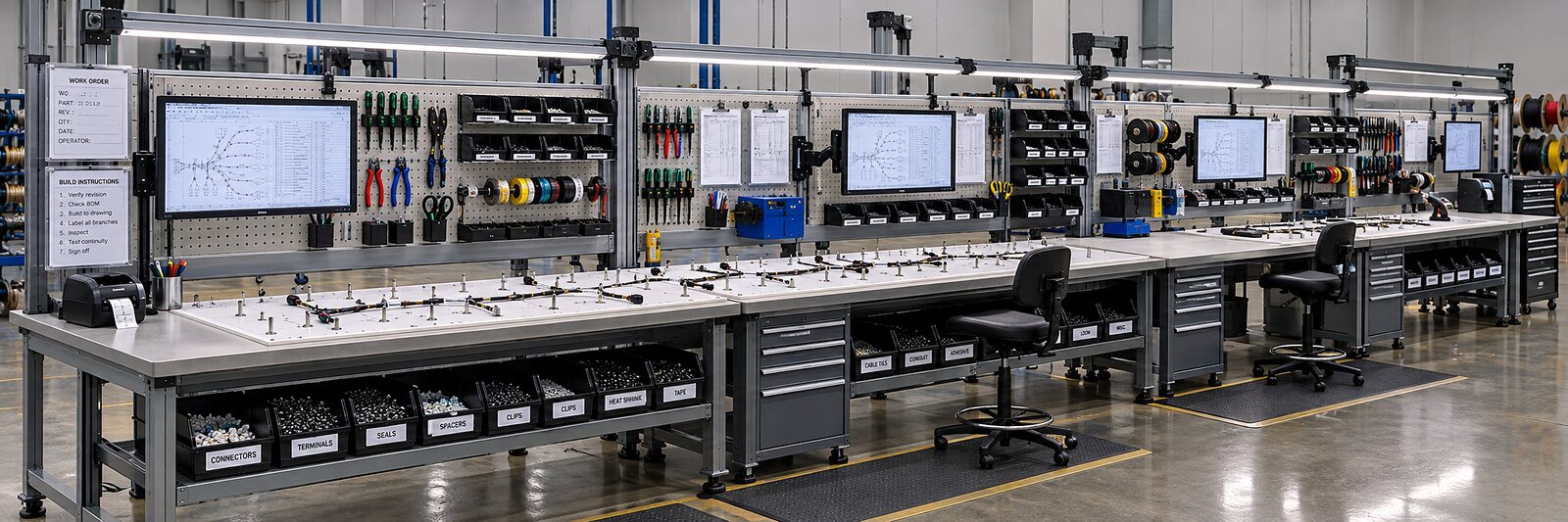
Nothing is fabricated until the drawing is signed. You issue the set. We take it off: every conductor, every termination, every length as drawn, every connector by part and by pin. Where the set is silent we write the question down and send it back, and the answer goes into the signed revision, not into somebody's memory. When the revision is signed the takeoff becomes a cut list, a termination schedule and a material order, and the formboard is laid out from the drawing at full size.
A value nobody measured never reaches a wire. A length comes off the drawing, or off a walk of the machine. A crimp comes off the tool the terminal maker specified for that terminal, and the tool is checked before the run. A torque comes off the connector's own data. None of them come from what worked last time.
Every finished assembly is tested before it leaves. A continuity test asks whether every pin lands where the drawing says. An isolation test asks whether two circuits that must never meet are in fact separate. A pull test on a sample crimp asks whether the joint is a joint. What each test proved is written on the assembly's record with the drawing revision it was built to, so that a harness on a machine can be traced back to the sheet, the batch and the hands that built it. The method is laid out on how it is built, and what travels with the harness is on the record.
What we will not do
- We will not cut to an unsigned drawing, however sure everyone is about what it will say.
- We will not put a safety circuit in a bundle, a splice or a shell with power to save a connector or a day.
- We will not fill a gap in your set with a guess and call it a build.
- We will not take design authority we have not been given, and we will not keep the manufacturing detail from the programme that owns the design.
- We will not state a test value for a class of assembly; a value is set on your assembly by the engineer responsible for it, against your specification, or it is not stated.
Where to go next
Each line has its own page: UAV, autonomy, training systems and industrial plant and remote site packages. The seam walks the argument through segregation, shielding and bonding, connectors, routing and test and acceptance. How to engage says what to send and what comes back, and contact is where to send it. Bring the drawing. If it is not signed yet, bring it anyway and we will tell you what it still needs. We will not cut to it until it is.