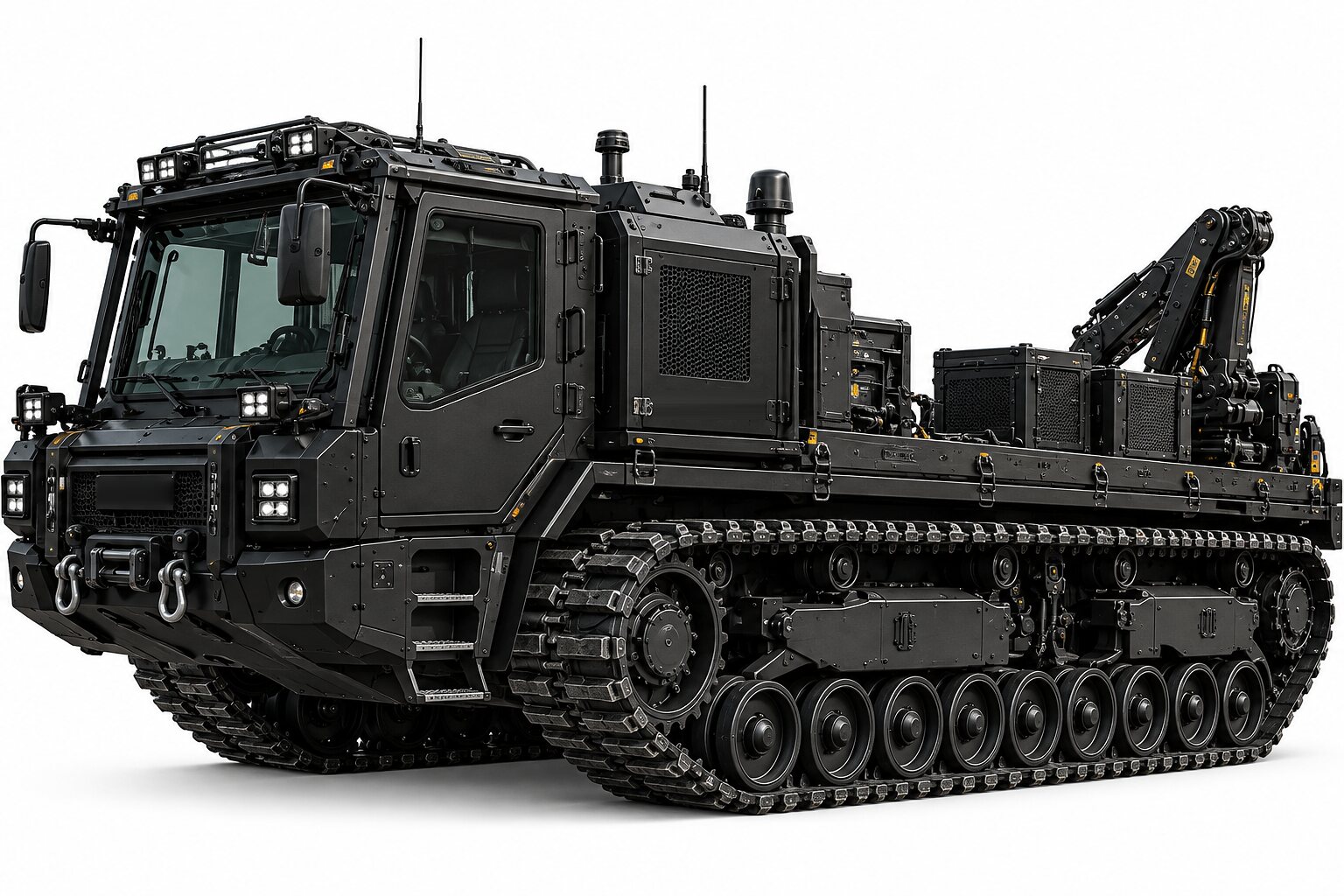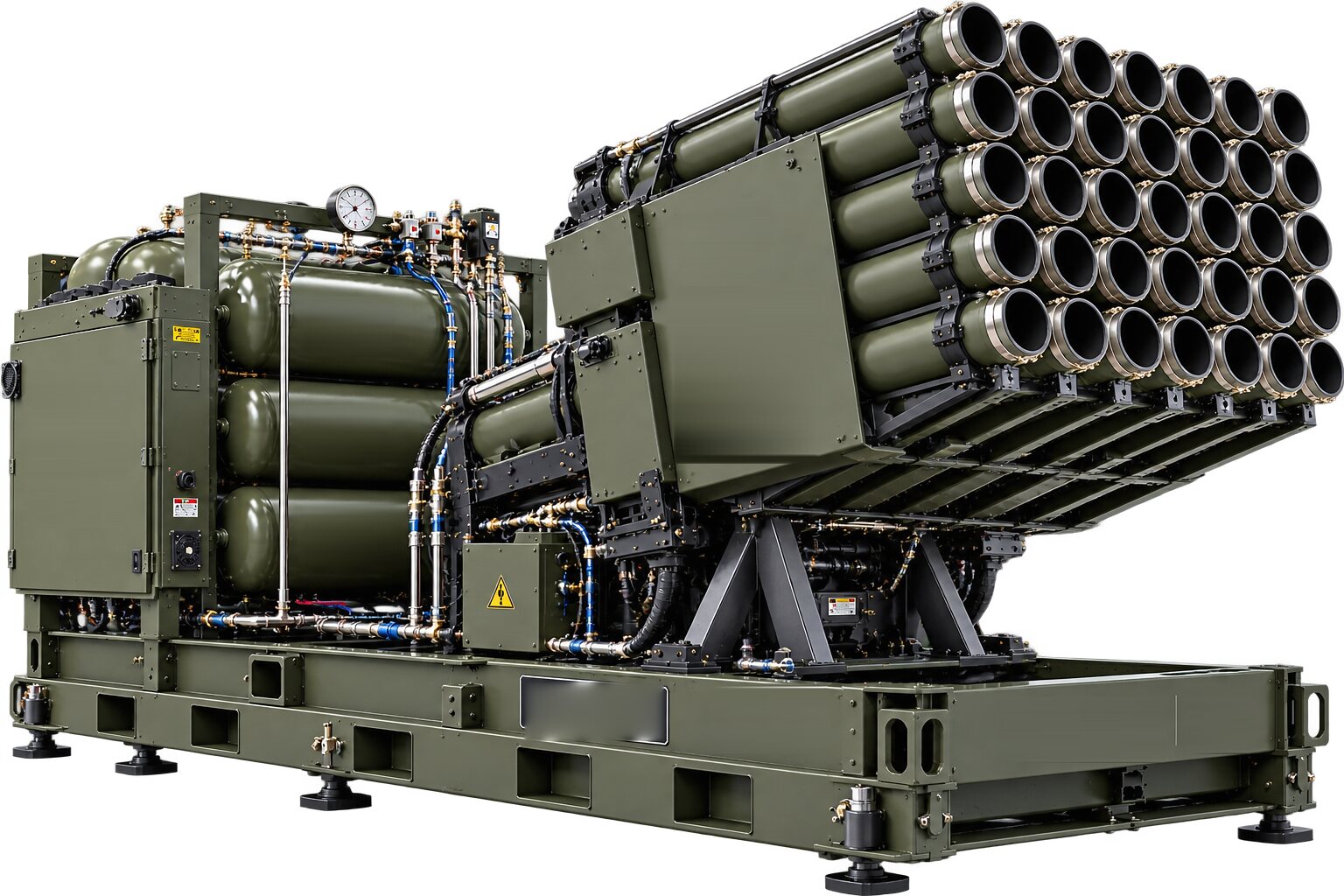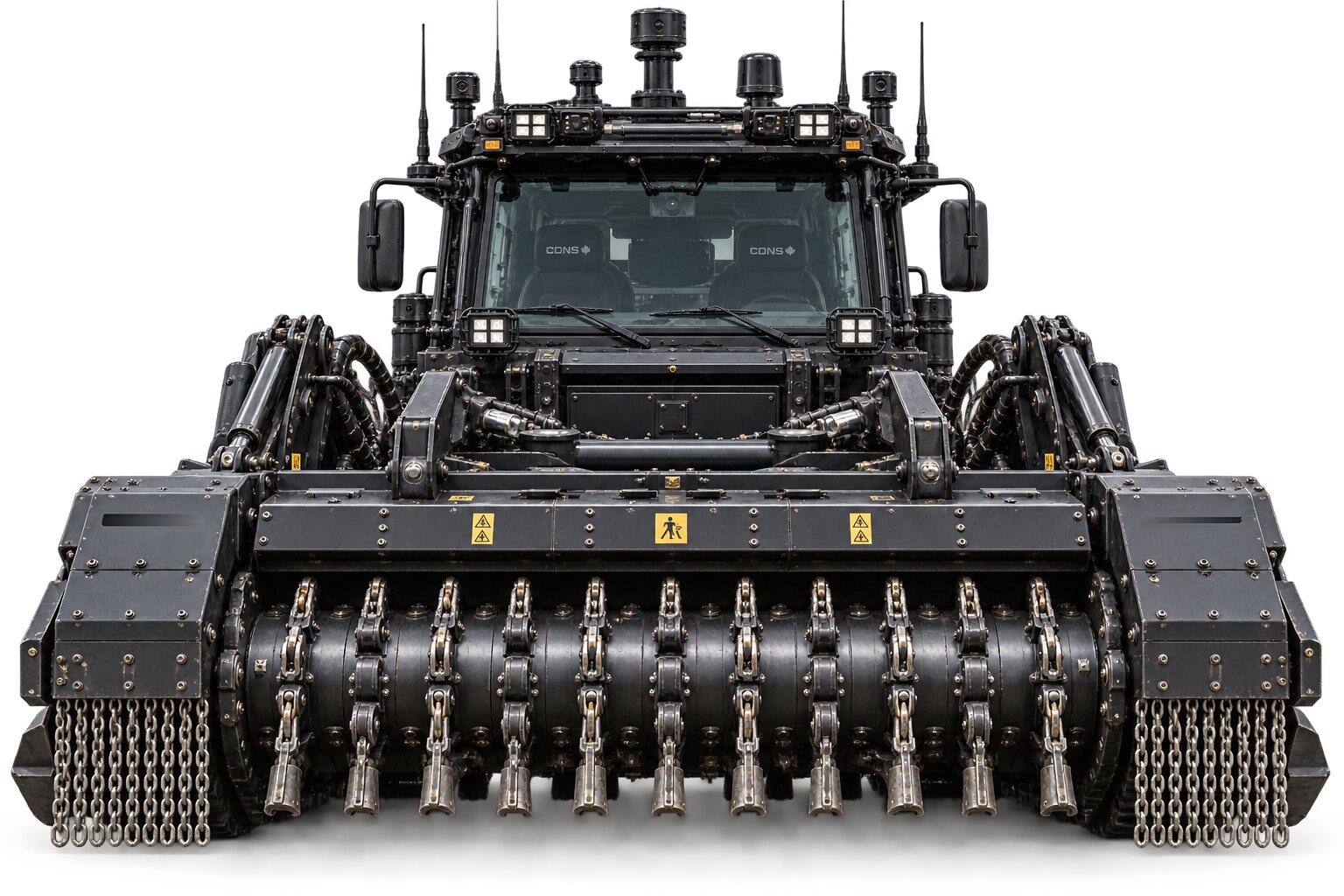
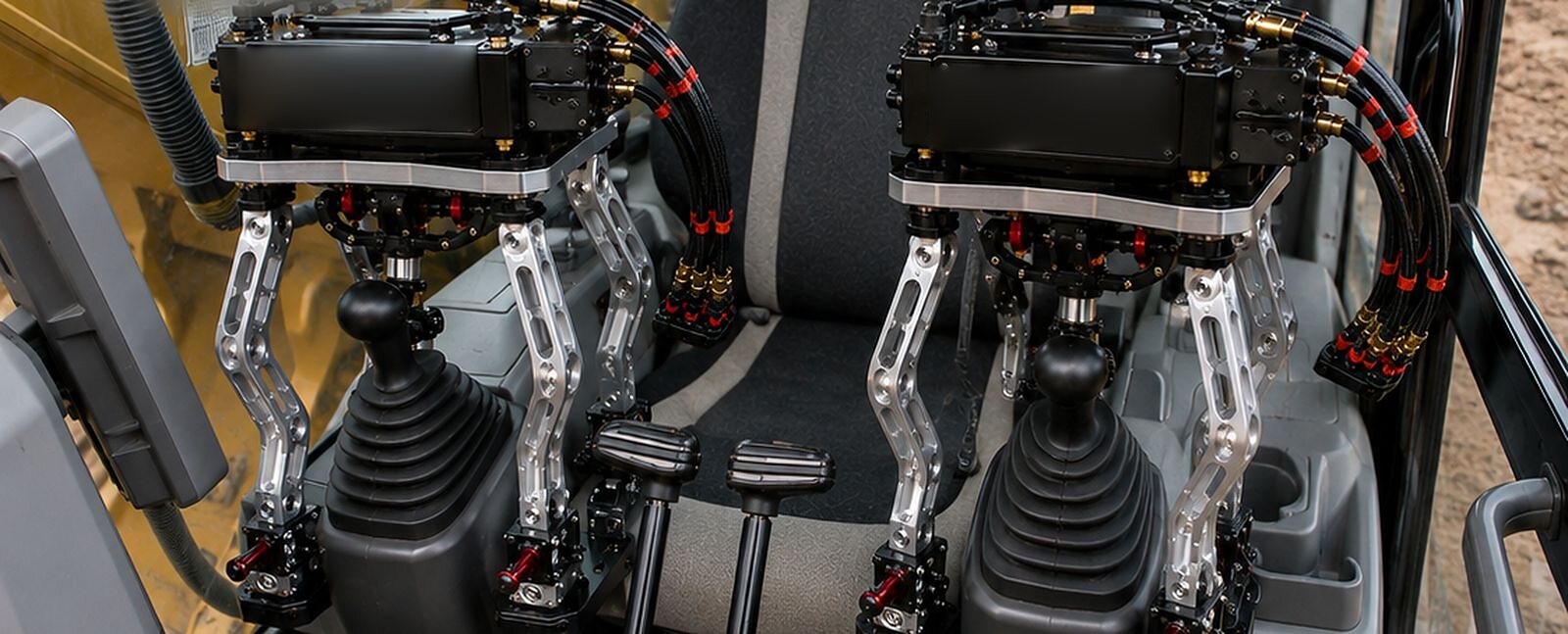
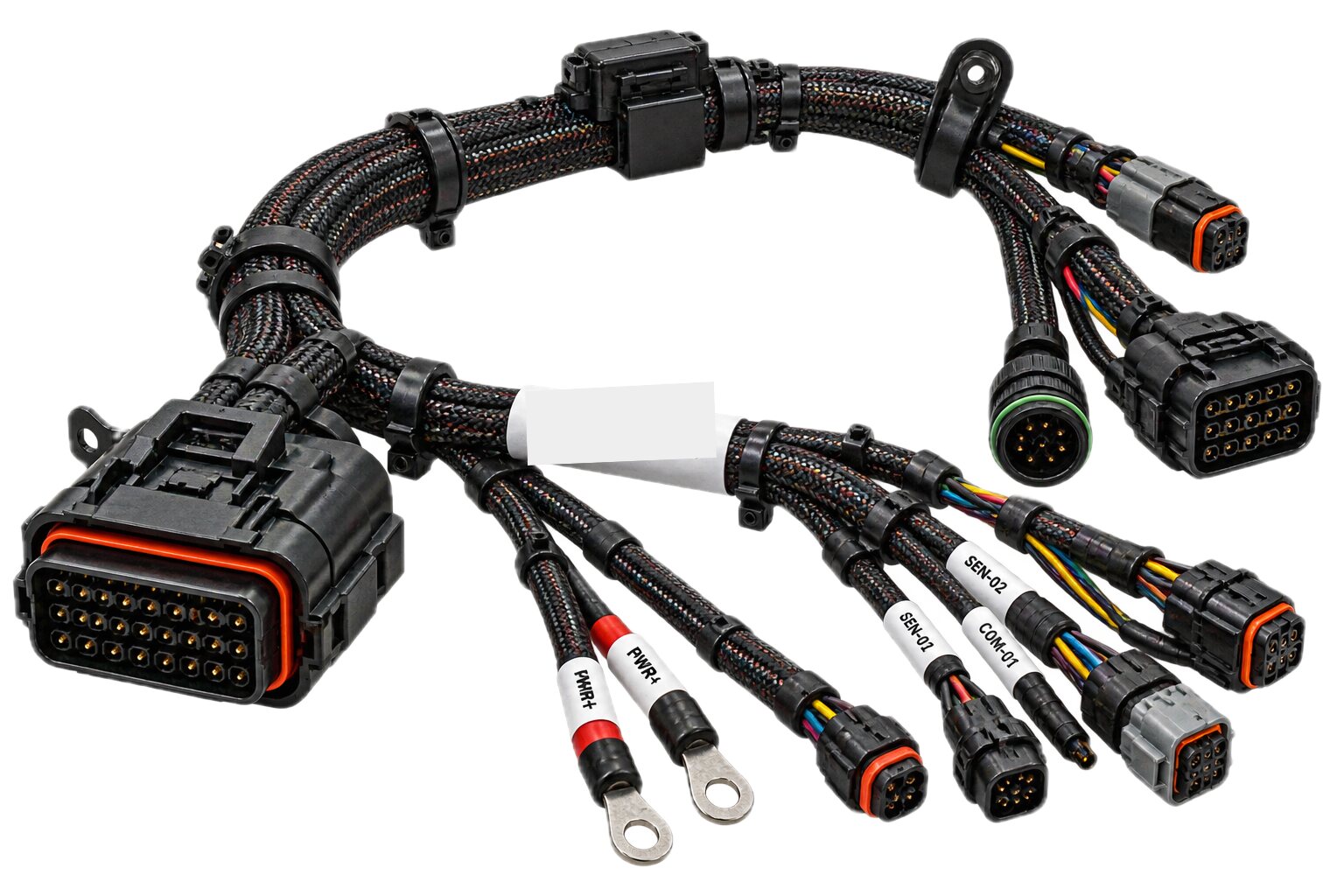
Every harness this shop builds serves a seam. On one side is a thing that decides: a flight controller, an autonomy computer, a logger, a plant controller. On the other is a thing that acts or is acted on: a payload, a lever, a hand on a control, a pump on a skid. Between them runs one physical bundle carrying a power feed, a data path and a safety circuit, and the bundle has to keep those three apart while it carries them together. That is the seam. The four lines below are four seams, and one discipline builds all of them.
What the four share is what they are made of, so it is stated once. Every conductor is cut to a signed cut list and marked with its circuit identity at both ends and along its length. Safety circuits never share a bundle, a splice or a shell with power. Shields are terminated at the end, or the ends, the drawing names and nowhere else, because where a shield is grounded is decided by what it has to stop, and a shield grounded at an end the drawing meant to float carries current nobody designed. Every branch length, breakout and clamp point is fixed on a formboard made from the drawing, so the loom fits the machine because the board fits the drawing. And a value nobody measured never reaches a wire. A dimension that is not on the drawing is not on the harness.
Those facts are the same on every line. What changes from line to line is the seam each one serves, and what that seam is not allowed to do.
UAV: the payload-to-carrier seam
A payload is built by one team and a carrier by another, and they meet at a connector face agreed before either was finished. The seam carries a power feed that runs the payload, a data bus that commands it and brings back what it sees, a safety-interlock set that says whether it may be armed, and a ground and a bond. The ground is the reference the rest are read against. The bond is the path a fault current takes. The failure of this seam is never dramatic on the bench. It is a data link that drops frames on climb-out, or an interlock that reads closed when it is not, and it presents in the air.
The harness is made of a power pair, feed and return run together so the loop they make is small, protected at the carrier end where the energy comes from. The data bus runs on a shielded twisted pair, and the shield runs unbroken to the backshell at the end the design names. The interlock is a hardwired loop of contacts in its own jacket, and it goes into its own shell. Signal return and chassis bond are two conductors doing two jobs: the return carries the circuit's current back, and the bond gives a fault or a static charge somewhere to go that is not through the data pair. They meet at one designated point and nowhere else. The ground contact is the long one in the arrangement, so it makes first and breaks last every time a person mates the payload.
What is engineered as one set is the mating face and everything behind it. The insert arrangement is laid out so that no interlock contact sits beside a power contact. The keying is chosen so the power plug cannot be forced onto the signal receptacle in the dark with gloves on. Strain relief, backshell, shield termination and boot are chosen as one stack for the cable that enters them. The stack is set out on connectors.
The shop delivers both sides of the seam: the carrier-side whip and the payload-side lead, built to the same interface specification, each with its own test record showing that every circuit goes where the drawing says and that the circuits that must never meet do not.
The shop refuses to put the interlock in a shell with power. It refuses to change where a shield is grounded without the drawing changing first. It refuses to build a payload side to an interface specification the carrier side has not signed. And it refuses to give a spare contact a job the specification does not name. The UAV line carries the seam in full.
Autonomy: the retrofit loom behind a removable operator
An autonomy retrofit puts actuators on the controls of a machine that was built for a person, and it has to let the person come back. The seat is still there. The levers still move. The retrofit loom sits beside the machine's own wiring without becoming part of it. That is the seam: a kit that bolts on, plugs in and comes off, on a machine that was never drawn with it in mind.
The loom carries four things and keeps them apart. Power distribution runs from the machine's supply to a protected distribution point and out to each actuator and each controller on its own protected branch. Actuator motor leads and actuator feedback are two bundles, not one: a motor drive puts fast edges on its leads, a position sensor puts a small signal on its own, and the second does not survive in a bundle with the first. Network and fieldbus run on their specified pair, terminated where the design says and nowhere else. The emergency-stop and safety-interlock chain is a hardwired series loop through every stop control and through the switch that says whether the operator has taken the machine back. It is monitored by a safety relay, not by the autonomy computer, and when it opens it removes power from the actuators. It runs in its own bundle through its own connectors, and it is proven before power is applied, not after.
The loom is built to survive the machine: sealed connectors at every boundary, abrasion sleeving at every edge the drawing marks, clamp points that follow the machine's own hinge lines so that a lever at full travel does not tension a wire, and a drip loop at every enclosure entry.
What is engineered as one set is the safety chain and the power it interrupts. The chain is designed with the distribution it controls, so that opening it drops the actuators and not the logic that has to report the stop. One circuit, one drawing, and the loom is its physical form.
The design belongs to the machine programme. We build to a customer's issued set and we return the manufacturing detail: the cut list, the formboard drawing, the termination tables and the test records, so the design owner holds the full shop pack. The shop delivers the loom in its branches, the actuator whips, the distribution enclosure pre-terminated, and the kit of clamps and hardware the drawing calls for.
The shop refuses to route the emergency-stop chain through a programmable device. It refuses to put the safety chain and the actuator power in one bundle. It refuses to cut into the machine's own harness where the drawing says plug in. And it refuses to add a conductor the drawing does not show, however useful that conductor would be. The autonomy line carries the loom in full.
Safety circuits never share a bundle, a splice or a shell with power.
Training systems: the instrumentation loom inside a capture rig
A capture rig measures a person working a machine: where the levers are, how hard the pedal is pressed, when the hand moves and in what order. The loom inside the rig is an instrument, and the rule for an instrument is older than any of this. It must not change the thing it measures. So the loom adds no force to any control, draws no power from the machine, and shares no conductor with it. A continuity check from the rig to the host harness returns nothing, and an isolation test proves the two are separate.
The loom is made of sensing lines, each on a shielded pair, each running to one logger. The logger keeps one clock, and every channel is stamped by that clock, so every movement is placed against every other in time. The logger and every sensor draw from one battery that belongs to the rig. There is one ground reference, and it is at the logger. Dressing is part of the design: a loom with slack in the wrong place loads a lever, and a lever that a loom is pulling on produces a data set about the loom.
What is engineered as one set is the loom, the logger, the clock and the battery: one instrument with one reference, which is what lets the rig move from one machine to another and mean the same thing on both.
The failure to design against is the shared reference. Take power from the machine and every time its starter turns, the logger's ground moves. Share a return with it and the machine's own currents appear in the measurement as a person's hand. Software cannot remove that afterward, because it cannot tell which part of the signal was the person.
As with the autonomy line, the design belongs to the machine programme. We build to a customer's issued set and we return the manufacturing detail. The shop delivers the loom with its identity on every line, the logger end pre-terminated, the battery lead, the mounting kit, and a test record that shows every channel where it should be and, separately, that the rig and the host machine are electrical strangers.
The shop refuses to power a rig from the machine it is measuring. It refuses to tap a host signal because the machine already has one. It refuses to tie a rig loom to a host harness. And it refuses a sensor mount that pushes on the control it is watching. The training-systems line carries the rig in full.
Industrial plant: pre-wired plant for ground that has no labour
A remote site is a place where the electrician is a plane ride away. The seam is between a shop with every tool at hand and a site with none. So the package leaves complete: skid and modular assemblies with their enclosures mounted, glanded, terminated and labelled; remote-site power and control packages with the interconnect already made; pre-terminated enclosures and interconnect that land as a plug, not as a spool and a stripper.
The package is made of enclosures with terminal strips laid out to a schedule, so that the door drawing and the marker on the conductor say the same thing. Interconnect harnesses with connectors at both ends. Power and control in separate raceways on the skid. Cable glands sized to their cable, because a gland that does not grip its cable is a gland that lets water in.
What is engineered as one set is the enclosure, the interconnect and the field devices they serve. The interconnect is cut to the skid's own drawing, the terminals are numbered to the schedule the interconnect is marked to, and each field device is plugged or pre-wired to a junction box with its own identity. Landing it is then plugging and bolting, done with the drawing in hand.
Any electrical assembly built for a Canadian site has to satisfy CSA certification and the Canadian Electrical Code. The components we specify carry their own certification. The approval route for a finished, project-specific assembly is confirmed with the certifying body for that assembly before it is built, and we tell you where yours sits before we build it, not after. CSA and the Code sets out how that route is confirmed.
The shop delivers the package crated or skid-mounted, its interconnect coiled and capped, its terminal schedule and test record in the door, and a kit list checked against the crate. It refuses to ship an assembly whose approval route is not confirmed. And it refuses to leave a termination for the field that the shop could have made. The industrial plant and remote site line carries the packages in full.
How a harness is bought
You send the drawing set or the interface specification. We do the takeoff and come back with a shop pack: a wire list, a cut list, a formboard drawing, a termination table for every connector, a kit list and a test plan written against your specification. Where the drawing set is silent on a dimension, the shop pack says so, and the question comes back to you rather than being answered on the bench. Nothing is fabricated until the drawing is signed.
The signed pack is what the harness is built to and tested against. The test record on each assembly states what was checked and what the result was; the values it was checked to are set by the engineer responsible for that assembly, against that assembly's own specification, and they are stated on that record and nowhere else. The record sets out what travels with a harness, and how to engage sets out the sequence from first enquiry to signed pack.
What we do not sell is a harness to a description. A sketch, a photograph of the old one, a conversation and a promise to sort out the rest on the bench are not a drawing set, and we will not cut wire against them. We will tell you what a set has to contain before it can be built from, and we will list what yours is missing. Then we build to the set.