You own a seam. Somewhere in your machine, your rig or your plant, one physical bundle carries a safety circuit, a power feed and a data bus side by side, and they must never touch. Somewhere on that bundle there is a connector that a person will make and break, in the rain, with gloves on, more times than anyone counted. That seam is decided in software and built in copper. Once it ships, software cannot reach it. A fault in the firmware gets a patch pushed overnight. A fault in the loom gets a truck, a technician, a machine held still, and an intermittent that may not show itself while anyone is watching.
That is the part of an autonomous system most often designed last, by whoever has time, and it is the part we build. You bring the set. We perform the takeoff, draw the assembly, walk the machine or the pad, build to the signed drawing, test every finished assembly, and return the manufacturing detail to your master. We do not own your design and we do not want to. Five kinds of reader arrive at that seam from different directions, and each gets its own answer to the same three questions: what you bring, what you get back, and what we refuse to do for you.
If you build uncrewed systems
The seam you own is the one between the payload and the carrier. Power feed, data bus, safety-interlock set, ground and bond all cross it, and the temptation on every programme is to treat them as four parts that happen to share a shell. They are one assembly. The interlock has to open before the power feed can do harm. The data bus has to hold its integrity beside a feed that is switching. The ground and the bond have to give every shield the path home the drawing chose for it, because a shield left to find its own is a loop, and a shield with no path at all is an antenna. Get one wrong and the fault presents on the flight line, on the day a payload from one supplier meets a carrier from another.
What you bring is an issued interface specification at its stated revision. It says what the carrier promises the payload and what the payload promises the carrier: which contacts carry power, which carry data, which carry the interlock, which pin is bond and which is signal return, what the mated pair has to survive, and who handles it. If your specification does not answer one of those questions, we list the question rather than guess the answer. You also bring the connector on each side of the seam, or the specification that fixes it.
What you get back is a matched set. Power, data, interlock, ground and bond are engineered together, routed as one bundle with the safety set segregated from power inside it, terminated to your contact assignment, and every conductor labelled with its circuit identity from one end to the other. Each finished assembly leaves with its own test record: continuity to the assignment, isolation between the circuits that must never meet, and the bond path checked. Your shop drawing comes back to you with the manufacturing detail on it.
What we refuse to do for you is build one side of the seam without knowing the other. A payload harness built without the carrier's assignment in hand is a guess with a connector on it. We will not invent the carrier side, we will not pick a pinout from a photograph, and we will not state a test value for a class of assembly; the value is set on your assembly by the engineer responsible for it, against your specification, or it is not set. The line page is the UAV line; the seam itself is on the seam and connectors.
If you are putting autonomy onto a working machine
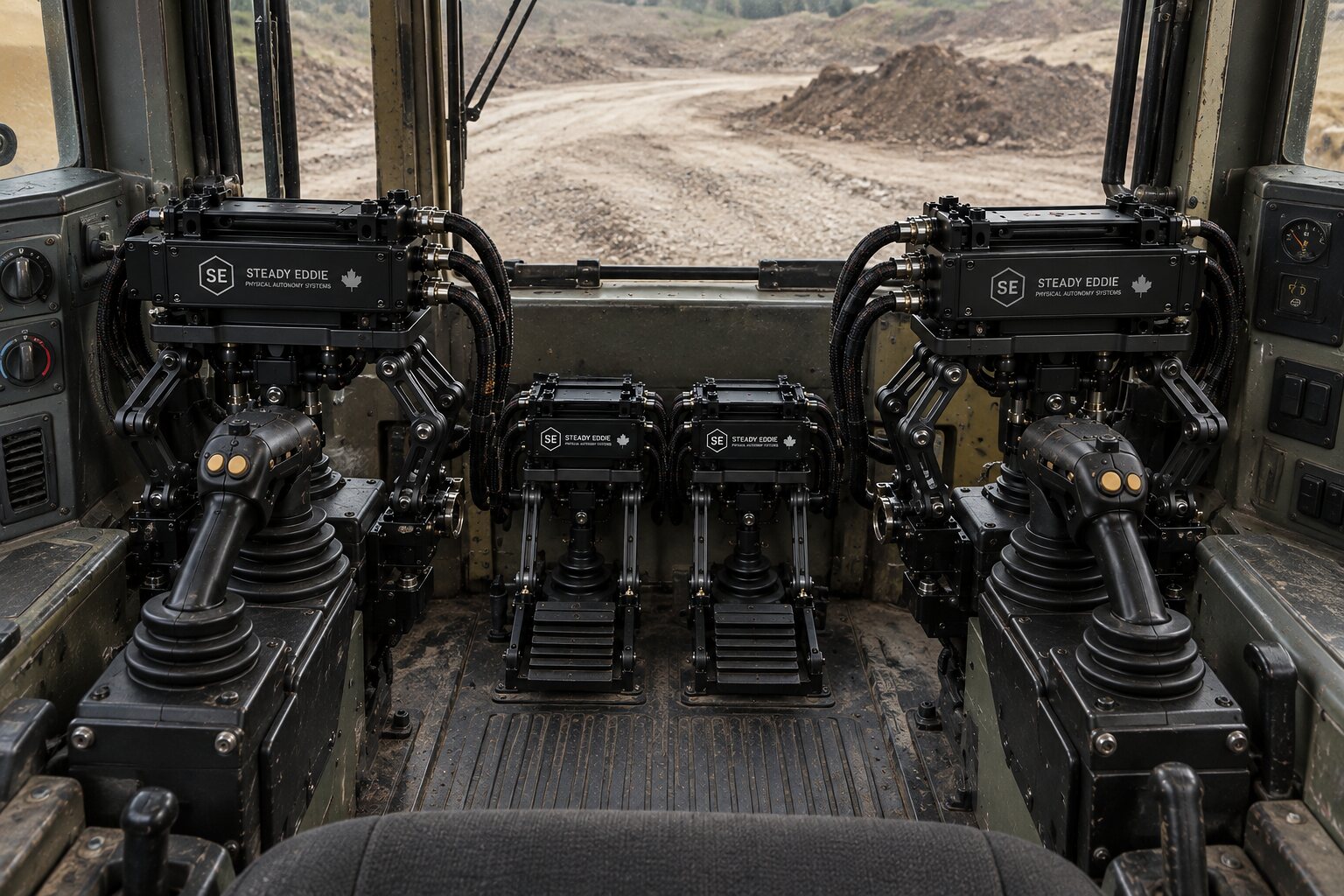
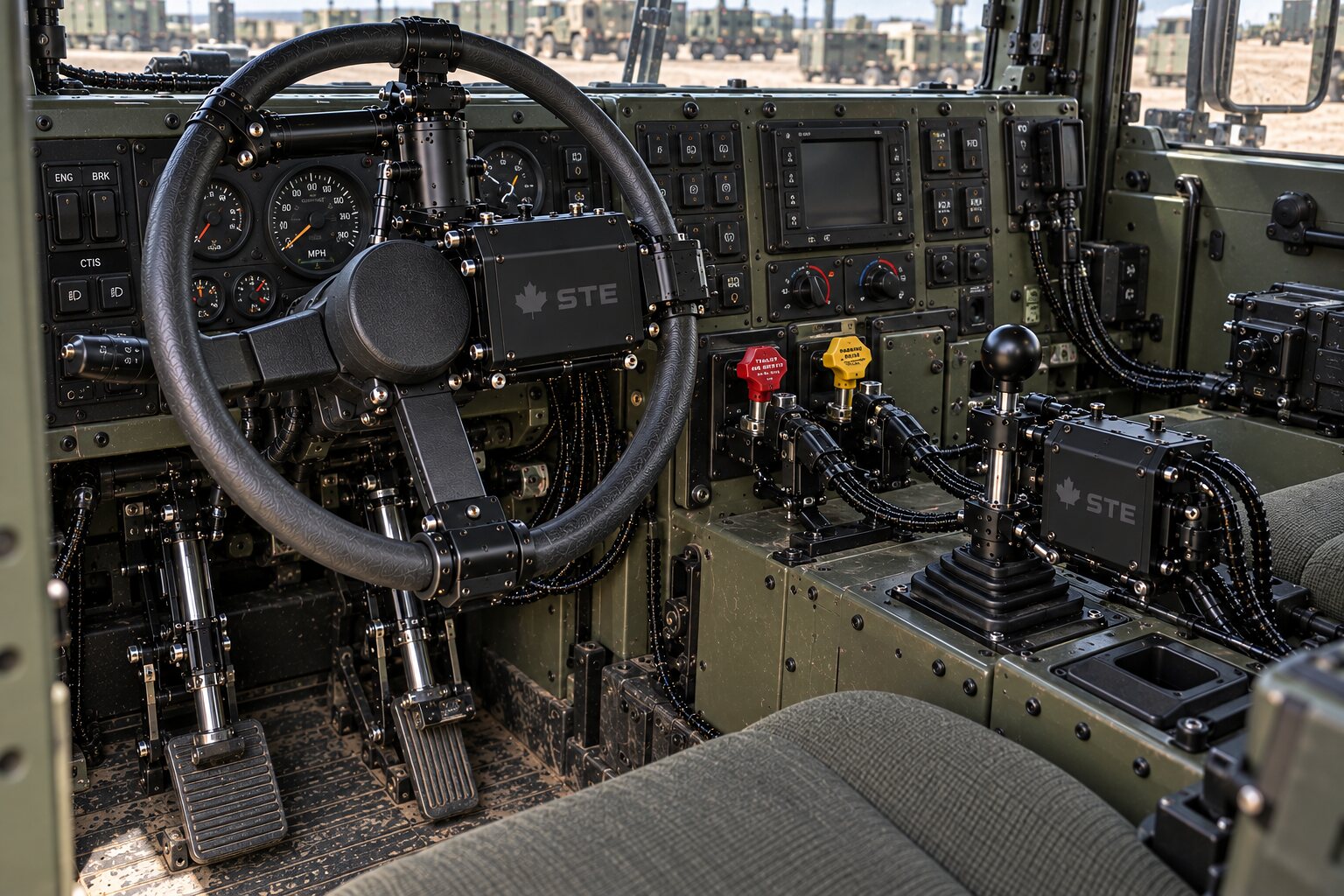
The seam you own sits behind a removable operator. A person still climbs into the cab, and everything that person can touch has to keep working when your kit is in and when it is out. Behind the seat there is a loom that did not exist when the machine was built: power distribution for your kit, actuator motor and feedback lines, network and fieldbus, and an emergency-stop and safety-interlock chain that has to fail in the one direction that stops the machine. Safety circuits never share a bundle, a splice or a shell with power. When someone routes an interlock through a connector that also carries a motor feed because it saved a shell, the failure arrives as an intermittent, on a machine that is now moving with nobody in it.
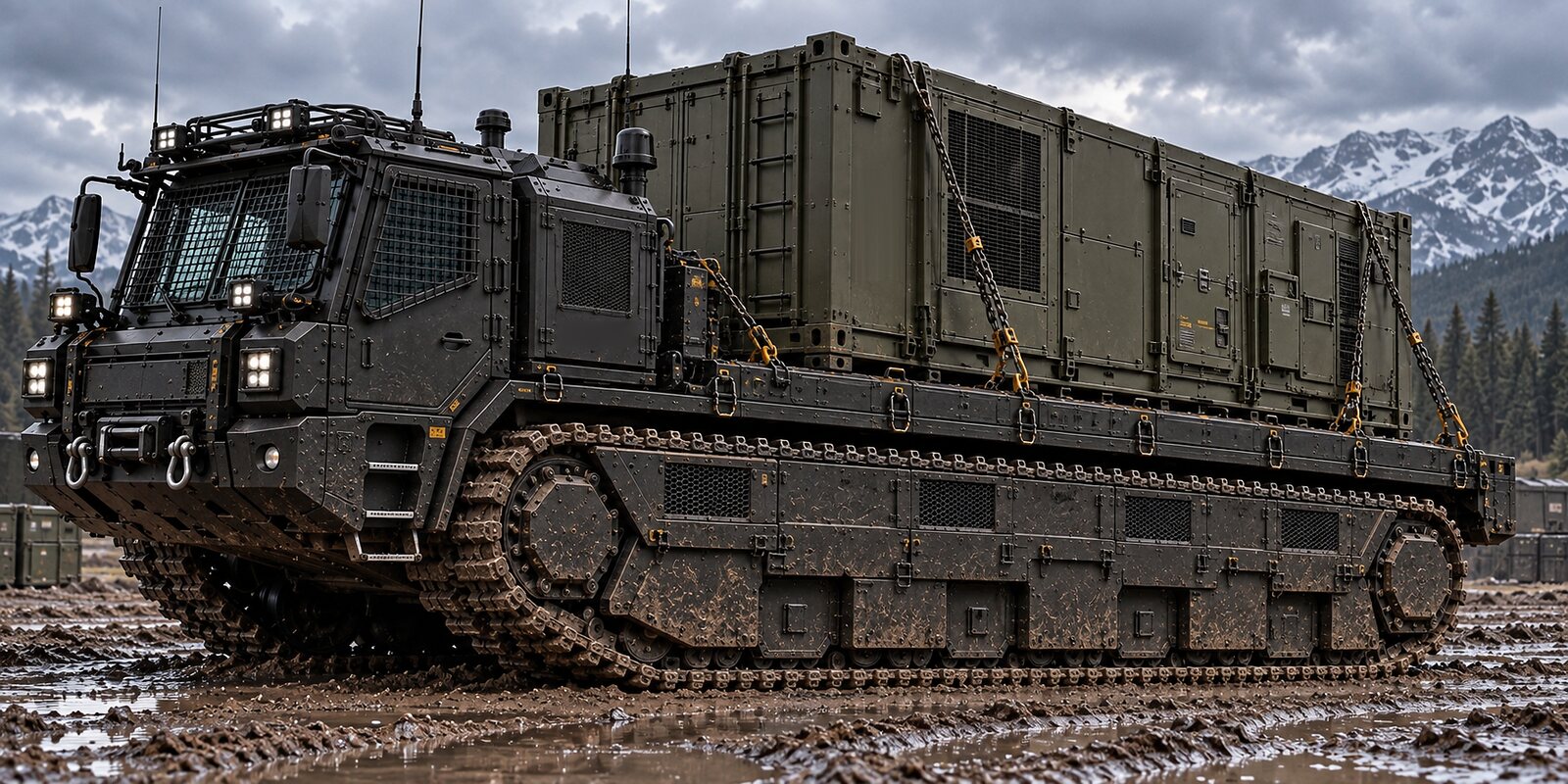
What you bring is the machine programme's issued drawing set at its stated revision, a machine we can walk, and a clear line between what the operator touches and what your kit touches. The design is yours, or it belongs to the programme you are building for. Either way, the drawing master stays where it is.
What you get back is the retrofit loom built to that set, with the full shop pack returned to whoever holds the master: takeoff, shop drawing, formboard, cut list and the test record for each assembly. We build to your issued set and we return the manufacturing detail. We keep no private copy and we claim no authority over your design.
What we refuse to do for you is design the machine. We will not decide where your emergency stop breaks the chain, we will not choose your actuator, and we will not route your safety circuit in a bundle with power to make it fit. We will not cut a conductor before you have signed the shop drawing. The line page is the autonomy line, and the rule that governs the loom is on segregation.
Nothing is fabricated until the drawing is signed.
If you build training systems
The seam you own is between the rig and the machine it measures. A capture rig that instruments a person working a machine has one job: to see what the person does without changing it. The instrumentation loom inside it has to add no force to any control, draw no power from the machine, and share no conductor with it. A continuity check from the rig to the host harness must return nothing, and an isolation test must prove the two are separate. An instrument that touches the machine has changed the thing it was measuring, and every record it takes after that is a record of the rig, not of the operator.
What you bring is the sensing plan: what is measured, where each sensor mounts, which logger it reports to, what the clock is, and what the battery is. You bring the host machine for a walk, because a sensor mount that is right on paper is wrong on the lever it has to sit beside. You bring the rule, in writing, that the rig may not touch the host.
What you get back is the loom that keeps that rule: sensing lines to one logger, on one clock, from one battery, wired to nothing on the host. Every conductor carries its identity so that a channel can be traced to a sensor without pulling the loom apart. Every finished assembly leaves with a record that the continuity check to the host side returned nothing.
What we refuse to do for you is borrow from the machine. We will not tap the machine's battery to save you a cell, we will not share a ground with the host because the bond point is convenient, and we will not pass a sensing line through a host connector because it is already there. Each of those is a loom that touches the machine, and each of them turns your measurement into a measurement of itself. The line page is training systems, and the grounding argument is on shielding and bonding.
If you are a prime or an OEM
You hold the drawing master and you are looking for a harness house that will treat it that way. What you need is a shop that builds to your set, returns the detail, holds no private copy and claims no design authority. That is what this shop is.
What you bring is an issued set with a revision discipline behind it, a person who can sign a shop drawing, and the approval route for the finished assembly, or the question of what it should be. The components we specify carry their own certification. The approval route for a finished, project-specific assembly is confirmed with the certifying body for that assembly before it is built, and we tell you where yours sits before we build it, not after.
What you get back is the shop pack in your numbering. The takeoff, the shop drawing, the formboard, the cut list and the test record for each assembly are all produced against your set and owed back to your master. Every conductor is labelled to your circuit identity. Every substitution, if there has to be one, goes through your change process before it reaches a wire, not after.
What we refuse to do for you is become the owner of anything that is yours. We will not claim design authority, we will not keep a private copy of your drawing master, we will not carry a dimension or a value from your programme onto anyone else's, and we will not publish a word about your programme. What returns to you is described on the record, labelling and traceability and formboards and manufacture.
If you are an electrical contractor or a plant owner
The seam you own is between the drawing and the ground. The plant is designed, the set is issued, and the site is somewhere the labour is not: a remote pad, a compound with no bunkhouse, a plant where every hour of licensed time is already spoken for. Whatever can be built in a shop and landed complete is an hour that does not have to be found on site. That is what pre-wired plant is for: skid and modular assemblies, remote-site power and control packages, pre-terminated enclosures and interconnect, shipped complete and landed plug-and-play.
What you bring is the issued set, where the assembly will be installed and what it has to survive there, the enclosures and the interconnect route, and the trade split on controls. On many building services sets the low-voltage controls belong to the mechanical trade and the line-voltage controls to electrical, and we do not assume which side of that line your job is on. The controls scope is agreed in writing before we quote, so that nobody discovers at landing that the package stops one enclosure short.
What you get back is a package built to the issued set, with its approval route confirmed with the certifying body before it is built rather than after. Every whip and every conductor is labelled to the drawing, so the crew on the ground lands it by the label rather than by tracing it. There is no loose spool on site to cut, to strip or to lose.
What we refuse to do for you is price a sketch. We will not quote low-voltage controls without the scope agreement, we will not build ahead of the signed drawing, and we will not ship a kit whose lengths came from a description rather than from a walk, a survey or an issued set. The line page is industrial plant and remote site packages, and the position on the Code is stated in full on CSA and the Code.
Who we are not for
If you want a length guessed, we are not your shop. A length comes from a walk on the machine or the pad, or from a dimension on an issued set that somebody owns. It does not come from a description. A length nobody measured is a harness that is either too short to land or long enough to chafe, and the second is worse, because it works on the day it ships.
If you want a value invented, we are not your shop. A test voltage nobody set, a current rating nobody calculated, a torque nobody specified: each is a figure with no source, and a value nobody measured never reaches a wire here. We will ask you for the value, or for the engineer who owns it, and we will wait.
One assembly is a job we take. The board and the first article are the same work whether the run is one or many, and we say what that costs before you decide.
If you want a seam nobody owns, we are not your shop. When the payload side says the carrier will sort it out and the carrier side says the payload will, the seam has no owner, and a harness built across it is built on a guess about two other people's intentions. We will ask who owns the seam. If the answer is nobody, we stop there, and we tell you why. If the answer is you, the process starts with one message and the set attached to it, and it is set out step by step on how to engage. We do not skip a step of it for anyone, and we do not start it without the set.