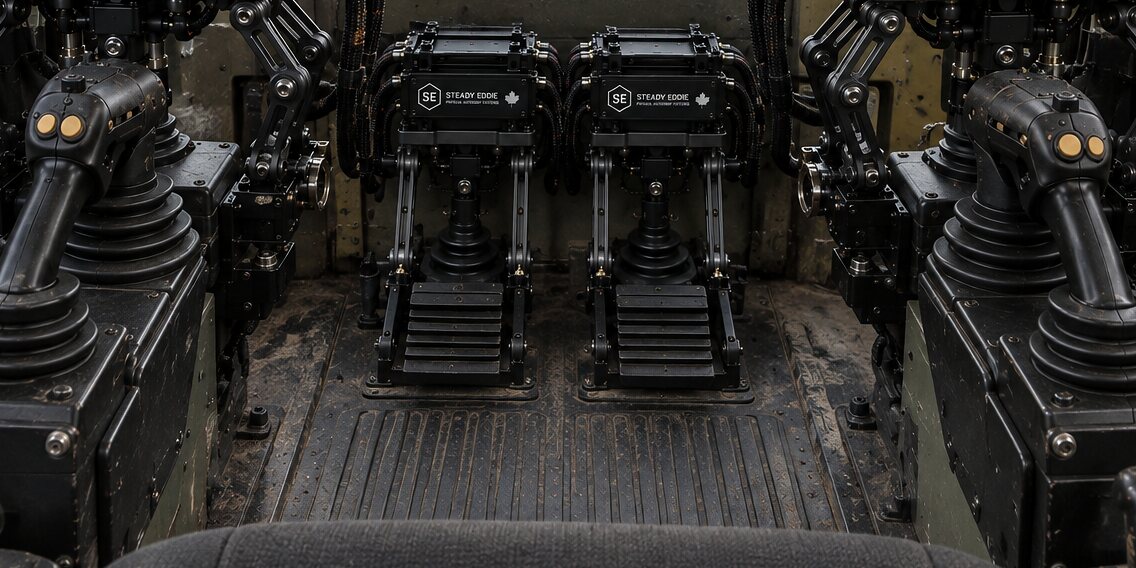
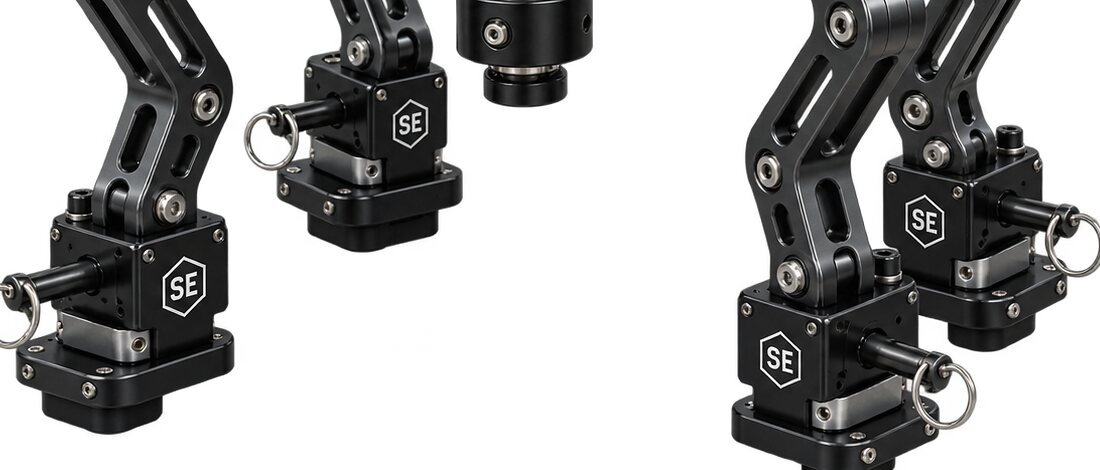
A host machine is designed around a person. The retrofit removes that person, puts actuators on the controls the person used to work, reads the sensors the machine already carries, and threads an emergency-stop and safety-interlock chain through the whole so the machine stops whether the fault is in the kit or in the host. Every one of those functions rides on a loom, and the looms are not separate jobs. They are one kit.
Each loom has its own brief: the power distribution loom, the actuator motor and feedback loom, the network and fieldbus loom and the emergency-stop and safety chain. This brief is about the set: one shop, one signed master, one walk of the machine, and a kit that lands in one go.
The mechanism
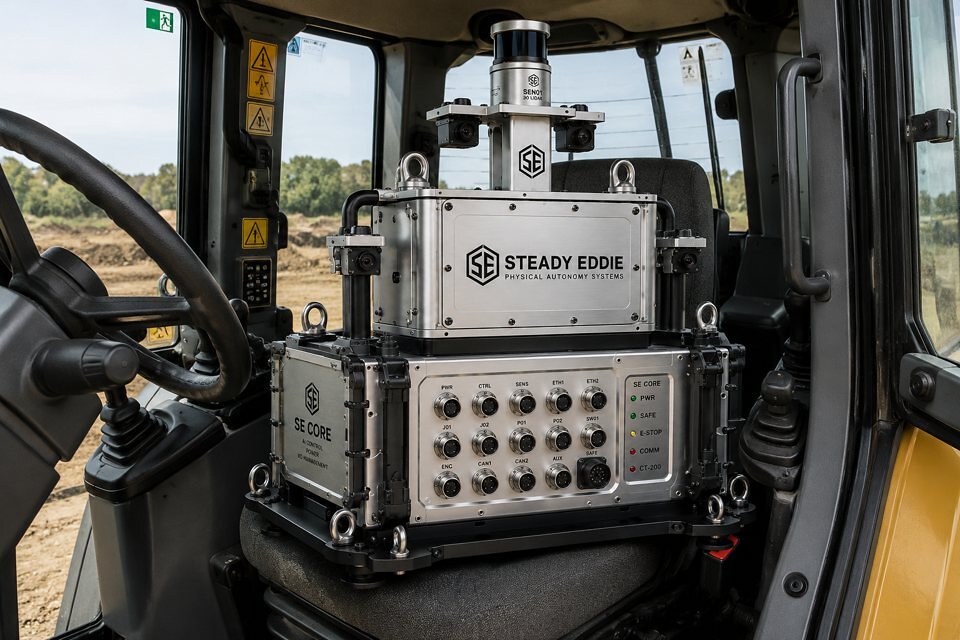
Physically, the set is a star with a loop threaded through it. At the centre is the kit's enclosure, mounted where the programme's drawing puts it. The power distribution loom runs from there to the host's feed and out to each of the kit's modules, carrying protection with it so every branch is fused at its source. The actuator loom runs to each actuator that now sits on a control, drive out and position feedback back. The network loom runs node to node and to the host's own controller network at the point the drawing defines. The safety chain is the loop. It passes through every stop station and every interlock in series and returns, so that any one of them opening breaks the whole.
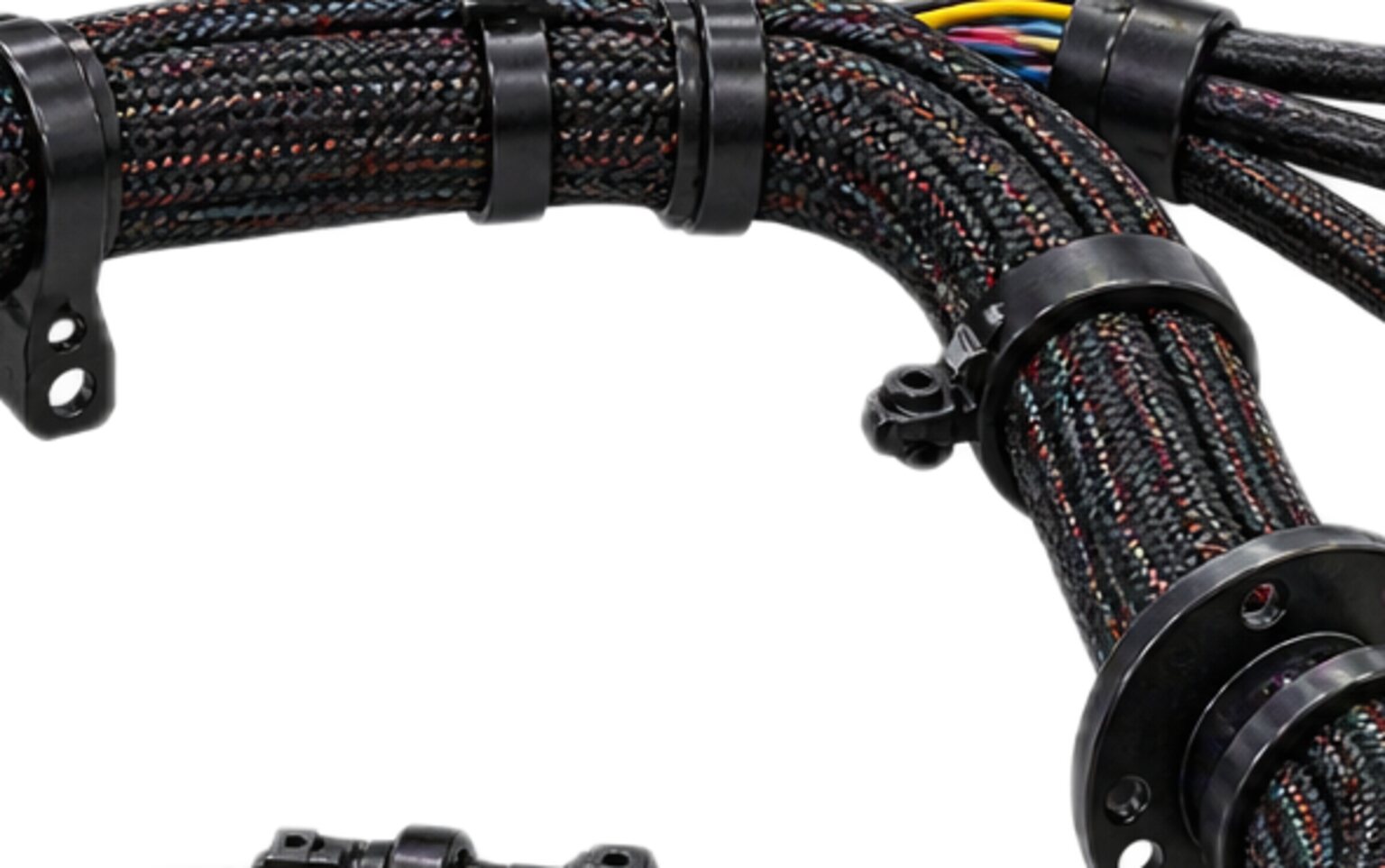
Those looms share a route because a machine has only so many ways through it: one path from the cab floor to the frame, one along a boom, one gap across the articulation. Every loom uses the same path. No loom shares a bundle. Each has its own sheath, clamps and tie points, and where they lie side by side their spacing is fixed by the drawing. Where power and signal must cross, they cross at a right angle and keep going.
Safety circuits never share a bundle, a splice or a shell with power. On a retrofit that is the rule that decides whether a stop button is a stop button or a suggestion.
At the host, the kit ends in shells. Each point where the kit meets the machine is a connector pair, defined by the programme's interface specification and keyed so a kit-side plug fits only the socket it belongs to. Every one of those pairs is a seam. Where the kit reads one of the machine's own sensors, it reads through an in-line pair that sits between the machine's existing plug and socket. The host's harness is unplugged, not cut. Take the kit off and the machine's harness plugs back into itself. The operator is removable, and so is everything the retrofit adds.
That star, with its bundles on shared paths to shells at the host and the loop that visits every place a person might need to stop the machine from, is the autonomy line, built.
What it is engineered to
The interface between kit and host is a set of promises, and the machine programme writes them down. The host promises a feed with its own protection ahead of the kit, sensors that speak in known signals at known shells, controls that move through a known travel under a known effort, a stop path the safety chain can open, and a frame the kit can bond to. The kit promises to draw from that feed only through its own protection, never to back-feed the host, to read the sensors through an input high enough in impedance that the host still sees what it saw, to drive its own actuators and never the host's harness, and to open the host's stop path and drop its own drive enable in one action from any stop station. Every conductor in the set exists because one side promised something to the other.
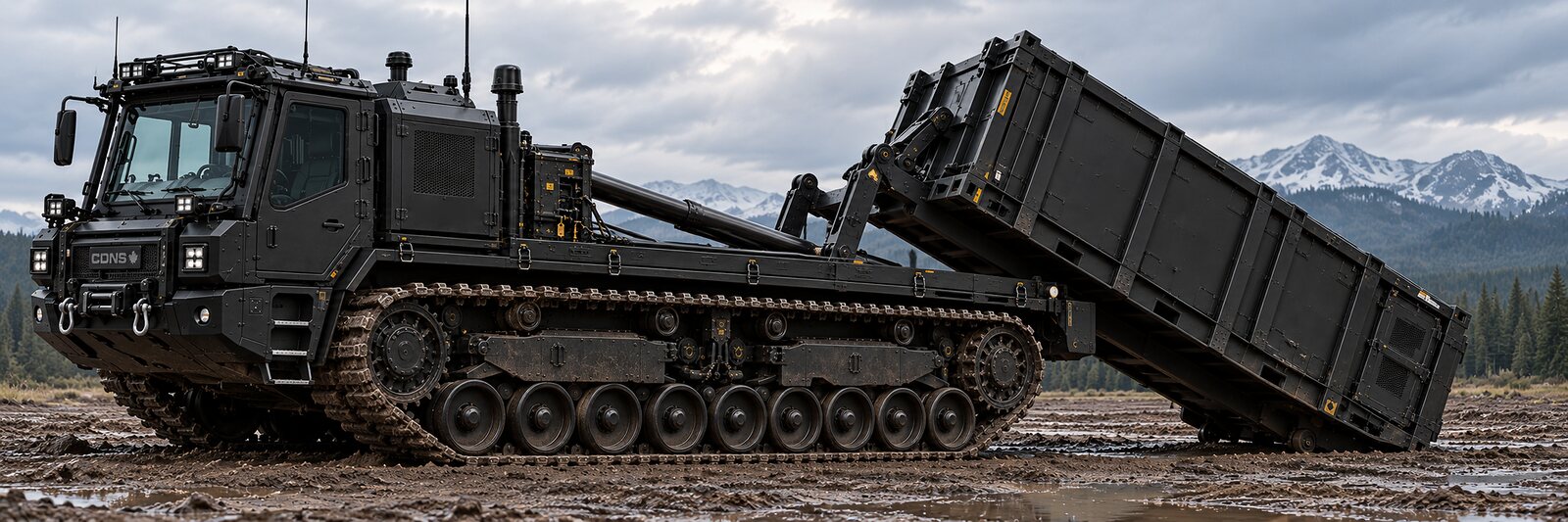
A set on a working machine has to survive the machine. Engine, ground and implement all shake the frame, in a rhythm nobody designed. A cab sits on isolators, so cab and frame move against each other, and every loom that crosses between them carries that motion in a length made to flex, not at a termination. An articulated frame folds at a joint, and a loom that crosses it gets a service loop and a clamp on each side so the flex lives between the clamps. Hydraulic oil finds its way onto everything. The machine is washed with a pressure lance. None of that is a measurement. All of it is a build fact with a consequence in the drawing: a sheath chosen for oil, a shell sealed because it lives outside the cab, a clamp spacing set so the bundle cannot chafe on an edge that moves.
When one side of the interface changes, the set changes with it. A new sensor at the host is a new shell, a new pin table entry and a new label. That change belongs in the programme's drawing master first, and the shop pack is rebuilt to the new master. A change that arrives on the bench as a note on a print never reaches a wire, because a note on a print is a value nobody measured. That is what keeps a machine's second kit matching its first.
Safety circuits never share a bundle, a splice or a shell with power.
The discipline applied to this harness
Segregation on a set is about what lies next to what along a shared path. The safety chain has its own bundle from the enclosure to the last stop station and back, and never enters a splice or a shell with a power conductor. The network loom's shielded pairs run as their own bundle and never lie parallel with actuator drive inside a sheath, because a fieldbus that picks up drive noise reports errors that look like a failing node. Shielding and bonding is decided once, for the whole set. Every shield is grounded at the end the drawing says and nowhere else. A shield grounded at both ends where the drawing grounded one is a loop, and a loop on a machine whose frame carries starter current is an antenna the kit did not order. The enclosure is bonded to the frame through a stud cleaned to bare metal, not through a painted bracket. The host's own bonding is not assumed. It is checked on the walk.
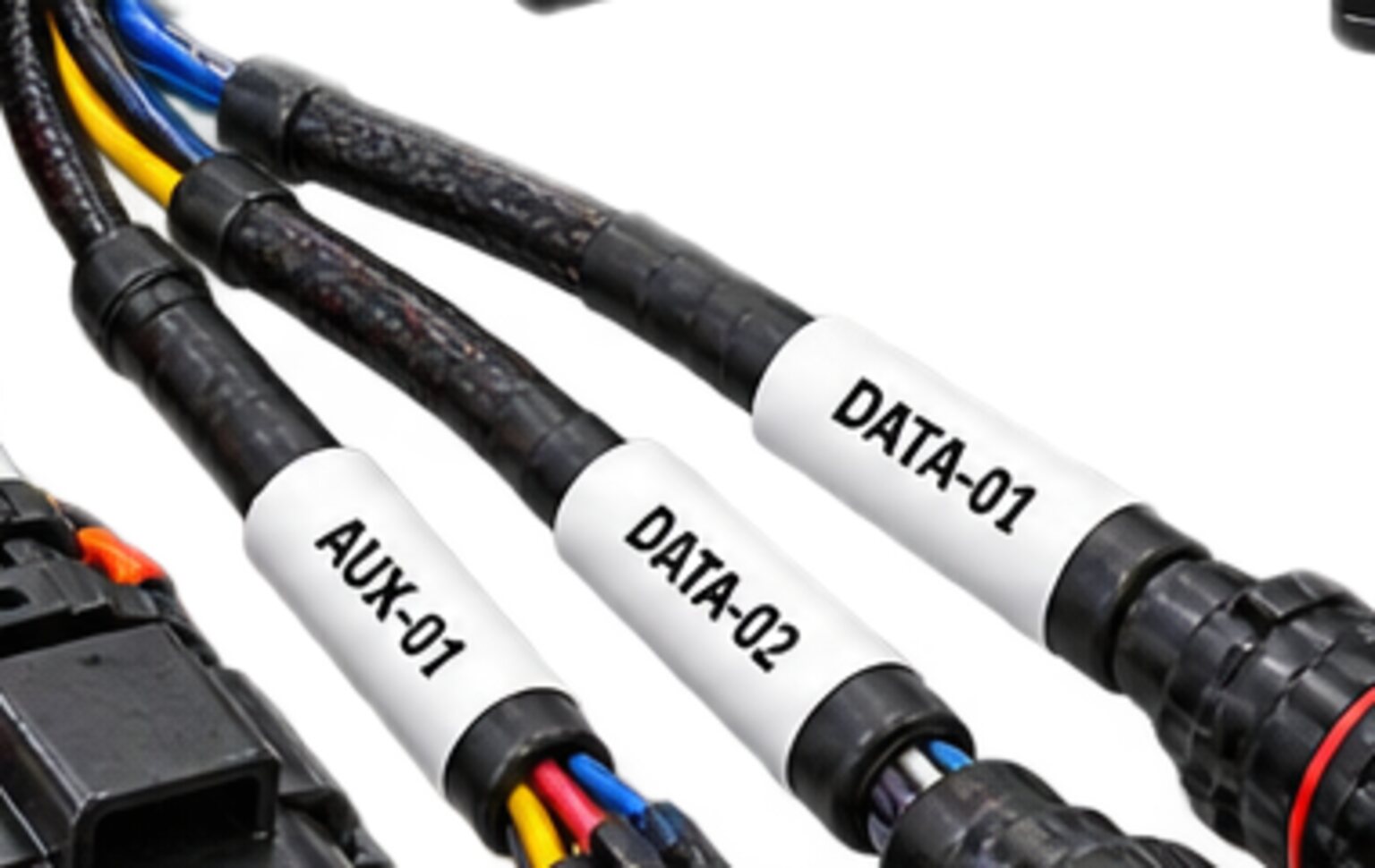
Connectors on a set are one family wherever the drawing allows it, so a fitter carries one tool, one crimp die and one set of spares. Every shell is keyed to its mate, sealed where it lives outside the cab, and strain-relieved on the loom so a pull on the bundle lands on a clamp and not on a crimp. Routing is fixed by the walk, not by the drawing alone. Labelling is where the doctrine becomes literal: every conductor carries its circuit identity, end to end, and the identity comes from the programme's master, so a wire in our shop reads the same as the programme's pin table. Test on a set proves the set. Every finished loom gets a continuity check and an isolation check, which asks whether circuits that must never meet are in fact separate. The safety chain is proven open and closed before power is applied to anything. Then the looms are mated on the bench as the kit, against the pin tables, so the first time the power loom meets the actuator loom is on a formboard and not on a machine.
That last point is why the set is one job. A drawing set has places in it that can be read two ways. A pin table that lists a shield and does not say where it grounds. A length given from the enclosure wall and read from the shell face. Give the looms of one set to two shops and each resolves every reading its own way, correctly. The power loom arrives with its shield grounded at the enclosure. The network loom arrives with its shield grounded at the node. The stop-station lamp returns on the pin the other shop gave to the interlock. Nothing is wrong on either bench. Everything is wrong on the machine, in a yard, with a crew standing round it. A tunnel driven from both ends meets in the middle only when both crews work from one survey. Two surveys, each right to itself, meet with a step in the floor. One shop building every loom to one signed master reads every pin table with one pair of eyes, finds the reading that can go two ways, and sends one query back to the programme before anything is cut.
How it is bought
A full machine set is bought to the machine programme's issued set. The programme owns the design and the drawing master. We build to what it issues and we return the manufacturing detail. Nothing below changes that.
The work begins with the takeoff. From the issued set we count every conductor, shell, contact, sheath and clamp the set needs, and from that comes the material list and the price. Then comes the shop drawing: the issued set translated into what the bench will make, each loom laid flat, each branch and breakout, each shell with its pin table. You sign it. Nothing is fabricated until the drawing is signed. A signed shop drawing is the only point at which the programme's intent and our reading of it are provably the same document.
Between the takeoff and the shop drawing there is the walk. Someone from this shop goes to the machine with the takeoff and walks every route the set will take, from the enclosure to every shell. Every length is fixed on the machine, not read off a general arrangement. Every place the drawing shows a straight run and the machine shows a hose bracket is found. A length nobody walked is a value nobody measured, and a value nobody measured never reaches a wire.
The formboard is built from the walked drawing and proven on the first article. The first loom off each board is checked against the pin table and the walked lengths, then mated to its neighbours as the kit, and only then is the run built. Every assembly that leaves carries its own record: the continuity result, the isolation result, the safety-chain result, the crimp lot, the label set, the person and the date. That is the record made specific to one loom on one machine.
An assembly built for sale or installation in Canada answers to CSA and the Canadian Electrical Code. The components we specify carry their own certification. The approval route for a finished, project-specific assembly is confirmed with the certifying body for that assembly before it is built, and we tell you where yours sits before we build it, not after.
Then the shop pack goes back. A full shop pack is the cut lists, the formboards as drawings, the pin tables as built, the label schedules and the test records for every assembly in the set. It goes into the programme's drawing master, because the programme owns the design, and a drawing master that does not carry what was actually built is not the master of anything. With the pack in the master, the programme can have the next set built by us or by anyone, to the same detail, and can trace a field fault to a conductor, a crimp lot and a person. Without it, the design authority is split between a drawing in one place and the built article in another.
The set ships as one kit, labelled to land in one go, with the formboards it was built on held for the next run. The rest of how it is built applies to every loom in it.
- What this shop does not do is as fixed as what it does.
- We do not build to a marked-up print.
- We do not cut a length nobody walked.
- We do not ship one loom of a set before the set has been mated on the bench.
- We do not keep a private master.
- We keep each assembly's record under its own identity, for as long as you tell us the assembly can be in service, and we take no design authority from it.
- If your programme has an issued set, or an interface specification it is building one from, start there.
- Send the set.
- We answer with what the takeoff needs, and with what the walk has to see before a length is cut; the shop drawing comes back for your signature after the walk.