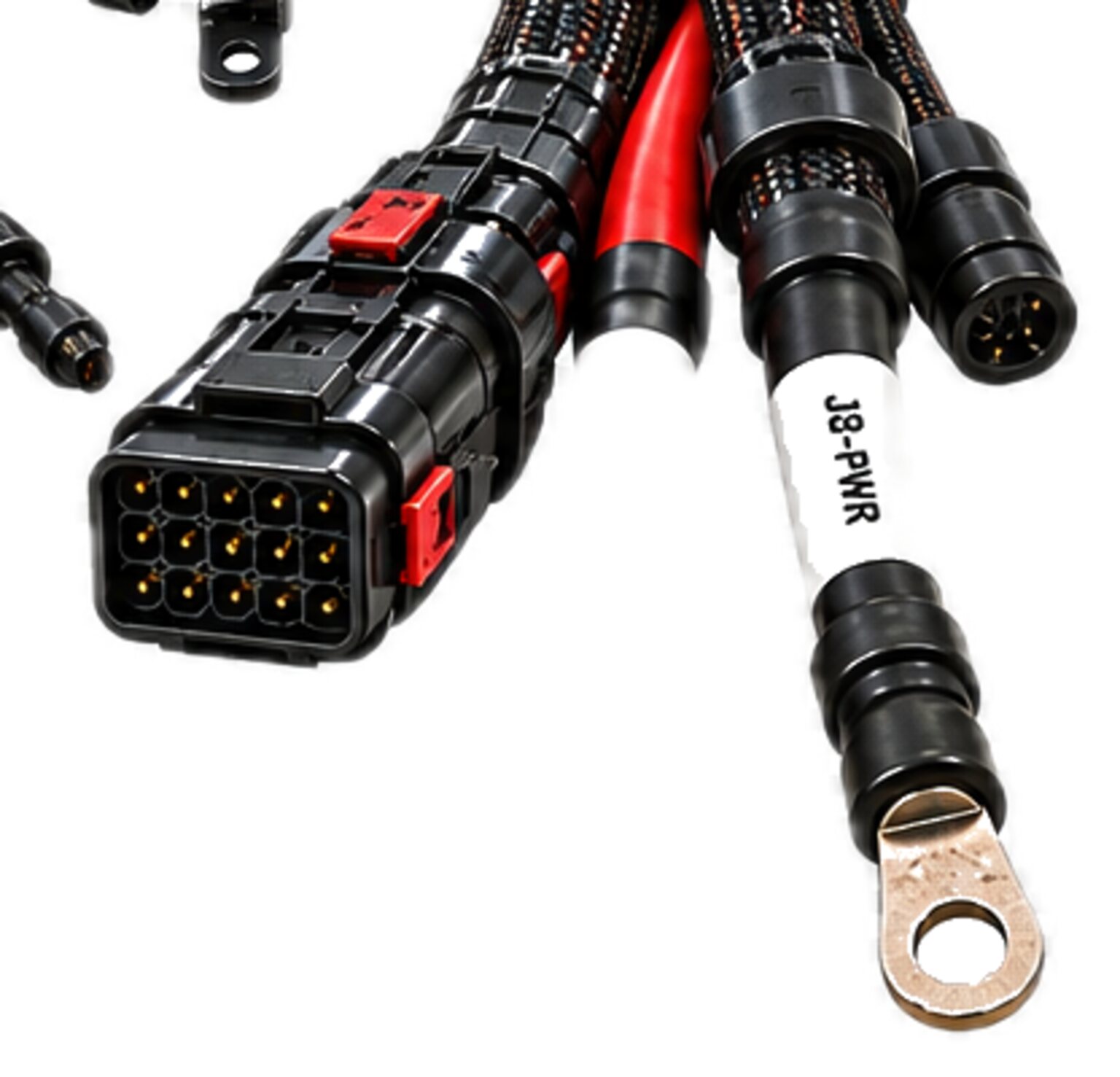
A host machine was built with a load budget: an alternator, a battery, a master disconnect and a fuse block sized for the loads its builder fitted, with one operator in the seat. An autonomy kit is a second consumer that machine was never told about. It arrives with a controller, actuator drives, a network switch, radios, sensor heads and a monitored stop chain, all wanting power from a system with no spare terminal marked for them. The machine power distribution harness takes that power once, from the right point, protects it there, and delivers it to every kit consumer on its own conductors, so that the host sees one new load and the kit sees one supply.
Tapped off the nearest fuse, returned through the chassis and run down the same conduit as the stop chain, a kit works on the bench and on its first day. This harness is built for every day after that.
The mechanism
The harness has a trunk, a distribution point and branches, and that is its whole topology. The trunk is a feed and a return, run as a pair, from the take-off point on the host to a protected distribution block inside the kit's enclosure. Every branch leaves that block through its own fuse or breaker, and every branch is again a feed and a return, run as a pair, to one consumer. One trunk, one distribution point, one branch per consumer. No consumer is fed from another's terminals, and no branch feeds two things.
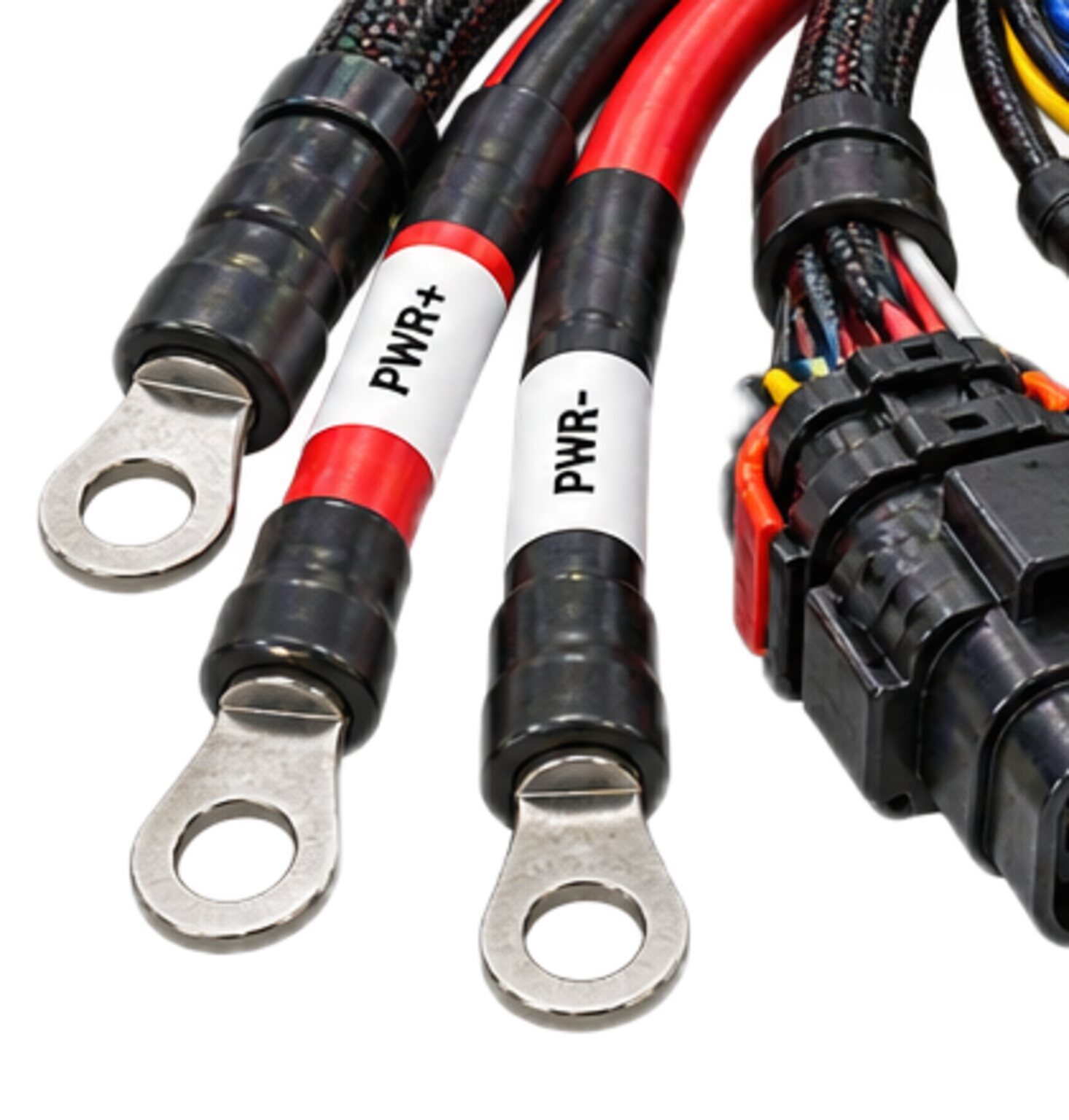
The take-off point is the load side of the host's master disconnect, or, where the programme's issued set directs it, the battery terminal with the kit's own disconnect beside it. Either way it is at the source. The trunk's protection sits within reach of that terminal, so that the conductor between the source and its first fuse is as short as the machine allows; that length is the one piece of the harness that nothing protects but its own insulation. The take-off lands as its own lug, on top of the stack, so it comes off without disturbing the host's lugs beneath it.
The return is the part that gets left out. The kit's returns run with their feeds, branch by branch, back to the distribution block, and the trunk return runs back to the terminal the trunk feed took off from. The kit does not return its current through the machine's chassis. The chassis is bonded to the enclosure by a separate conductor whose only job is to hold the enclosure at the machine's reference; it is not a return path and carries no load current in normal service.
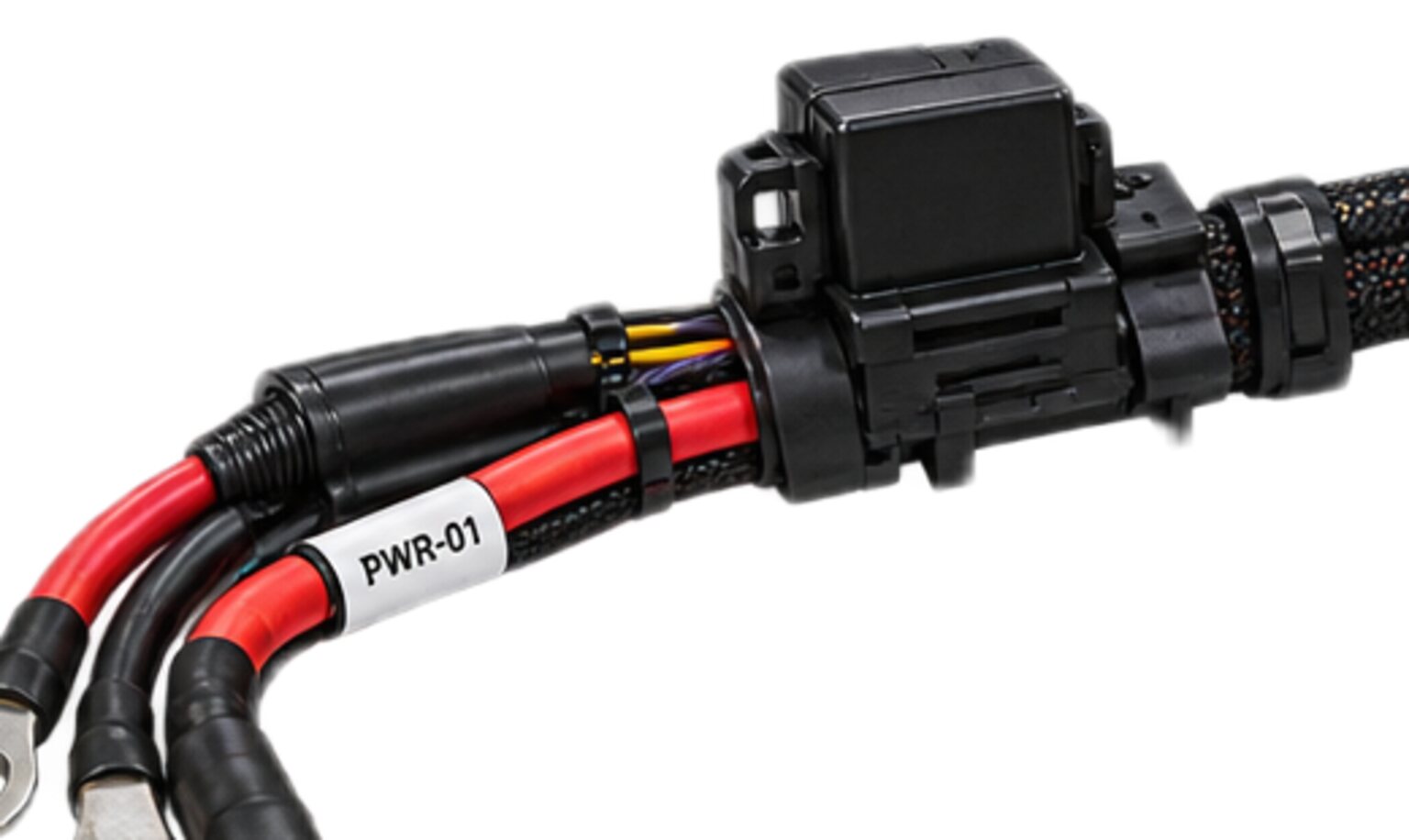
The shells are sealed and keyed. At the enclosure bulkhead the trunk enters on one connector and each branch leaves on its own, from a shell family chosen so that a power plug cannot enter a signal socket and one consumer's branch cannot be mated to another's socket. Contacts are matched to the conductor they crimp onto and crimped with the tool the contact's maker specifies. A branch to a consumer on a moving part of the machine crosses the joint on flex-rated cable, anchored either side, and the drawing states the free length.
The bundle is its own bundle. The power loom is tied, clamped and routed as a distinct assembly, with its own identity series on every conductor and its own label at every connector, separated from the stop chain and from the actuator feedback loom along its entire route. Where it must cross them, it crosses at a right angle and does not share the tie.
What it is engineered to
The seam is between two electrical systems designed by different people at different times. The host promises a supply at its terminal within the band its builder chose, with its own protection upstream of its own loads and a chassis at its own reference. The programme's issued set states what the host provides at the take-off point, and that statement is the interface: it is what we build to, and when it changes, the harness changes with it.
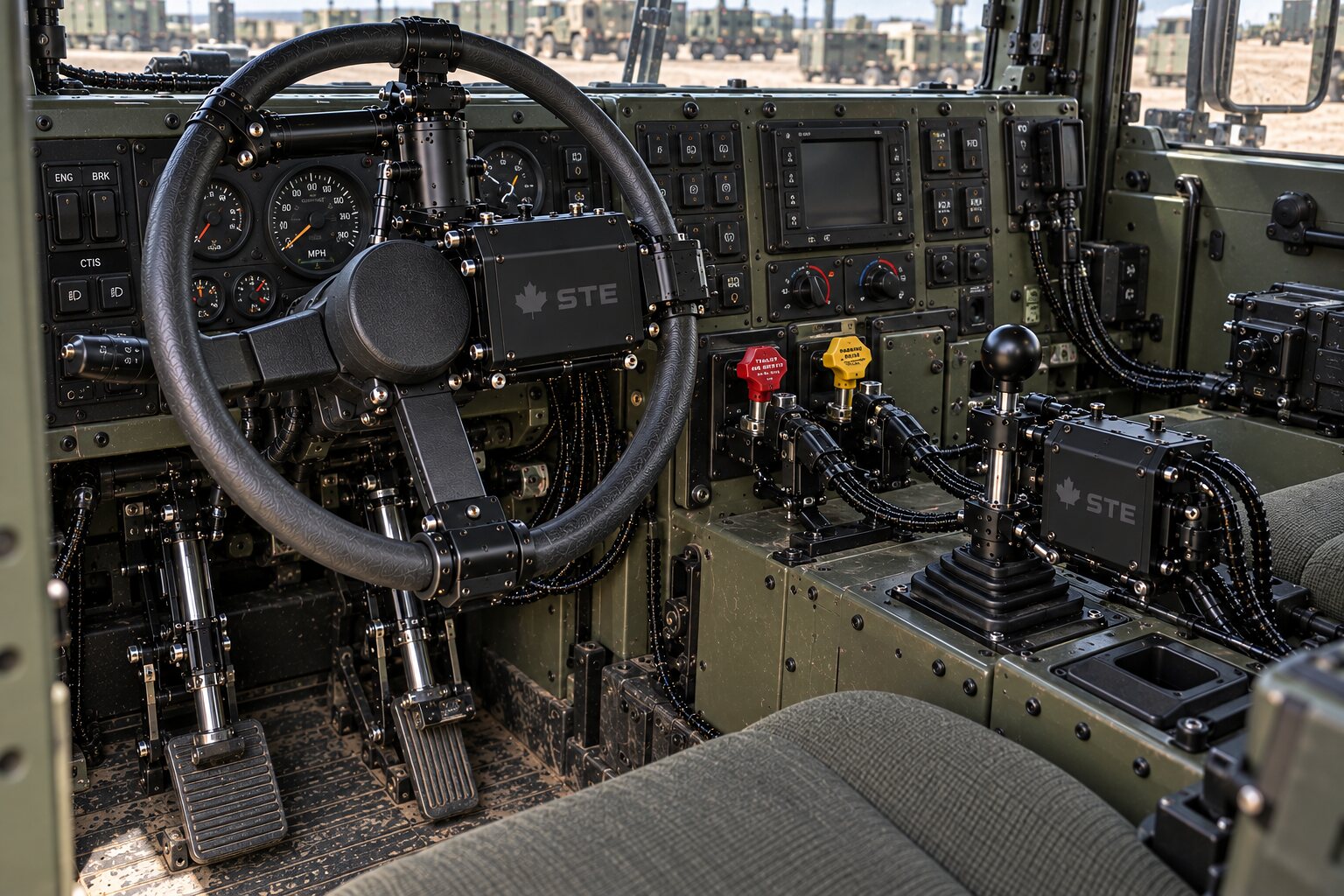
The kit promises three things in return. It draws only through its own protection, so a fault in the kit opens a kit fuse and never a host fuse. It returns every current it draws on its own conductor, so no kit current passes through a host conductor or the chassis, and the host's ground reference does not move when the kit's load changes. And it presents itself at one take-off and one return, so the host sees one load that can be disconnected at one place.
Those promises decide what happens when the kit switches under load. An actuator drive starting, or a pump motor, pulls the machine's bus down until the alternator's regulator catches up. The host's controller and instruments see that dip; there is no avoiding it, and the programme's load budget bounds it. What the harness controls is whether the dip is the only thing the host sees. A kit returned through the chassis puts its load current through the metal the host's circuits use as their reference, and every time a kit motor starts, the host's sensor grounds move. The engine controller logs a fault that appears only when the kit is working and looks like the host's fault. A dedicated return to the point the trunk took off from gives the kit's current one path in and one path out, and the host's reference stays where it was.
The joint at the take-off has to survive an engine bay: heat, vibration all day at idle, fuel, hydraulic oil, wash-down and a boot. A lug that is not locked at a battery stud loosens under vibration and arcs, and an arcing supply lug under a hood is a fire. It has to survive a jump-start, because a machine that will not start gets jumped, and whatever the jump does to the host's bus it does to the kit's trunk. It has to survive the daily switch-off, because the machine's master disconnect is now the kit's disconnect too.
And it has to survive being removed. Removable means the host has to be a machine again, with a person in the seat, once the kit is gone. Everything the power harness does to the host is undone by unplugging and unbolting. The take-off lug comes off the stack. The distribution block, the branches and the bonding conductor leave with the enclosure. What stays is the mounting points, a labelled and capped take-off pigtail where the programme's set calls for one, and a host loom that matches the host's own drawing as it did before the kit arrived.
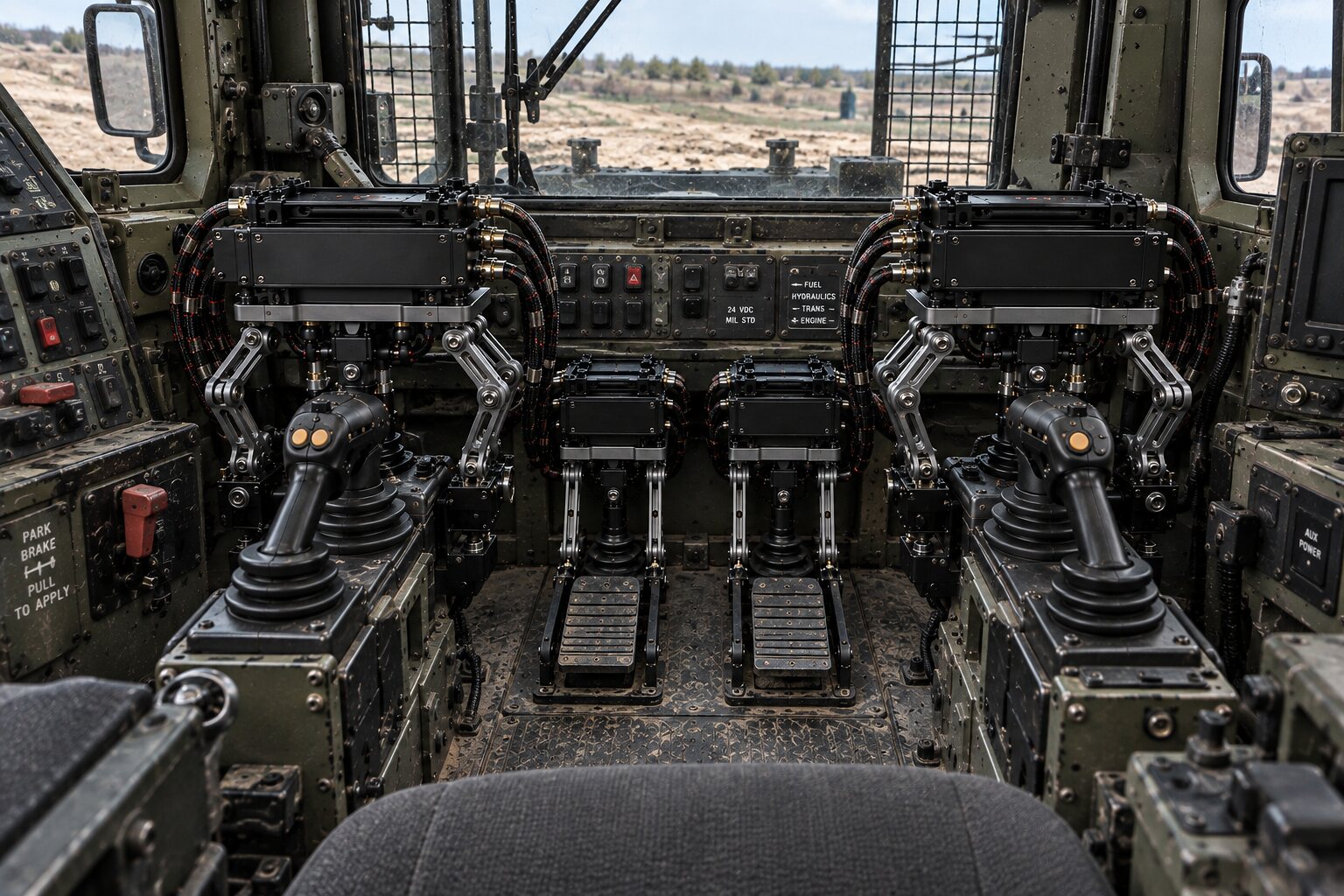
Safety circuits never share a bundle, a splice or a shell with power.
The discipline applied to this harness
Safety circuits never share a bundle, a splice or a shell with power. On this harness that sentence is the whole of the segregation rule. The power loom does not run in the same tie as the stop chain and does not share a splice with anything. A power conductor that chafes through inside a shared bundle energises the conductor beside it, and if that conductor is the stop chain's return, the stop chain reports a made circuit that no switch made. A stop chain energised by a fault cannot stop. The rule is on the segregation page; this harness is where it costs the least to follow and the most to break.
Shielding does not apply to a supply loom, but bonding does. The enclosure is bonded to the chassis by a conductor whose only job is that bond, and the return current does not use it. A bond that carries load current is no longer at the machine's reference, and an enclosure off the reference is a hazard to the fitter who touches it and a noise source to every signal that leaves it.
Protection sits at the source and is rated to the conductor it protects, not to the consumer that draws through it. A fuse at the load protects the load's own pigtail and leaves the whole trunk protected by nothing but its insulation, and a trunk that chafes to chassis then carries whatever the battery can supply until something burns through. The rating of each fuse is stated by the programme's engineer, for that conductor. The shop does not choose it. A value nobody measured never reaches a wire.
Routing follows the host's own loom where the host's route is a good one and leaves it where it is not: clear of exhaust, clear of hydraulic hoses that move, with a drip loop at every entry to the enclosure, and clamped at the intervals the drawing states. Every conductor carries its circuit identity end to end, and the take-off carries a label at the host terminal, so that a fitter who finds an unfamiliar lug on the battery knows what it is, what it feeds and where its fuse is.
Test is against the drawing and it is per assembly. Continuity proves every conductor lands where the drawing says. A polarity check proves the feed and the return sit where the contact map puts them, because a reversed supply pair at a drive enclosure is a destroyed drive. An isolation test asks whether the power loom and the stop chain, which must never meet, are in fact separate, and it is run on every finished assembly before it leaves. A bond check proves the enclosure is at the chassis reference through its own conductor. What each test is set to is stated on that assembly's own specification by the engineer responsible for it, and the result is recorded against that assembly.
Done badly, this harness fails late and points elsewhere. A take-off downstream of the host's fuse block puts the kit's current through a host fuse and a host conductor that were never sized for it, and opens a host fuse under a kit load. A chassis return puts an intermittent fault in the host's engine controller that shows up only when the kit is working. A shared bundle with the stop chain turns a chafe into a machine that will not stop. An unlabelled take-off is removed by the next fitter, or tapped by the one after. None of these appears on the bench. All of them appear on a machine, months in, with nobody in the seat.
How it is bought
The machine programme owns the design and the drawing master. It issues the set: what the host provides at the take-off point, the kit's load schedule, the protection schedule, the connector schedule and the routing intent. We build to that issued set and we return the manufacturing detail to it. We do not own the design authority for the kit and we do not present ourselves as if we do.
From the issued set we perform the takeoff and produce the shop drawing: every conductor with its identity, every contact with its cavity, every fuse with the conductor it protects, every clamp and every label. The shop drawing is walked on the machine before it goes to you, so the lengths on the drawing you sign are the lengths that were measured. Nothing is fabricated until it is signed. With the enclosure mounted and the take-off point agreed, every length is fixed on the machine itself, because a length taken from a drawing of a machine is a guess and a length taken on the machine is a measurement.
The build carries a per-assembly record: which conductor, which contact, which crimp, which test, and what that test showed on that assembly. The record and the full shop pack, the formboard, the cut list, the contact map and the test sheet, go back to the programme's drawing master, so that the next harness is built from the record and not from memory, and the programme's own set is complete without us.
CSA certification and the Canadian Electrical Code govern an electrical assembly built for sale or installation in Canada. The components we specify carry their own certification. The approval route for a finished, project-specific assembly is confirmed with the certifying body for that assembly before it is built, and we tell you where yours sits before we build it, not after.
To start, send the issued set, or the interface specification if the set is not complete, through the enquiries page, and describe the host's electrical system as the programme has documented it. We answer with what the takeoff needs, and with what the walk has to see before a length is cut. We do not cut the host's loom, we do not tap a host circuit downstream of its fuse, we do not return kit current through the chassis, and we do not fabricate ahead of a signature.