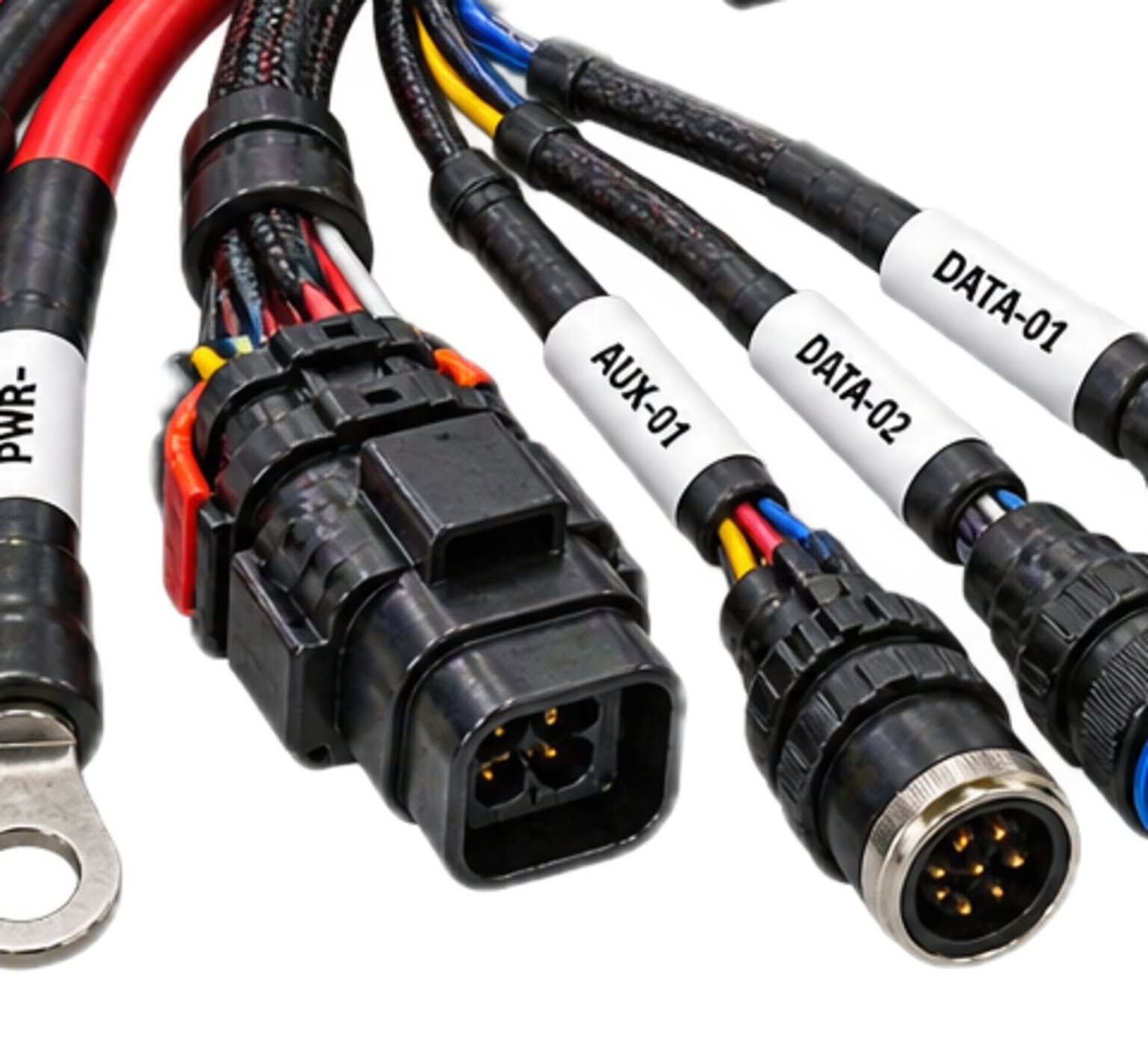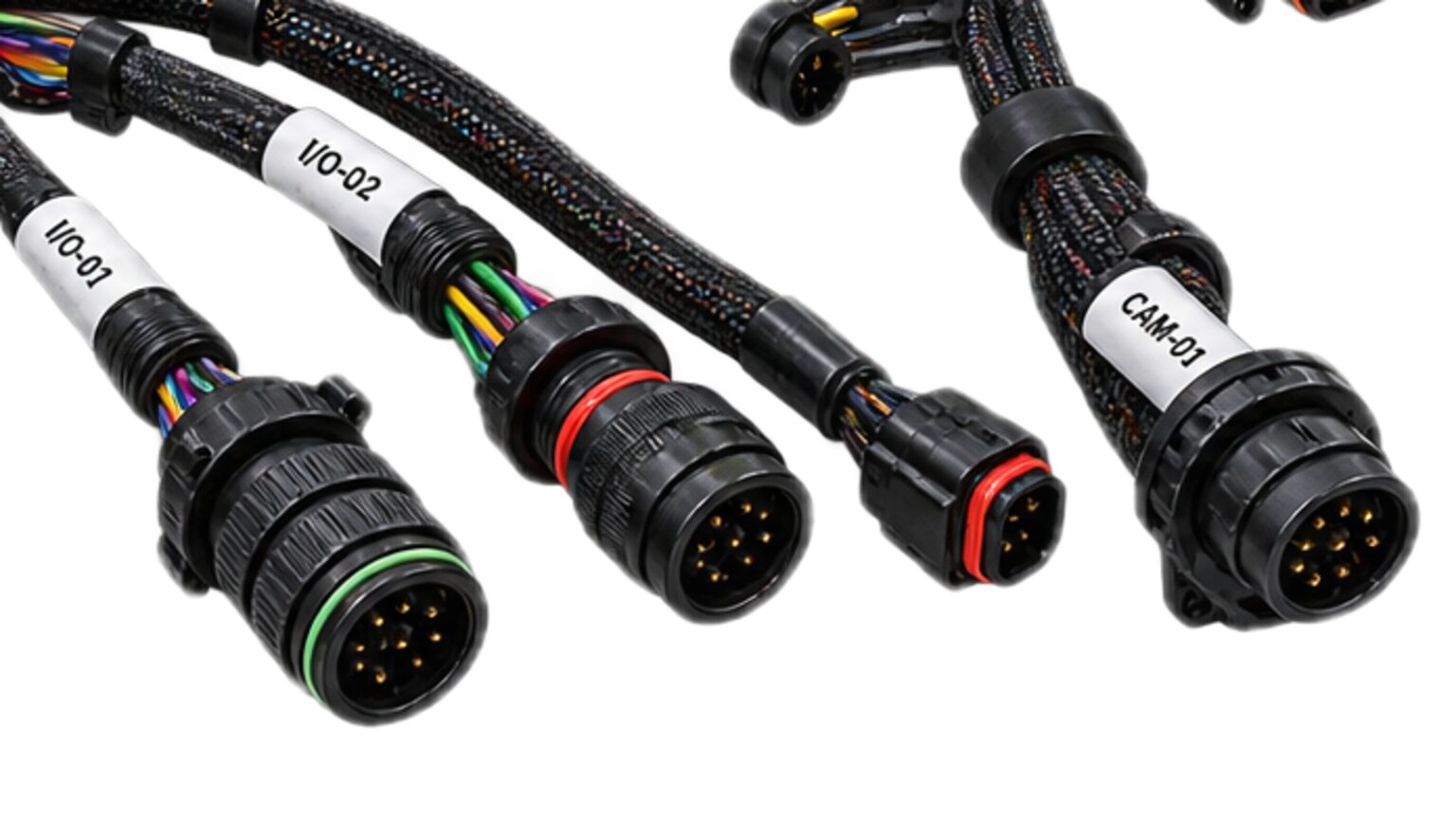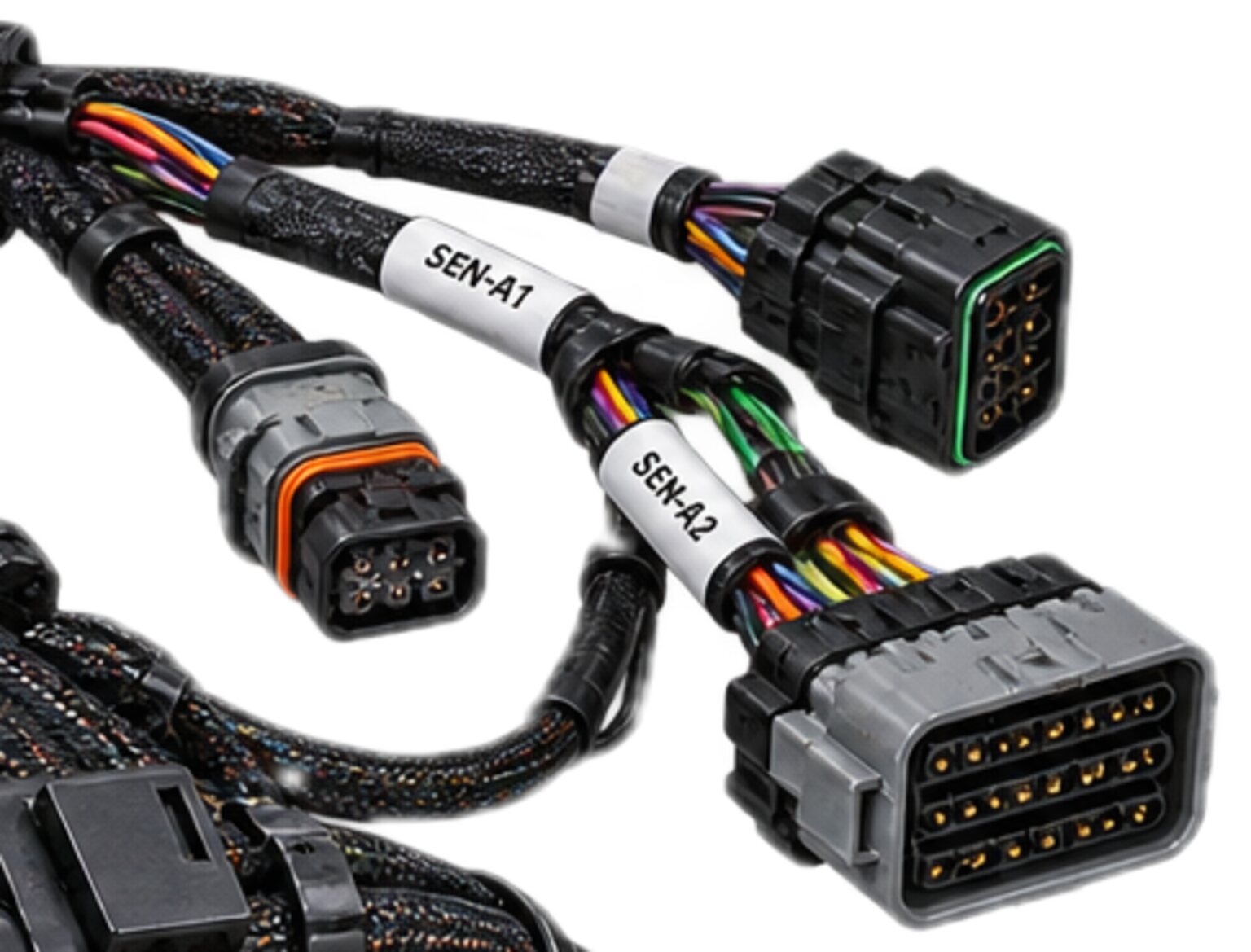
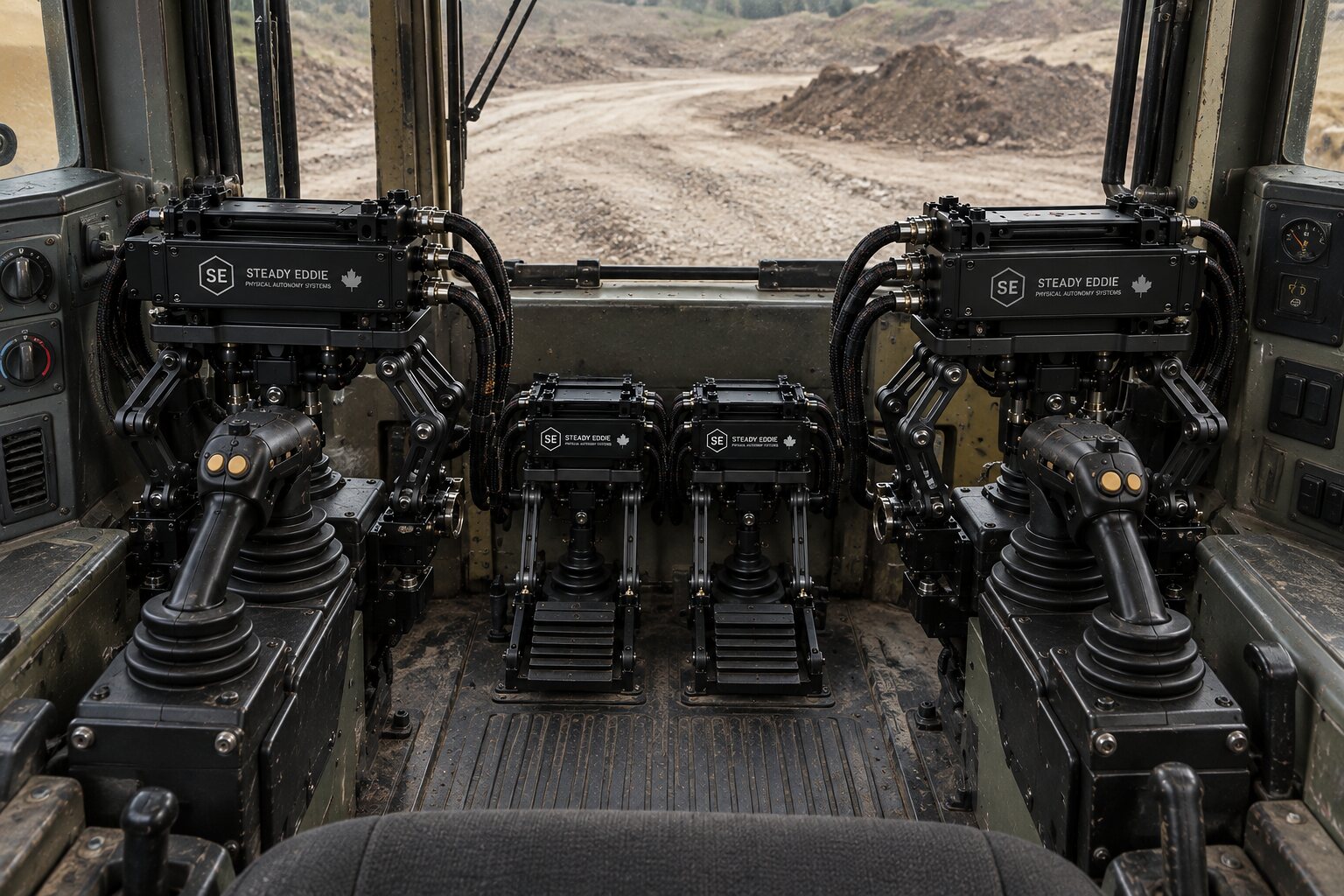
A retrofit kit brings its own network onto a machine that already has one. The kit's sensors, its computer, its radio and its actuator controllers talk to each other on a network the kit's designer laid out. The machine talks to itself on a fieldbus its maker laid out for an operator who is no longer in the seat. The kit needs to hear it: engine state, hydraulic temperature, fault codes, hours, everything the machine already reports to its own dashboard and would otherwise have to be sensed again with hardware of the kit's own. So the two networks are joined, in one place, for that. Everywhere else they are kept apart, because each has its own reference, its own noise and its own way of failing, and a harness that lets those mix has built a machine that lies to itself.
This harness is the copper that does the joining and the keeping apart. It is one of the four looms in the machine set behind a removable operator, and it is the one that fails quietest.
The mechanism
The kit's network is twisted pairs. Each link is two conductors twisted together along their whole length, and the return for each signal runs in its own pair, never through the frame and never through a conductor shared with another pair. Around the pairs is a shield, a braid or a foil with a drain wire, and around the shield is a jacket. The jacket holds only this network. No power conductor shares it, and no conductor of the safety chain comes near it.
The topology follows what the kit's network needs. Where the kit runs a bus, the harness is a trunk with drops: one continuous pair from the first node to the last, each node hanging off it on a stub held as short as its connector allows, and a termination at each end of the trunk and nowhere else. Where the kit runs point-to-point links, each link is its own pair from one node to one node, under its own shield.
The host machine's fieldbus enters the harness at one point: the tap. The programme's drawing names where the tap sits, on a connector the host already carries or on a drop the programme has made for it. From the tap, a stub carries the host's pair, under its own shield, to the gateway. The gateway is the module where the kit's network and the host's bus meet, and the isolation barrier between them lives inside it. The harness delivers the kit's network to the gateway on one connector and the host tap on another, keyed differently, so that a person cannot put the host's bus where the kit's network goes, in the dark, with gloves on.
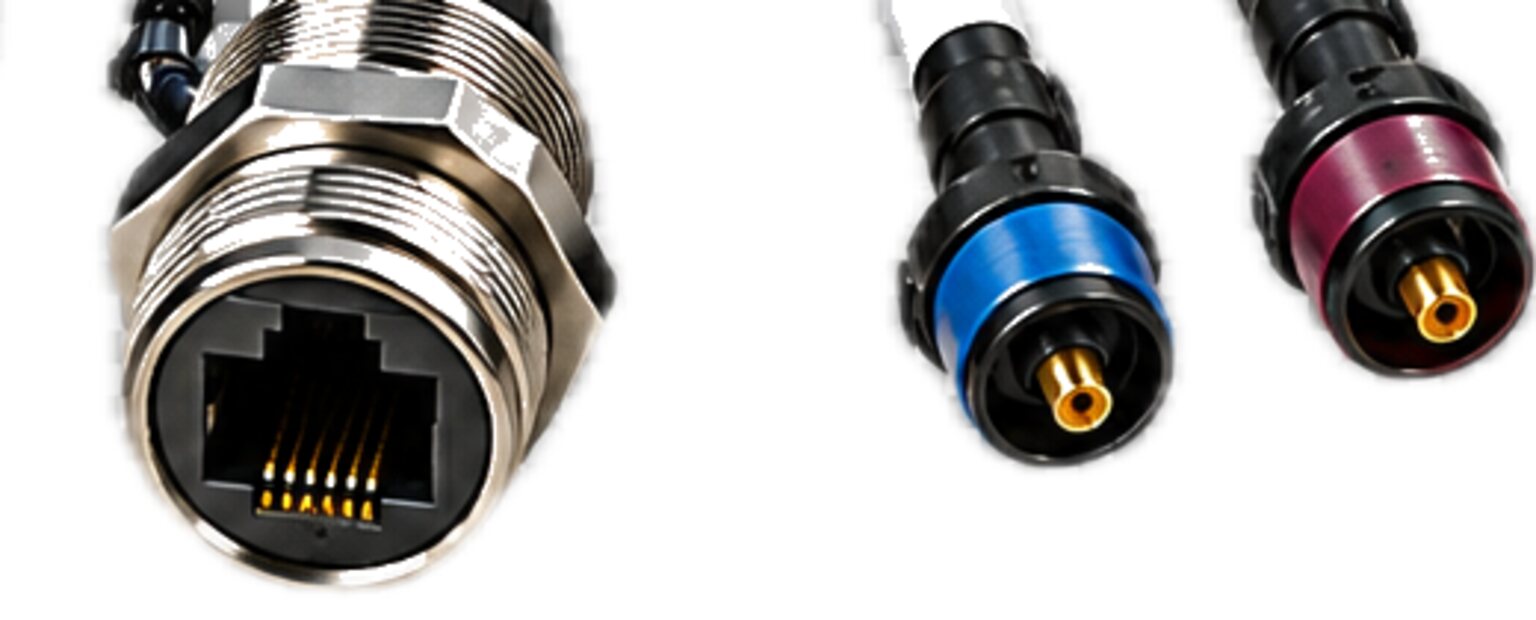
The shells are metal or metallised, with backshells that carry the shield from the cable to the shell and through to the mating half. Every connector has a secondary lock on its contacts and a latch that needs a deliberate act to open. Where a connector lives outside the cab, it is sealed. Where it lives on a part of the machine that moves, the harness arrives with slack that is drawn, not left to the fitter.
What it is engineered to
The harness sits on the interface between the kit and the host, and each side makes the other a promise. The kit promises that its network's reference is its own, and that it touches the host's reference only inside the gateway. It promises that the tap presents the host's bus with a load the bus was designed to tolerate, at the point the programme names. It promises that what the kit puts onto the host's bus is what the programme's interface names, and nothing else. Where the interface names nothing, the gateway is the listener, and the harness's part is to present the host's pair at one point and nowhere else.
The host promises that the bus at the tap is the bus the interface describes: the same pair, the same reference, the same connector the programme drew. It promises a point on its frame as the host side's reference. It promises that its own nodes do not change without the interface changing with them.
Between the two promises is a joint, and the joint lives on a working machine. It carries engine vibration through every clamp for every hour the machine runs. It starts cold on a winter morning and finishes the day beside an engine. It is washed down. It is unplugged by a person in a hurry, with gloves on, and plugged back in with mud on the shell. If the kit is removable, the joint is made and broken every time the kit comes off. The consequences are specific. A crimp that holds under a static pull and opens under vibration presents as error frames that climb with rough ground. A pin without a lock backs out a little further each time the connector is mated. Water in a shell puts a resistance across a pair that changes with the weather. None of these kills the link. Each degrades it, and a degraded bus does not announce itself; it drops traffic, and the machine works around the loss until it cannot.
When either side changes, the interface changes. A service update that adds a node to the host's bus, or a redesign of the kit's network, is a new revision of the issued set, and the harness is built to the revision it was built to. The record says which.
A value nobody measured never reaches a wire.
The discipline applied to this harness
Every conductor carries its circuit identity, end to end. That sentence does more work here than anywhere, because a network harness is one pair after another that look alike, under shields that look alike, with terminations that look alike. The only way to know which pair is which, which end of a shield is grounded and which node a drop serves is to have written it on the conductor, at both ends, before the harness left the bench. Everything below depends on that.
Segregation comes first. The network bundle runs on its own route, on its own clamps, through its own entries into every enclosure. It does not share a bundle with power, with actuator motor lines or with the emergency stop and safety chain. Where it must cross a power run, it crosses at a right angle and moves on. A pair that runs beside a motor line for the length of a boom picks up the motor's switching for the length of the boom, and no shield undoes a run like that.
Shielding and bonding comes second. Each shield is carried end to end, through every connector, by the backshell and the shell, not by a pigtail that leaves the drain bare inside a housing. Each shield is grounded at the end or ends the drawing names. The other end is insulated, and the label on it says it floats, so that a fitter with a meter does not bond it because it read open. A shield grounded where the drawing grounds it is a shield. A shield grounded where the drawing did not ask is a loop, and the current in the loop is current nobody designed. Nothing on the kit side of the gateway is bonded to the host's frame, and nothing on the host side is bonded to the kit's reference, because either is a second path around the isolation barrier, and a barrier with a path around it is decoration.
The bus is matched along its length: the same cable, with the same spacing between the conductors of its pair, from one end to the other, with the twist kept right up to the contact and the termination fitted at the named ends and nowhere else. A bend tighter than the jacket allows changes the spacing at the bend. A clamp that crushes the jacket changes it at the clamp. A stub longer than it needs to be is a change the bus meets on every frame. Shout down a length of pipe and the echo comes back from wherever the pipe changes bore. A bus is a pipe for a signal, and each of those places is a change of bore. One echo the bus tolerates. Enough of them, or one that moves with the machine, and frames are lost.
The tap gets its own care. Its stub is as short as the host's connector permits. Its shield is grounded on the side the programme names, once. Where the interface gives the kit nothing to send, the gateway is the part that listens and does not drive, and the harness gives the host's pair no second path and no spare contact a later change could use.
Test asks what the bench can prove. Continuity, pair by pair, proves each pair goes where its label says. An isolation test asks whether the kit's network and the host tap, which must never meet outside the gateway, are in fact separate, and it is run on every finished assembly before it leaves. A shield test proves each shield is continuous end to end and floats at the end meant to float. A termination check proves the terminations are at the named ends and absent from every drop. Then the harness is flexed, section by section, with a bus running through it and the error counter watched, because a bus that passes every test at rest and drops traffic on a bump has a fault that only moves when the harness does.
That last test is how this harness is found when it has been done badly. The symptom is nodes that drop off on rough ground and come back on the smooth, and a static check that passes every time. The fault is in the harness's mechanical life: a crimp that opens under vibration, a pin backed out, a drain wire pinched under a clamp and touching a second ground only when the clamp is loaded, or a pair crushed under a saddle so that the echo from the crush grows when the saddle moves. It is found by tapping each connector and flexing each section in turn while the counter is watched, and it is found faster when every pair and every shield carries its identity, because the person searching is looking for a name, not a colour.
How it is bought
The machine programme owns the design and the drawing master. The network's topology, the node list, the interface between the kit and the host's bus, the tap point, the ends at which shields are grounded and terminations fitted, all come from the programme's issued set. We build the full shop pack to that set, and we return the manufacturing detail to it.
The takeoff comes first: every pair, shield, contact, shell, termination, clamp and label, taken off the issued set as a list the programme can check. The shop drawing follows, and nothing is fabricated until it is signed. Before it is signed, the harness is walked on the machine. The walk fixes every length, because a schematic knows where a node is and not how far the cable travels to reach it, around a boom pivot, through a bulkhead, with the slack a moving joint needs. The lengths go on the shop drawing, the drawing is signed, and then the reel is cut.
Each assembly leaves with its own record: the reel it was cut from, the contacts and shells, the tool and its setting for every crimp, the person who built it, the result of every test above, and the labels, end to end. The record, the shop drawing, the cut list and the formboard go back to the programme's drawing master, so that the master carries what was built and not only what was drawn.
The components we specify carry their own certification. The approval route for a finished, project-specific assembly is confirmed with the certifying body for that assembly before it is built, and we tell you where yours sits before we build it, not after. CSA and the Canadian Electrical Code govern any assembly built for sale or installation in Canada.
To start, send us the issued set, or the interface between the kit and the host if the set is not complete. We answer with what the takeoff needs, and with what the walk has to see before a length is cut. The enquiries page says how.
- We do not cut a network harness to a schematic that has not been walked.
- We do not ground a shield at both ends because the drawing is silent, and we do not guess the end.
- We do not add a contact, a spare or a second landing to a host tap the interface did not give us.
- A bus that drops traffic on a bump costs days to find on a machine nobody can hold still, and the discipline above is cheaper.