Power on a plant is a tree. It has one root, where the service or the generator lands, and it branches, and every branch carries its protection at the point where it leaves the branch above. The controls that switch that power, the starters, contactors, relays and interlocks that decide when a motor runs and when it stops, hang off the same tree and are built to the same Code. This package is that tree, or as much of it as fits in a shop: the distribution, the motor control and the line-voltage control wiring, built to the issued set, tested, and shipped to a site where the licensed pair of hands is scarce.
What the package is not is the low-voltage control layer. On most industrial drawing sets the low-voltage controls and their wiring are the mechanical trade's scope, and line-voltage power and controls are the electrical trade's. We build to that line, and we decide which side of it every conductor sits on before a quote is written, not after.
The mechanism
At the root is the main: the lugs where the site's feeder lands, the main protective device, and the bus or the block it feeds. Off the bus come the feeders and off the feeders the branch circuits, each protected at the point it leaves the level above, and every protective device is chosen on the drawing to protect the conductor it feeds, never chosen to suit the load and left to the conductor to survive. The shop builds what the single-line shows and the panel schedules list, and it does not add a branch that is not drawn.
The motor control sits on the branches that feed motors. A starter is a protective device, a contactor and an overload in one section, with a control transformer where the control circuit runs below the line. The control circuit itself is the stop, the start, the selector, the pilot light, the auxiliary contacts that tell the next starter this one is running, and the interlocks that hold it off until the thing it depends on is ready. Where a drive is drawn, its motor conductors run apart from everything else, because a drive output is a source of noise and the conductor that carries it is an antenna.
The line-voltage controls are the ones that run at the voltage of the circuit they switch, or at a control voltage taken from that circuit through the starter's transformer: a thermostat that switches a heater directly, a float switch in the coil circuit of a contactor, the pushbutton station at the machine. These are electrical scope and they are in the package. The low-voltage controls are the sensing and automation layer: the controller, its inputs and outputs, the sensors, the fieldbus, the building-automation wiring to a damper or a valve. On most sets that is mechanical scope, and it is in the package only when the scope agreement puts it there.
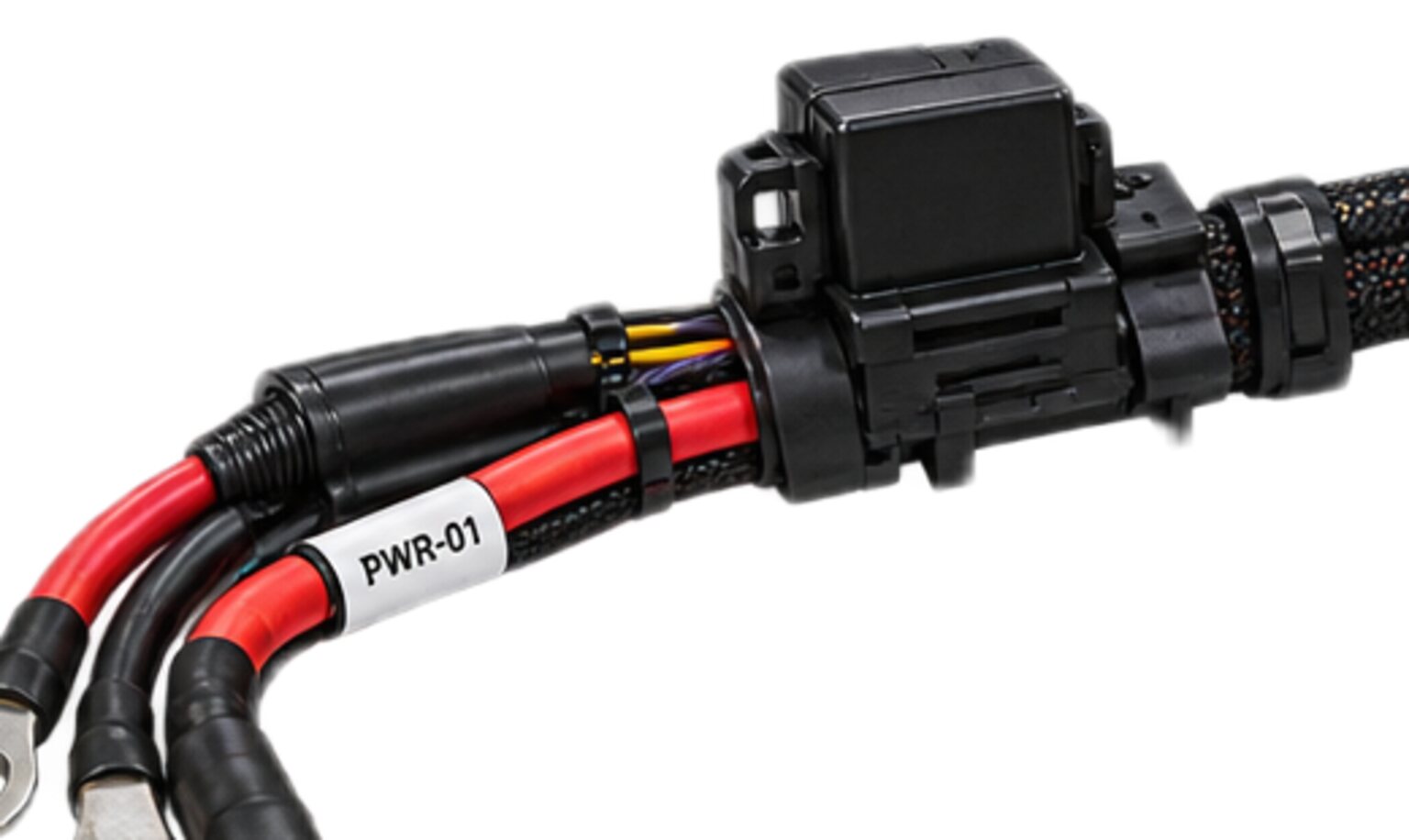
Inside the enclosures, power conductors run in their own duct and control conductors in theirs, and a signal conductor that has to pass through runs in a third. Every conductor is stranded, ferruled at every termination, and marked at both ends with the identity the drawing gives it. The terminal strip is the seam: our conductors on the panel side, the site's on the field side, the numbers matching the schedule.
The topology out of the enclosure is the topology on the single-line: radial, from the source outward, each branch ending at a load. The package can be one section or a lineup, with the interconnect between sections made to walked lengths. It is always a tree, delivered so that the site can read it in the door pocket record and find any conductor from the root down.
What it is engineered to
The landing at the root is the site's feeder, arriving at the main lugs. The landings at the leaves are the loads: the motors, the heaters, the receptacles, the lighting, each with a nameplate the load list was built from. The package promises the site that the protection coordinates from the source outward, so that a fault on a branch clears at the branch and not at the main; that the bonding is continuous from every load back to the source; that every conductor is identified; and that the control logic on the drawing is the logic wired. The site promises the package that the feeder and the loads are the ones on the drawing, that the bonding conductor from the site's electrode arrives at the drawn point, and that the neutral is bonded where the drawing says and nowhere else.
When the site's loads change, the tree changes. A larger motor on a branch sized for a smaller one is a branch that trips on start or a conductor that runs hot. A load added to a panel that was full is a branch with no protection of its own. The package is engineered to the load list on the issued set, and the load list is the site's: from nameplates, from the mechanical schedule, from a measured demand where one exists. A value nobody measured never reaches a wire. We do not size a branch to a load we assumed.
Transit works a lineup the way it works a single box, only with more mass. Bus connections, heavy contactors and transformers are supported to the frame, checked before the crate is closed, and listed in the record for the site to check again before power.
Winter shifts the way protection behaves and the way motors start. A protective device in a cold enclosure trips later than the same device warm, and a motor starting a cold load draws its starting current for longer. Neither is a reason to oversize; both are reasons to fit the enclosure heater where the drawing calls for it and to set the overload to the motor, not to the day. A wash-down is answered as it is on every enclosure package: entries low, glands matched to their cables, unused entries plugged, gaskets clean, and nothing inside that a wet floor can reach.
Nothing is fabricated until the drawing is signed.
The discipline applied to this harness
Segregation is the discipline this package leans on hardest. Power is kept from control, and control is kept from signal, in separate ducts, through separate entries, in separate bundles between enclosures. A control conductor that shares a bundle with power for the length of a lineup picks up enough from its neighbour to hold a relay in after the contact has opened, and a signal conductor bundled with a drive output reads a value that is not there. Where a safety circuit runs through the package, an emergency stop or a guard interlock, it never shares a bundle, a splice or a shell with power. That sentence is a rule here, not a preference. The general rule is set out under segregation.
Protection sits at the source, by the device the drawing shows. A device substituted because the drawn one was late is a substitution on the drawing first, with a signature, or it does not happen.
Bonding is drawn, not assumed. The bonding conductor for every circuit runs with that circuit's conductors, sized on the drawing to the protection ahead of it, and lands on a lug that is drawn and labelled. The enclosure, the backplate and the door are bonded through connections that bite bare metal. The neutral is bonded to ground once, at the source, and not again at any panel downstream, because a second bond puts return current on the bonding conductors and on every metal thing they touch. The practice is described under shielding and bonding.
Every conductor carries its circuit identity, end to end. The panel schedule names every branch, the breaker label matches the schedule and the conductor marker matches the breaker. A starter is labelled with the motor it starts, and the motor's conductors carry that identity to the motor terminal box. The person who opens a panel on a wet night to kill one circuit finds the right one by its label, and the label was made from the drawing, not from memory.
Every finished section is tested before it leaves. A point-to-point check reads every conductor on the wire list from its device to its terminal. An isolation test asks whether each circuit is separate from the enclosure and from every circuit it must never meet, with the devices that bridge them lifted where the drawing says to lift them, and it is run on every finished assembly before it ships. Where the control circuit can be powered on the bench it is, and the logic on the schematic is exercised through every state the drawing shows. What the tests prove goes on the record. What they are set to is stated on the specific assembly by the engineer responsible for it.
The Canadian Electrical Code governs how conductors are protected, separated and bonded, and CSA governs the components and the route for the finished assembly. The components we specify carry their own certification. The approval route for a finished, project-specific assembly is confirmed with the certifying body for that assembly before it is built, and we tell you where yours sits before we build it, not after.
Done badly, this package fails as a truck roll or a hazard, and often both. An unlabelled breaker becomes a wrong circuit killed and a right one left live. A neutral bonded downstream becomes current on a conduit somebody leans on. A control conductor bundled with power becomes a motor that will not stop when the button is pressed, which is the one failure this shop refuses to build toward. Each presents months later on a site that is empty, and the truck that goes out carries a licensed pair of hands and the road at both ends of the fix.
How it is bought
The package is built from the issued set: the single-line, the panel schedules, the motor list and the load list, the control schematics, and the layout. Where the set is missing a schedule, the shop drawing produces one and returns it for signature; the shop does not fill a gap on the drawing with a guess in the enclosure.
The takeoff comes off the set: every protective device, every contactor and overload, every transformer, every terminal, every conductor by construction, every gland, every marker. The shop drawing follows: the layout of every section as it will be built, the wire list with every conductor's identity and both its ends, and the control schematic as it will be wired. Nothing is cut, ordered or wired until the shop drawing is signed, and the signature is yours.
Each section ships with its own record in the door pocket: the drawing as built, the schedules, the torque record, the test record and the settings record for every adjustable device, with a copy returned for the project file. The settings record states what each device is set to, on that assembly, by the person who set it.
To start, send the single-line and the schedules, say where the plant is and who owns the controls, through enquiries. The first thing back is the scope question, then what the takeoff needs and what the walk has to see before a length is cut.
The scope agreement on controls is settled before the quote. We do not quote low-voltage building-automation or instrumentation harnesses as part of an electrical package without an explicit scope agreement that names whose they are, where the boundary between line-voltage and low-voltage control falls on the schematic, and on which terminals the two meet. If the agreement puts the low-voltage layer in the package, it is built to the same discipline and tested to the same record. If it does not, the terminals for it are fitted, labelled and left clean for the trade that owns them. We refuse to price a control layer nobody has assigned, and we refuse to build a branch to a load that is not on the list.